hankyoreh
Links to other country sites 다른 나라 사이트 링크
[Column] The far right’s foreign language phobia

By Robert Fouser, linguist
Already a year has passed since the latest US presidential election. Donald Trump’s second victory brought with it the same catastrophic shocks that accompanied his first win. His supporters were ecstatic, but anxiety was palpable across America as a whole.
Trump’s two victories may look similar, but there is a crucial difference between them. In 2016, Trump won the Electoral College, but lost the popular vote to Hillary Clinton by approximately 3 million. It was only natural for Trump to lack clout as he stepped into the White House. In 2024, however, Trump won the electoral vote and also left his competitor Kamala Harris in the dust in the popular vote. This time, he swaggered into the Oval Office.
We can see this difference reflected in the past nine months since his second inauguration. He has no reservations about revealing his true colors: his blatant pursuit of white supremacy.
To Trump, the “real” America is one that only has white inhabitants. He oppresses legal immigrants and US citizens in the name of purging “illegal” immigrants. He rationalized the deployment of National Guard troops to Washington, DC, and Los Angeles, metropolitan cities that many people of color call home, declaring that he was waging a war against crime. His threats to send more troops to other cities and the large-scale memorial service for conservative political activist Charlie Kirk, who was assassinated in early September, only goes to highlight his propensity for white supremacy.
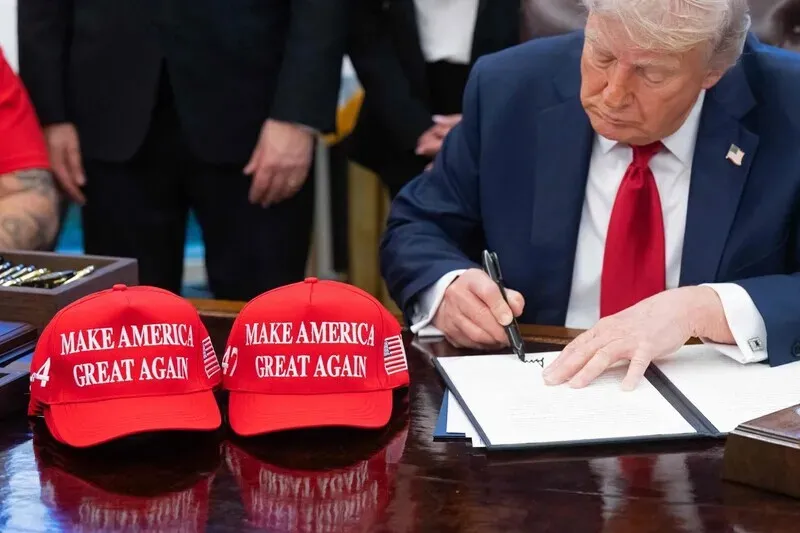
Of course, that’s not all. On March 1, Trump signed an executive order designating English as the official language of the US. This unprecedented move shows how Trump reflected his age-old belief that English should be the only language used in the US in legislation. Language and identity are intertwined; as such, language can be used as a tool to create “others” for the sake of strengthening internal unity.
As a federation, language use and education in America are decided by individual states. Even before the executive order, 27 states had already labeled English as the official state language. Those states were the ones that Trump came out triumphant in the past three presidential elections — southern states that have a high proportion of white residents and a long history of legalized racism against African Americans. Not many of the 20 states that have not designated an official language demonstrate such high support for Trump, meaning that they will probably not follow this executive order.
Many countries choose a native language to be their country’s official language, which means we cannot definitively say that this sort of behavior is explicitly an outgrowth of the far right. However, the US is a different case. The core of the far-right movement in the US is rooted in white supremacy. To these people, those who use languages that are not English are targets to be attacked for threatening the “purity” of only-English-speaking white folk.
Japan is also rapidly swerving toward the far right. The slogan “Japan First,” which undoubtedly comes from far-right influences, is gaining traction, thanks to the Sanseito party. It is very easy to come upon YouTube videos in which Sanseito supporters complain about how there are too many foreigners in the country, how difficult it has become to use Japanese to communicate, how the streets ring with unfamiliar languages, and that Japanese will soon become a lost language if foreigners continue to arrive in Japan. This demonstrates this obsession, much like the one harbored by many white supremacists: a longing for a “pure” Japan. These people regard those who speak other languages as a threat.
It unfortunately appears that Korea is no exception to this dangerous trend. Racist anti-China protests have become a regular occurrence in Seoul’s Myeongdong and Daerim areas, escalating to the point of threats against local merchants and residents. More and more people are complaining about “not being able to communicate” with coworkers in lines of work where foreign labor is common. The implication of course being that that they aren’t able to communicate “in Korean.”
Korea’s far right has yet to make language an explicit target of its hostility, like the US and Japan. Thus far, its obsession with “purity” has primarily been expressed in terms of Sinophobia. But there’s no guarantee that this antipathy won’t spread to other nationalities and ethnicities, or other languages.
What matters is how we respond if it does. The far right is gaining ground across the world, but a closer look at many of the countries suffering from the far-right fever shows they are, at the same time, earnestly striving to find new ways to advance open democratic values that reject notions of “purity.” These are the voices that Korea must foster.
Sitting around and waiting for an opportunity to present itself won’t solve anything. We need to actively foster voices for open democratic values. There was no future for the far right after its failure in the 20th century. We need to prove that the same goes for today. Doing so will be the first step toward building a future in which we can all live with dignity together as neighbors.
Please direct questions or comments to [english@hani.co.kr]

Editorial・opinion
![[Editorial] Trump’s baseless claim that Iran bombed girls’ school crosses line](https://flexible.img.hani.co.kr/flexible/normal/500/300/imgdb/original/2026/0309/4217730446901883.jpg "[Editorial] Trump’s baseless claim that Iran bombed girls’ school crosses line") [Editorial] Trump’s baseless claim that Iran bombed girls’ school crosses line
[Editorial] Trump’s baseless claim that Iran bombed girls’ school crosses line![[Correspondent’s column] JD Vance’s 67-hour disappearance](https://flexible.img.hani.co.kr/flexible/normal/500/300/imgdb/original/2026/0306/2517727866984907.jpg "[Correspondent’s column] JD Vance’s 67-hour disappearance") [Correspondent’s column] JD Vance’s 67-hour disappearance
[Correspondent’s column] JD Vance’s 67-hour disappearance- [Column] Withstanding Trump’s predatory hegemony
- [Editorial] US dragging Kurds into its war with Iran would be a disaster
- [Column] US allies in the Gulf are in flames. Can Korea avoid a similar fate?
- [Editorial] North Korea’s tough talk mustn’t deter Seoul’s efforts to rebuild trust
- [Editorial] Attack on Iranian girls’ school is an indefensible crime against humanity
- [Editorial] Trump’s unjustified war with Iran threatens chaos for us all
- [Column] What a Korean man’s foiled plan to seek assisted death in Switzerland reveals
- [Column] This is what accountability looks like
Most viewed articles
- 1Wave of US transport planes depart from Osan for Mediterranean amid speculation of Patriot shipments
- 2[Editorial] Trump’s baseless claim that Iran bombed girls’ school crosses line
- 3[Interview] Is war in Iran the beginning of the end for nuclear nonproliferation?
- 4Korea braces for energy shock as Middle East crude production falls
- 5Seoul mayor issues ultimatum to party: Drop Yoon or lose me
- 6Iran war fuels demand for Russian oil, raising possibility of eased sanctions
- 7Kim Jong-un, confident in nuclear deterrent, appears in public amid US strikes on Iran
- 8On trial for 6 years in South Korea, a Pyongyang woman seeks to return home
- 9[Interview] Judith Butler: Repressive acts by anti-democratic regimes are ‘confessions’ of fear
- 10[NBS] Korea’s Lee logs 67% approval rating, his highest since taking office