hankyoreh
Links to other country sites 다른 나라 사이트 링크
[Editorial] Yoon’s absence from state-of-the-nation budget address is height of uncommunicativeness, arrogance
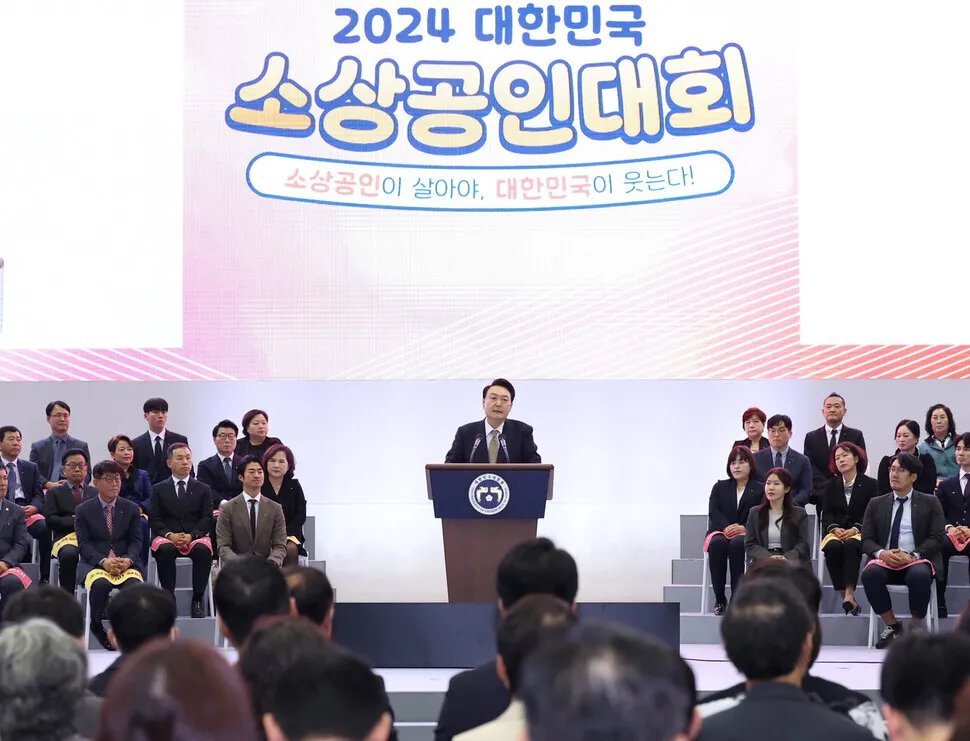
President Yoon Suk-yeol skipped the annual budget speech at the National Assembly on Monday. His chief of staff, Chung Jin-suk, stated on Friday that “nothing has been decided,” and that Prime Minister Han Duck-soo was expected to address parliament.
The presidential office refused to let even the speaker of the National Assembly know whether the president would attend the meeting or logistics related to security. Everyone knows that Yoon had already made up his mind to boycott the speech, so no one was fooled by this attempt to alleviate the wrath of the public by pretending to contemplate participation until the very last minute.
The annual budget speech serves as a state-of-the-nation address and is an opportunity for the sitting president to explain to parliament the government’s budget plan for the upcoming year and seek its cooperation before the National Assembly deliberates on the proposal itself.
For the past 11 years, since 2013, it has been tradition for the president to visit the National Assembly to make the budget speech. This is not the first time since Yoon’s inauguration that he has dismissed and upended the customs and traditions of our democracy, which so many fought valiantly to establish.
Yoon boycotted the formal opening of South Korea’s 22nd National Assembly in September, breaking the tradition upheld by previous presidents since 1987.
Yoon’s refusal to address the National Assembly on the government’s budget proposal makes him the first president to boycott the National Assembly’s formal opening and its budget speech, a dishonorable feat that will be attached to his name throughout history.
The presidential office justified the president’s absence by arguing that the opposition party could have chosen to demonstrate or shout slogans calling for the president’s impeachment during the speech, much like what happened during the opening of the National Assembly in September.
There is no national emergency that requires the president to forgo other obligations. The president merely finds the prospect of facing the opposition party’s unfiltered and vehement criticism threatening and distasteful.
Is this a fitting excuse for the president, as the head of the executive branch of the government, to ignore his presidential duties by refraining from addressing the National Assembly and the public in person on how the annual budget of 677 trillion won will be used in 2025?
Every South Korean president has stood before the legislature to ask for its cooperation on state governance even when engaged in high-spirited arguments with the opposition party. Why should Yoon be the exception?
The presidential office has also demonstrated that it doesn’t think much of warnings from the public, as shown in the 19% approval rating for Yoon’s job as president (Gallup Korea). “Former Japanese Prime Minister Fumio Kishida constantly was around the 15% or 13% mark, and there aren’t many leaders in Europe who can clear 20%,” said Chung. Of course, the president’s chief of staff failed to mention that Kishida stepped down in large part due to low approval ratings.
Yoon’s first-in-a-decade boycott of the budget speech is an extension of such arrogance and uncommunicativeness. This flagrant dismissal of an opposition-majority National Assembly by a president who has lost the mandate of the public is simply not normal. Such an attitude will only fuel the Korean public’s doubts about the president’s ability to lead the country as he should.
Please direct questions or comments to [english@hani.co.kr]

Editorial・opinion
![[Column] Coupang’s play in Washington](https://flexible.img.hani.co.kr/flexible/normal/500/300/imgdb/original/2026/0227/7817721808892682.jpg "[Column] Coupang’s play in Washington") [Column] Coupang’s play in Washington
[Column] Coupang’s play in Washington![[Editorial] Clarification and accountability needed on USFK standoff with Chinese jets](https://flexible.img.hani.co.kr/flexible/normal/500/300/imgdb/original/2026/0226/4817720940359806.jpg "[Editorial] Clarification and accountability needed on USFK standoff with Chinese jets") [Editorial] Clarification and accountability needed on USFK standoff with Chinese jets
[Editorial] Clarification and accountability needed on USFK standoff with Chinese jets- [Editorial] USFK’s provocation of China demands more than perfunctory protest by Seoul
- [Editorial] PPP’s refusal to cut ties with Yoon will be its undoing
- [Editorial] Korea is no staging ground for US operations against China
- [Editorial] Court convicts Yoon, but fails to fully reckon with his attempted coup
- [Editorial] Just because Japan is rushing US investments doesn’t mean Korea should
- [Column] Moment of truth: What the Epstein files really show us
- [Editorial] Coupang’s lobbying in US won’t win back Korean customer base
- [Column] Today’s diverging paths of human virtue, hegemony and tyranny
Most viewed articles
- 1Real-life heroes of “A Taxi Driver” pass away without having reunited
- 2Threatening North Korea has not made peninsula any safer, says South Korea’s Lee
- 3Russian Embassy in Seoul ignores host nation’s request to remove pro-war banner
- 4[News analysis] Behind split strategies, Kim Jong-un stays focused on regime security, advancement
- 5Former bodyguard’s dark tale of marriage to Samsung royalty
- 6Trump open to talking with Kim Jong-un ‘without any preconditions,’ says White House
- 7[NBS] Korea’s Lee logs 67% approval rating, his highest since taking office
- 8Hard labor an increasing punishment for poor people unable to pay fines
- 9Rosé’s ‘APT.’ was best-selling single of 2025, a first for singer not from North America or Europe
- 10[Editorial] USFK’s provocation of China demands more than perfunctory protest by Seoul