hankyoreh
Links to other country sites 다른 나라 사이트 링크
[Column] Had Han Kang not been in pain
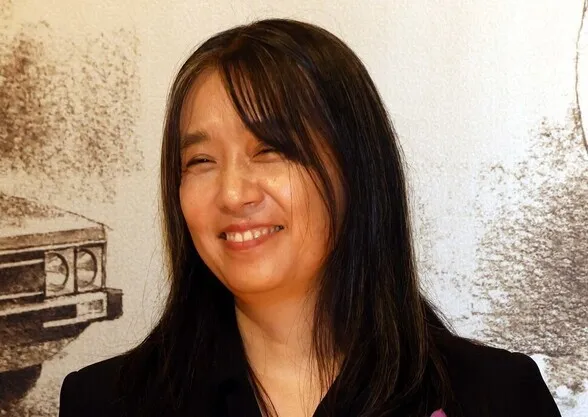
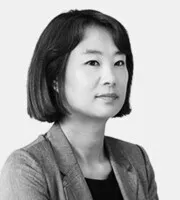
By Seo Bo-mi, director of new content
When I heard that Han Kang won the Nobel Prize for Literature on Oct. 10, my mind wandered to “The Vegetarian,” which I read four years ago. To be more exact, I thought about Han’s comments added to the end of the novel.
“I wrote ‘The Vegetarian’ and ‘Mongolian Mark’ by hand, not on a computer, due to the ache I felt in the joints of my fingers. A student called Y, who was tall and had sparkling eyes, came to type out my writing for me.” Han soon learned that she had been lucky when she could still bring herself to write by hand. “When my wrist ached before I could even fill one empty page, I was rendered useless.” After wallowing in despair for around two years, she came up with an idea: hold a ballpoint pen upside down to tap on the keys of her keyboard. As such, she was able to finish “Flaming Trees” by herself.
Han started to write her trilogy of suffering — “The Vegetarian,” “Mongolian Mark” and “Flaming Trees” — which would end up in one volume, “The Vegetarian,” in the winter of 2002 when she was 32. Can you imagine that a writer in her 30s finished a novel by tapping out her thoughts on a keyboard with the cap of a pen when her fingers and wrists gave out? It seemed to me that Yeong-hye, who wished to become a tree after being pressured by society to eat meat, was not the only one suffering profusely.
Han commented that she was “using all ten of her fingers on her laptop keyboard to write” in 2007, but I still felt anxious whenever I read the books she subsequently published. The feeling was most prominent when reading “We Do Not Part.” “I am a prisoner within the moments of suffering conjured up every minute by my own body. I am pulled away from the time before the onset of my agony, torn away from a world in which I do not writhe in anguish.” Kyung-ha’s vivid testimony of pain seemed to be a confession made by Han herself.
Like Kyung-ha, Han has been subject to severe migraines since she was a teenager. In a 2017 interview with the Guardian, she said, “When a migraine comes, I have to stop my work, my reading, my routine, so it’s always making me humble, helping me realise I’m mortal and vulnerable.” I wondered how many times during her novel-writing journey her ailment prevented her from working. Did she feel any pain elsewhere, I worried.
There is a more personal reason behind my concern for the health of a writer I barely know. When I first read about how she suffered in her 30s, I was also in my 30s and in ill health. After experiencing pain in the joints all over my body, I could not work at all, let alone use my laptop. I must’ve felt that pain more acutely since there was so much I wanted to do. While I was feeling apathetic and anxious, reading about the experience of a writer who had also experienced such feelings in the past felt comforting. I persevered through that pain while reading her novels, and after a year, I was able to work again.
Han says that the inspiration for her work lies within her ailing body. She even went so far as to say that she couldn’t have become a writer if she were “100% healthy.” I understood that to mean that her frail body made her more sensitive and attuned to the pain of other weak beings while preventing her from turning a blind eye to their agony. Without such deep empathy for the vulnerable, I wonder if she could’ve finished writing “Human Acts” and “We Do Not Part” while being subject to “overwhelming pain” which brought her to tears almost every day. In a talk at Chonnam National University in 2017, Han said, “If I do not bring myself through the pain to write, it only makes me suffer even more. This is the power which helps me bear the weight of my life,” remarking that writing was less painful than ignoring the suffering of others.
While it is often said that writing about the suffering of others is less grueling, the process is one of self-punishment. In an essay she wrote in 2011, Han, who was 41 at the time, said that when she was writing she did not “walk or eat, but adopted the most passive of postures to do nothing but write.”
Thankfully, 11 years later in 2022, Han wrote in an essay that she “devote[s] two hours a day to stretching, exercising with weights and walking” when she works on her novels. She was taking care of her body so as to “be able to once again sit at her desk for prolonged periods.” For the sake of her health, she has quit caffeine completely. I wish for her to fully achieve her goal to write three more books until she reaches her 60s, a time thought to be the prime of a writer, and that she fulfills her hope of “steadily maintaining balance in [her] daily life.”
Please direct questions or comments to [english@hani.co.kr]

Editorial・opinion
![[Editorial] PPP’s shameless parade of disgraced presidents](https://flexible.img.hani.co.kr/flexible/normal/500/300/imgdb/original/2026/0602/1417803899056627.jpg "[Editorial] PPP’s shameless parade of disgraced presidents") [Editorial] PPP’s shameless parade of disgraced presidents
[Editorial] PPP’s shameless parade of disgraced presidents![[Column] From complete denuclearization of North Korea to managing nuclear risk](https://flexible.img.hani.co.kr/flexible/normal/500/300/imgdb/original/2026/0601/8617803026931084.jpg "[Column] From complete denuclearization of North Korea to managing nuclear risk") [Column] From complete denuclearization of North Korea to managing nuclear risk
[Column] From complete denuclearization of North Korea to managing nuclear risk- [Editorial] Korea is a model US ally on defense. It’s time it regains wartime OPCON.
- [Editorial] Election fraud conspiracy theorists are the real threats to Korea’s democracy
- [Column] Israel: The definition of a democratic fascist regime
- [Column] The tyranny of merit and the distribution of profit in the AI era
- [Editorial] Working groups on Korea-US fact sheet must yield tangible results
- [Editorial] Head of USFK continues to cross the line with inappropriate political remarks
- [Editorial] A disgraced former president like Park Geun-hye has no place on the campaign trail
- [Editorial] Korea’s online hate problem calls for platform regulation and anti-discrimination law
Most viewed articles
- 1[Column] From complete denuclearization of North Korea to managing nuclear risk
- 2Little-known former US official sets off flurry of election misinfo in Korea
- 3Ripped from families for not being ‘Korean enough,’ mixed-race adoptees seek truth and justice
- 4[Editorial] Korea is a model US ally on defense. It’s time it regains wartime OPCON.
- 5[Column] The tyranny of merit and the distribution of profit in the AI era
- 6[Column] Israel: The definition of a democratic fascist regime
- 7[Editorial] Election fraud conspiracy theorists are the real threats to Korea’s democracy
- 8Another deadly explosion casts shadow over Hanwha Aerospace’s cutting-edge image
- 9Korean activists say Israeli captors physically and sexually assaulted flotilla activists
- 10South Korea is ready for OPCON handover, defense chief tells US lawmakers