hankyoreh
Links to other country sites 다른 나라 사이트 링크
Who is Xi Jinping rooting for: Trump or Harris?
If Chinese President Xi Jinping could vote in the US presidential election, whom would he pick? Kamala Harris or Donald Trump?
The Chinese government has remained unusually reserved regarding the upcoming US presidential election. Lin Jian, spokesperson of China’s Ministry of Foreign Affairs, has emphasized that China has never interfered with a US presidential election, nor does it have the capacity to do so. Within China, the prevailing sentiment can be summarized by a statement from Zhao Minghao, a professor at the Institute of International Studies and director of the Center for American Studies at Fudan University:
“Trump and Kamala Harris are two bowls of poison for Beijing.”
“Both see China as a competitor or even an adversary,” Zhao said.
China is doubling down on its claim that neither candidate is favorable to China, and that Beijing is therefore indifferent as to who wins. Obviously, however, Chinese policymakers will adjust their various calculations regarding potential gains and losses depending on the outcome of the US election.
China experts are conflicted over whether Harris or Trump is a more favorable candidate to Beijing.
Gong Jiong, a professor at the University of International Business and Economics, thinks Harris is better for China. While addressing Renmin University of China’s Chongyang Institute for Financial Studies in August, Gong argued that Harris is likely to simply continue Biden’s policies regarding China.
“If Trump is elected,” Gong said, “Heaven and earth will shake, and China-US relations will be hit by a vicious storm.”
China’s economy is faltering. Unemployment is high. Trump could levy punishing tariffs on Chinese imports, or threaten China’s fragile economic state with other unpredictable measures, Gong argued.
Gong is also concerned that Trump could end the war in Ukraine, thereby allowing the US to continue its “Pivot to Asia” to confront China directly.
“Obama proposed the Pivot to Asia strategy, but the US has yet to complete such a pivot. Financial crises, the COVID-19 pandemic, and the war in Ukraine has prevented that from happening. China has been lucky. But if Trump returns to office, the war in Ukraine will quickly come to an end, and the US will successfully complete its ‘Pivot to Asia,’” Gong said.
Gong thinks that under Trump, the US will be able to concentrate on checking and containing China, thereby increasing Beijing’s strategic troubles.
However, the view that a Trump victory would benefit China’s long-term strategic goals sounds more persuasive.
Peking University professor Wang Jisi, known as the diplomatic tactician of former Chinese President Hu Jintao, co-authored a piece titled “Does China Prefer Harris or Trump?” in the diplomatic journal Foreign Affairs on Aug. 1.
“Chinese strategists hold few illusions that US policy toward China might change course over the next decade,” they wrote. “Given US public opinion polls and the bipartisan consensus about China in Washington, they assume that whoever is elected in November 2024 will continue to prioritize strategic competition and even containment in Washington’s approach to Beijing, with cooperation and exchanges taking a back seat.”
American politicians and media maintain a firm hard-line stance against China, and the authors reached the fundamental conclusion that there will be no change in the US goals of maintaining supremacy by stopping the spread of China’s global influence and suppressing the rise of China, in particular the development of cutting-edge technology that is directly linked to military power.
At the same time, the article took note of Trump’s “predilection for dealmaking.” Although Trump fiercely pushed ahead with a trade war against China during his presidency from 2017 to 2021, the writers believe that “overall, the Trump administration maintained a degree of flexibility toward China. Despite its punitive tariffs and other measures, it remained open to trade talks and demonstrated some willingness to compromise on thorny issues such as technological competition and Taiwan.”
Based on this evidence, the trio of authors forecast that if elected, Trump “might decide to pursue bilateral agreements with Beijing” and that he might “try to use the Taiwan issue as a bargaining chip to gain leverage in other areas, such as offering to restrain Taiwan’s provocative actions in exchange for Beijing’s compromise on trade”
In an interview with the South China Morning Post on July 22, Dean Yan Xuetong of the Tsinghua University Institute of International Relations stated, “Economic confrontation between China and the US will increase, and it will be even more serious than their disputes on security.”
“Trump always claimed that he was the only US president since the Cold War who had not been involved in a new war. What does that mean? Trump really does not want to go to war with China in the Taiwan Strait,” he said.
“The security protections provided by Trump to his allies will be much weaker than during the Biden era,” he added. “I think China will also take the initiative to improve relations with US allies.”
Chinese policymakers and strategists believe US checks on China will continue irrespective of who wins the presidential race. In particular, they predict a Trump victory would lead to stronger pressure on China in the short term, and have prepared accordingly.
To prepare for the possibility that Trump levies a 60% tariff on all Chinese goods and attempts to block Chinese products from the US market, China has expanded its markets in Russia, Africa and South America and stockpiled reserves of key raw materials. China has also enacted its own tariff laws to facilitate retaliation against the US.
However, it is believed that a Trump victory will ultimately lead to a situation that favors China in the long term. The keywords are allies, Europe and Taiwan.
If a Trump victory leads to more intense antagonism and chaos within the US, the US-led international order would rapidly deteriorate. The 59-strong network of global US allies would be impaired, and the siege against China would lose strength.
The potential for “European drift” is of particular importance. The Biden administration created a “US/Europe vs China” dynamic by involving European nations that had previously been reluctant to be part of keeping China in check, but a Trump victory would inevitably lead to a split between Europe and the US. Trump has publicly stated he would quickly put an end to the war in Ukraine in a way that favors Russia, threatened tariffs on imported European goods, and pressured Europe to increase spending on NATO’s military costs.
“If Trump takes office again, it will completely erase Europe’s trust in the consistency of US policy,” says Jee Man-soo, a senior research fellow at the Korea Institute of Finance. “[Europe] will no longer be able to rely on the US when it comes to security either, including the Ukraine issue. Europe will seek an identity that is independent from the US, and the international order will completely change.”
With state-of-the-art technology and a market that boasts high purchasing power, a European shift toward China would be a decisive factor in the battle for supremacy between the US and China.
Trump has also given subtle hints regarding the highly sensitive issue of Taiwan. In a recent interview with Bloomberg, Trump questioned whether the US should foot the bill for protecting Taiwan, stating, “Taiwan took our chip business from us. They’re immensely wealthy.”
He also raised the practical difficulty of defending Taiwan, adding, “Taiwan is 9,500 miles away [from the US]. It’s 68 miles away from China.” This year, the Republican Party’s platform failed to mention Taiwan for the first time since 1980. Should Trump return to the White House, he could use the “Taiwan card” to pressure China or leverage it as a bargaining chip.
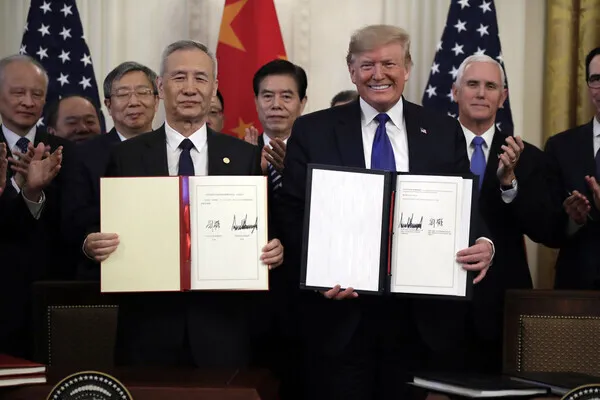
While Trump has played up his image as an “anti-China president” who launched a fierce trade war against China in 2018, this pressure was accompanied by negotiations. He even signed a “phase one” trade agreement with Chinese Vice Premier Liu He in the White House on Jan. 15, 2020. Under this agreement, China would end the injection of large subsidies to nurture cutting-edge industries and buy an additional US$200 billion in American goods.
Were it not for the COVID-19 pandemic, it is highly likely negotiations between Trump and China would have continued. The leadership of the Chinese Communist Party has a close eye on whether Trump’s threat to impose high tariffs on Chinese goods is an actual decoupling strategy or merely a negotiation tactic aimed at securing a favorable agreement for the US by applying pressure, and will react accordingly.
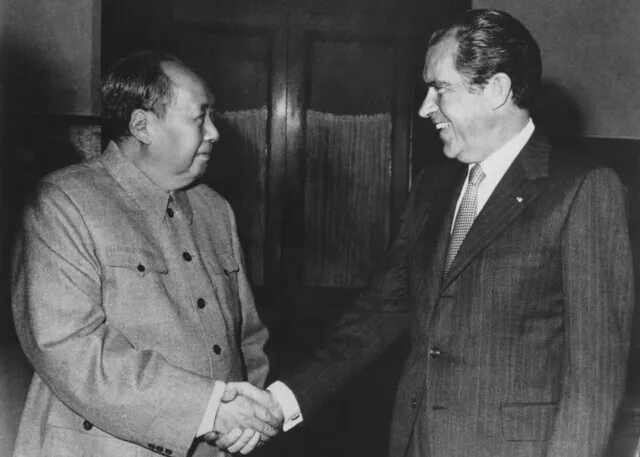
There is a historic precedent worth referring to in US-China relations. When Chinese Premier Mao Zedong met with President Richard Nixon, the first US president to ever set foot in China, on Feb. 21, 1972, he said, “I voted for you during your last election” and “I am comparatively happy when these people on the right come into power [in the West].” Nixon responded by saying, “In America, those on the right can do what those on the left talk about.”
In the 1970s, the US was stuck in the quagmire of the Vietnam War while facing nuclear competition with the Soviet Union and an economic crisis. Nixon and State Secretary Henry Kissinger extended a hand to China, which was itself embroiled in the woes of the Cultural Revolution, and suggested joining forces against the Soviet Union. The dramatic reconciliation between China and the US against the common enemy of the Soviet Union was an event that reshaped the world order, but to Korea and Taiwan, it came as a huge shock.
Whether it’s Harris or Trump who wins the White House, America’s ultra-polarized political disorder at home will only grow worse, while its isolationism in the world will grow stronger. When the day comes that the US and China make a deal according to the interests of their strong powers, the opinions of allies like Korea won’t be given a thought.
As he watches the chaotic US presidential election go down, Xi Jinping may be seeing visions of Mao’s conversation with Nixon.

By Park Min-hee, senior unification and foreign affairs writer
Please direct questions or comments to [english@hani.co.kr]

Editorial・opinion
![[Column] Don’t shoot the messenger](https://flexible.img.hani.co.kr/flexible/normal/500/300/imgdb/original/2026/0427/1217772801467434.jpg "[Column] Don’t shoot the messenger") [Column] Don’t shoot the messenger
[Column] Don’t shoot the messenger![[Column] People do not live on bread alone](https://flexible.img.hani.co.kr/flexible/normal/500/300/imgdb/original/2026/0422/1817768447705963.jpg "[Column] People do not live on bread alone") [Column] People do not live on bread alone
[Column] People do not live on bread alone- [Editorial] Another act of political violence, another red flag for America’s democracy
- [Column] Trump has no idea how to fight a war
- [Editorial] Seoul must make an effort to move up OPCON transfer
- [Editorial] US has no business telling Korea whether it can arrest Coupang founder
- [Editorial] Korea must protect its interests while sorting out US intel leak dispute
- [Column] America is a wounded giant running amok
- [Editorial] PPP leader’s trip to US is a stunt without substance
- [Editorial] Remembering Sewol tragedy is how we prevent another
Most viewed articles
- 1Is Lee about to realize Korea’s long-cherished dream of reclaiming wartime OPCON?
- 2Coupang dispute puts South Korea-US security cooperation in jeopardy
- 3[Column] Don’t shoot the messenger
- 4[Editorial] Another act of political violence, another red flag for America’s democracy
- 5[Editorial] Seoul must make an effort to move up OPCON transfer
- 6Big lessons from how we treat the littlest of creatures
- 7[Column] People do not live on bread alone
- 8With a click, 220,000+ member Telegram room generates illegal deepfake porn
- 9US’ real gripe with Seoul isn’t an intel leak or Coupang – it’s the delayed investment rollout
- 10Trump’s bid for energy supremacy by taking maritime choke points could fuel US decline