hankyoreh
Links to other country sites 다른 나라 사이트 링크
[Column] The pipe dream of India replacing China as the world’s factory
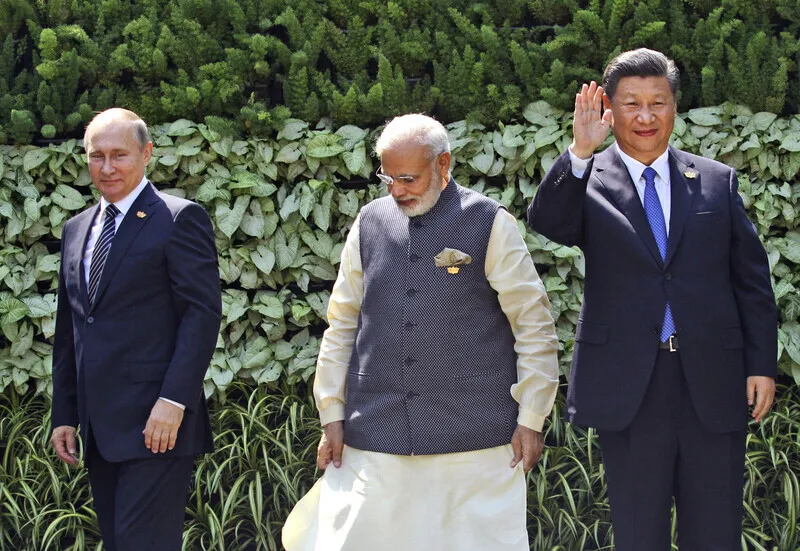
On June 22, during Indian Prime Minister Narendra Modi’s state visit to the US, the New York Times reported on how much India was profiting by maintaining neutrality between Russia and the West ever since the war in Ukraine.
Though it had barely imported Russian oil previously, once the West started imposing embargoes and sanctions on Russian oil on account of the war in Ukraine, India began importing 2 million barrels of oil a day — 45% of its total oil imports — from Russia. After importing Russian oil at a price below that of the market, India exported it at a higher price, making a profit. By refining Russian oil and exporting it to Europe and even the US, India has in fact been laundering oil for Russia.
One of the reasons the West’s sanctions against Russia lost power is not only China but India further expanding cooperation with Russia, including trade. Despite this, the US is trying its utmost to win India’s favor, inviting Modi and forming partnerships in areas like defense, clean energy, and space. Even US news outlets evaluated that out of all the state visitors, Modi received the most hospitable treatment, while US President Joe Biden remarked that the relationship between India and the US is “one of the most defining relationships of the 21st century.”
30 years of waiting for the Indian economic miracleWith the intensification of the strategic competition between the US and China, India has emerged as the US’ most important geopolitical variable. Following the US’ decision to opt for an Indo-Pacific strategy that aims to encircle and blockade China in the region as a whole, India became a country that will decide the course of international geopolitical competition.
Plus, following the US’ attempt to reorganize its supply chains that relied on China, India has been pointed out as a new hub and destination for corporations leaving China. This year, India surpassed China as the most populous country in the world. As the country possesses an abundant supply of high-quality labor power in the information and communications area, it may become the second China, expectations go.
Harvard University professor Graham Allison, a conservative hard-liner on China who is famous for his book, “Destined for War,” which argues that confrontation between the US and China is inevitable, wrote an essay titled “Will India Surpass China to Become the Next Superpower” for Foreign Policy on June 24, detailing his skepticism.
Although an economic miracle in India was expected as early as the early 1990s, it still has yet to manifest. In 2000, China’s manufacturing, exports, and gross domestic product (GDP) were two to three times larger than that of India, but now, China’s economy is five times larger. China’s GDP is US$17.7 trillion, compared to India’s US$3.2 trillion. Notably, in 2000, the share of global manufacturing for China and India was 7% and 1%, respectively, but in 2022, China’s share had grown remarkably to 31% while India’s share languished at 3%. While China’s share of global goods exports increased from 2% to 15%, India’s merely grew from 1% to 2%.
On the other hand, China’s illiteracy rate is 1% while India’s is 25%. Even in the information and communications field, where labor is supposedly plentiful in India, India cannot compete with China. Among the world’s 20 largest technology companies, four are Chinese, while none are Indian. China is responsible for half of the world’s 5G communications facilities, while India is only responsible for 1%. While China owns platforms like TikTok that serves users all over the world, India does not.
Citing these statistics and realities, Allison quoted Lee Kuan Yew, the former prime minister of Singapore. After working closely with India for a long time, Lee determined that India could not become “the country of the future” due to its deep-rooted caste system, rampant bureaucracy, racial and religious conflicts, and the national leadership’s lack of willingness to solve these problems. Lee’s conclusion was: “Do not talk about India and China in the same breath.”
India has been dubbed “the land of promise” thanks to recent geopolitical circumstances and its remarkable growth rate of 7% recorded last year. But some point out that this is merely a statistical illusion. India’s economy contracted more significantly than that of any other developing country due to the COVID-19 pandemic. Compared to 2019, India’s GDP for the second half of 2022 had only risen by 7.6%. In other words, a growth rate of 7% in 2022 only signifies a rallying effect after negative growth the year before.
In a November 2022 contribution to Foreign Affairs entitled “Why India Can’t Replace China,” Arvind Subramanian, a Brown University senior fellow and former senior economic advisor to the Indian government, observed that despite a boom in investment in India since the early 2000s, few foreign companies had relocated their production there.
The reason, he said, was the high investment risk: the policies in effect when investments are made end up changed later on, and even after investment, the rules are changed to benefit the huge Indian conglomerates that the government favors.
India’s having its cake and eating it tooMany also argue that the hopes of India joining the US’ front against China are just a fantasy. Just as India has adopted a strategy of having its cake and eating it too with the war in Ukraine, its approach to the US-China rivalry falls along similar lines.
Last May, Carnegie Endowment for International Peace senior fellow Ashley Tellis drew attention with another Foreign Affairs piece titled “America’s Bad Bet on India: New Delhi Won’t Side with Washington against Beijing.” Previously, Tellis had taken part in the process when the George W. Bush administration upgraded the US’ relationship with India to a “strategic partnership,” which included the provision of nuclear power plant technology.
“India values cooperation with Washington for the benefits it brings but does not believe that it must, in turn, materially support the US in any crisis,” he wrote. In particular, he stressed that New Delhi would never accept the concept of combined operations against China, as the US is pursuing with its Indo-Pacific strategy.
This attitude was publicly confirmed by an Indian government official after the contribution was published. Appearing in a television discussion with Tellis, Indian Foreign Minister Subrahmanyam Jaishankar stressed that India inevitably differed in its approach from a country like the US, which he described as searching the world for allies.
Noting that Australia and Japan were allies of the US, Jaishankar emphasized that India was only a “partner,” adding that it would be best for the two sides to maintain that relationship.
In a rebuttal titled “America’s Best Bet in the Indo-Pacific,” Stanford University researcher Arzan Tarapore wrote that the best course of action for the US would be to support India’s expansion of its military and economic capabilities in the Indian Ocean.
These two aspects represent sides of the same coin: the vulnerability of an overhyped India, and the maximum benefits that it draws by strictly maintaining equidistant diplomacy among the US, China and Russia.
By Jung E-gil, senior staff writer
Please direct questions or comments to [english@hani.co.kr]

Editorial・opinion
![[Editorial] Top priority in North Korean POW case should be human rights, not politics](https://flexible.img.hani.co.kr/flexible/normal/500/300/imgdb/original/2026/0928/6117905733887763.jpg "[Editorial] Top priority in North Korean POW case should be human rights, not politics") [Editorial] Top priority in North Korean POW case should be human rights, not politics
[Editorial] Top priority in North Korean POW case should be human rights, not politics![[Column] Fixing the blurred border between South and North Korea](https://flexible.img.hani.co.kr/flexible/normal/500/300/imgdb/original/2026/0928/8617905750498627.jpg "[Column] Fixing the blurred border between South and North Korea") [Column] Fixing the blurred border between South and North Korea
[Column] Fixing the blurred border between South and North Korea- [Editorial] Shark sighting in Busan is a warning from nature
- [Column] Is AI about to destroy humanity?
- [Column] Harari’s 2030s: A new age of repressive desublimation
- [Guest essay] This Chuseok, think of the seasonal workers who plant and pick your food
- [Editorial] To build back public confidence, Lee must address issues affecting everyday Koreans
- [Column] Korea-Japan cooperation still has a long way to go
- Trump has taken a wrecking ball to America’s democratic institutions
- [Column] Sending troops to Hormuz would be a fatal miscalculation by Seoul
Most viewed articles
- 1Korea in talks to inject $10 billion into US nuclear reactor project this year despite still reviewing viability
- 2Seoul pushes back on Trump’s Alaska LNG claims, says investment must be commercially viable
- 3[Notice] Hankyoreh’s Asia Future Forum to explore ‘navigating the great upheaval’
- 4Ukraine releases interrogation footage of captured North Korean soldiers, proposes prisoner swap
- 5Lee hails peace as ‘surest form of security’ on Korean Peninsula
- 6Korea’s monthly exports exceed $120 billion for first time in September
- 7How to interpret North Korea’s response to explosions in the DMZ
- 8Tensions mount over DMZ mine blast as North Korea alludes to military response
- 9Kyiv was first to request confidentiality in North Korean POW transfer, Seoul’s NIS says
- 10Less than half of South Koreans see need to reunify with North, survey finds