hankyoreh
Links to other country sites 다른 나라 사이트 링크
North Korea and Russia hail ties ‘written in blood,’ discuss continued military cooperation

North Korea and Russia reaffirmed their “friendship written in blood” and discussed a five-year plan for military cooperation on the first anniversary of Russia’s recovery of the Kursk region from Ukraine.
These moves signal that Pyongyang and Moscow, which have forged closer ties during Russia’s war against Ukraine, are exploring means of military cooperation in the medium and long term. While that could heighten security challenges on the Korean Peninsula, some observers are taking a wait-and-see attitude about the actual level of bilateral cooperation between the two sides.
The state-run Korean Central News Agency (KCNA) reported on Monday that North Korean leader Kim Jong-un and Russian Defense Minister Andrei Belousov had met on Sunday to exchange opinions about international developments and matters of mutual interest.
Russia’s TASS news agency reported that Belousov told Kim in the meeting that Russia is prepared to sign a bilateral military cooperation plan for the 2027-2031 period, but that was not mentioned in the KCNA.
The KCNA did report, however, that the two sides “discussed a series of issues for further consolidating and developing the political and military cooperation and assistance between the two countries.”
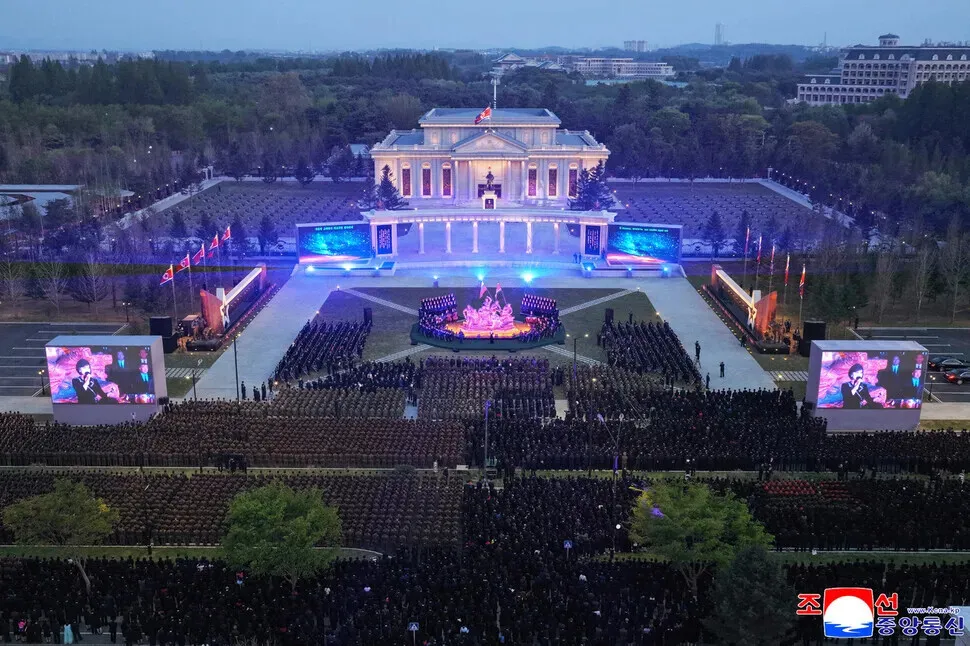
The Rodong Sinmun, the official organ of North Korea’s ruling party, devoted considerable coverage to the completion of a memorial for North Korean soldiers who died during Russia’s operation to liberate Kursk. Sunday marked the first anniversary of that operation’s conclusion.
In a speech for the opening of the Memorial Museum of Combat Feats at Overseas Military Operations, Kim stressed North Korea and Russia’s newly forged alliance and the sacrifices made by North Korean soldiers.
“In this museum we have recorded a new chapter in the history of DPRK-Russia friendship that was written in blood, the history of justice that was achieved at the cost of blood,” Kim said.
The memorial’s opening ceremony was attended by Belousov as well as Vyacheslav Volodin, the chairman of the State Duma.
Analysts posit that North Korea and Russia’s discussions and plans about military cooperation suggest the two countries are moving toward a formalized military alliance for the medium to long term.
“Thus far, cooperation [between North Korea and Russia] has been a short-term initiative focused on Ukraine. But now, that’s being elevated into regular cooperation organized into five-year periods,” said Hong Min, a senior research fellow at the Korea Institute for National Unification.
“They could move beyond the comprehensive strategic partnership [from June 2024] toward a more concrete operational military agreement,” he suggested.
Specific forms of cooperation could range from simple human exchange, such as inter-unit communication, to joint military exercises by ground troops, naval exercises involving port calls by Russian naval vessels, and military training.
The most concerning prospect for South Korea is cooperation in defense technology, which could include conventional weapons or even nuclear forces.
“North Korea has been strengthening its conventional weapons through operational integration of nuclear and conventional forces, and cooperation toward that end is the most worrisome. If Russia and North Korea hold military exercises, that could raise tensions in conjunction with South Korea’s bilateral exercises with the US and trilateral exercises with the US and Japan,” said Chang Yong-seok, a visiting scholar at the Institute for Peace and Unification Studies at Seoul National University.
That said, it remains to be seen how meaningful the cooperation between North Korea and Russia will turn out to be.
“Considering that North Korea and China don’t hold military exercises, any Russian meddling in the region via North Korea could lead to a power struggle between China and Russia. While there are various forms that cooperation could take, we’ll have to see how much that will actually aid North Korea with its desired [defense] buildup,” Chang said.
By Jang Ye-ji, staff reporter
Please direct questions or comments to [english@hani.co.kr]

Editorial・opinion
![[Correspondent’s column] The new generation of ‘sewer socialists’ are in it to win it](https://flexible.img.hani.co.kr/flexible/normal/500/300/imgdb/original/2026/0626/8217824618600972.jpg "[Correspondent’s column] The new generation of ‘sewer socialists’ are in it to win it") [Correspondent’s column] The new generation of ‘sewer socialists’ are in it to win it
[Correspondent’s column] The new generation of ‘sewer socialists’ are in it to win it![[Editorial] Who benefits from tug-of-war over jurisdiction in the DMZ?](https://flexible.img.hani.co.kr/flexible/normal/500/300/imgdb/original/2026/0625/4817823767123335.jpg "[Editorial] Who benefits from tug-of-war over jurisdiction in the DMZ?") [Editorial] Who benefits from tug-of-war over jurisdiction in the DMZ?
[Editorial] Who benefits from tug-of-war over jurisdiction in the DMZ?- [Column] Inequality in Korea hits high not seen since colonial era
- [Editorial] Unity doesn’t mean embracing defenders of insurrection
- [Editorial] Stiff sentence for ex-justice minister shows abetting insurrection won’t go unpunished
- [Column] Bridging the gap between pragmatic policies of North, South Korea
- The second China shock is here — and it’s bigger, broader and more global
- [Column] America declares its retreat from the Middle East
- [Column] North Korea’s economic boom
- [Editorial] Trump’s defeat in Iran raises stakes for Korea
Most viewed articles
- 1UN Command pulls rank, contradicts Seoul on possible violation of armistice by North in DMZ
- 2[Column] Inequality in Korea hits high not seen since colonial era
- 3[Editorial] Unity doesn’t mean embracing defenders of insurrection
- 4[Exclusive] US Congress calls for review of CCP’s ‘malign influence’ in South Korea
- 5[World Cup] Frustrating defeat to South Africa leaves Korea’s fate up in the air
- 6The AI boom is making Taiwan rich. So why do its people feel poor?
- 7The future of work and learning in the AI era depends on human choices
- 8Shincheonji leader detained for alleged plot to have followers join PPP in droves
- 9[Editorial] Who benefits from tug-of-war over jurisdiction in the DMZ?
- 10Korean firms join forces with Nvidia for massive AI infrastructure build-out