hankyoreh
Links to other country sites 다른 나라 사이트 링크
[News analysis] What Pyongyang and Beijing hope to gain by thawing ties
 Add as preferred source on Google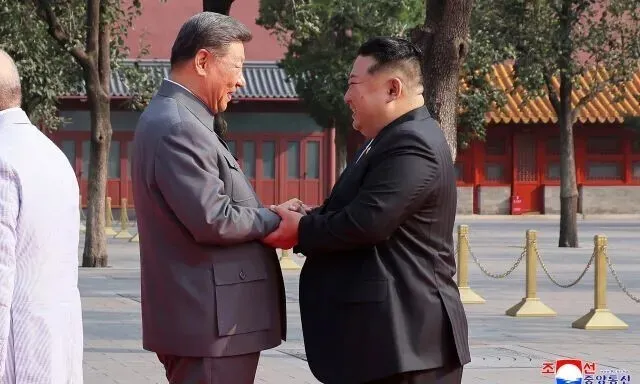
The summit between North Korean leader Kim Jong-un and Chinese President Xi Jinping on Thursday marks a major turning point, with the two nations’ leaders resolving recent tensions in bilateral relations and reaffirming their commitment to strengthening cooperation.
Though relations between North Korea and China appeared to gain momentum following the June 2019 summit in Pyongyang — the Chinese leader’s first visit to the North Korean capital since he took office in 2012 — the relationship suffered significant setbacks afterward due to unexpected factors.
First, North Korea responded to the COVID-19 pandemic by shutting down its borders in late January 2020. Kim’s overtly pro-Russia foreign policy bias following the outbreak of the Russia-Ukraine war in February 2022 also dampened cooperation with China. These shifts, compounded with Kim’s aggressive stance toward strengthening nuclear deterrence and Xi’s responsibility to implement UN Security Council sanctions against North Korea, have hindered bilateral exchanges and trade between the countries.
Above all, Kim and Xi’s disparate views of the international political landscape and differences in strategy put distance between the leaders. From June 2019 until Thursday’s summit, Kim and Xi remained quite aloof toward each other, while Kim sought to secure an ally in Russian President Vladimir Putin. Though Kim did visit China four times between 2018 and 2019, demonstrating a cordial partnership with Xi, North Korea-China summit meetings ceased for over six years after Xi’s visit to Pyongyang in June 2019.
However, Xi could not afford to neglect Kim as North Korea serves as a geopolitical buffer state, allowing China to avoid directly facing the US in the Northeast Asian context. Kim also needed to secure China’s support as it prepares for the post-war era of the Russia-Ukraine conflict, and to engage in negotiations with US President Donald Trump. Despite their differing perspectives, both sides chose the 80th anniversary celebrations of China’s victory over Japan in WWII as a stage for ameliorating relations, as the commemoration offered a shared historical memory that the two nations could bond over.
The hidden driving force behind this summit was North Korea’s need to expand economic cooperation with China to address its unstable economy and a trade deficit.
“Prices in North Korean markets are at an all-time high, with rice prices skyrocketing,” said a Korean government official. “It’s a dire situation. Supply isn’t able to keep up with demand at all.”
For Kim, stabilizing the domestic economy is of utmost importance in anticipation of the Oct. 10 celebration of the 80th anniversary of the foundation of the North Korean Workers’ Party. Realistically, large-scale economic support from China is the only viable solution to this economic strait.
The two leaders are presumed to have restored their plans to bolster exchange and interaction agreed upon during their 2019 summit, which had been suspended due to North Korea’s border closure during the COVID-19 pandemic. Following that summit, China provided North Korea with 600,000 to 700,000 tons of food and 200,000 to 300,000 tons of fertilizer. However, due to North Korea’s border shutdown, these supplies were stranded at the Port of Dalian until they finally reached North Korea in 2021.
Government officials and civil observers in South Korea believe North Korea likely raised several key demands with China at Thursday’s summit: increasing the quota for North Korean workers dispatched to China; resuming Chinese citizens’ group tours to North Korea; and easing the implementation of UN sanctions against North Korea.
By Lee Je-hun, senior staff writer
Please direct questions or comments to [english@hani.co.kr]

Editorial・opinion
![[Editorial] Seoul mayor risks losing office, but he’s already lost voters’ trust](https://flexible.img.hani.co.kr/flexible/normal/500/300/imgdb/original/2026/0723/2217847949281733.jpg "[Editorial] Seoul mayor risks losing office, but he’s already lost voters’ trust") [Editorial] Seoul mayor risks losing office, but he’s already lost voters’ trust
[Editorial] Seoul mayor risks losing office, but he’s already lost voters’ trust![[Column] Korea’s brave new world: Tanking employment and soaring home prices](https://flexible.img.hani.co.kr/flexible/normal/500/300/imgdb/original/2026/0723/1917847946266774.jpg "[Column] Korea’s brave new world: Tanking employment and soaring home prices") [Column] Korea’s brave new world: Tanking employment and soaring home prices
[Column] Korea’s brave new world: Tanking employment and soaring home prices- [Editorial] Korean Peninsula once again becomes the front line of a geopolitical rivalry
- [Editorial] Regulatory action needed after another preventable warehouse fire
- [Column] Seeking the Korean soldiers who showed mercy during Vietnam massacres
- [Reporter’s notebook] Trump’s White House windfall
- [Column] Will Lee’s NATO partnership end differently than Yoon’s support for Ukraine?
- [Editorial] For Korea’s disputes with the US, the only way out is through
- [Column] Trump’s war at home
- [Column] Another sign of an empire in decline
Most viewed articles
- 1[News analysis] Trump’s nuclear carrot for Saudis could further destabilize Mideast
- 2Peace, not denuclearization, now South Korea’s priority in policy toward North
- 3[Column] Trump’s war at home
- 4[Column] Korea’s brave new world: Tanking employment and soaring home prices
- 5SK Chairman and Roh tae-woo’s daughter expected to divorce
- 6Real-life heroes of “A Taxi Driver” pass away without having reunited
- 7A whole new China-North Korea alliance is taking shape, report argues
- 8Test-obsessed Korea reckons with smart glasses-powered cheating
- 9New MASGA hub marks next phase of Korea-US shipbuilding partnership
- 10After Iran war, North Korea’s nukes are an asset, not a burden, for China, says expert