hankyoreh
Links to other country sites 다른 나라 사이트 링크
Why Kim Jong-un opted for a 20-hour train ride to Beijing

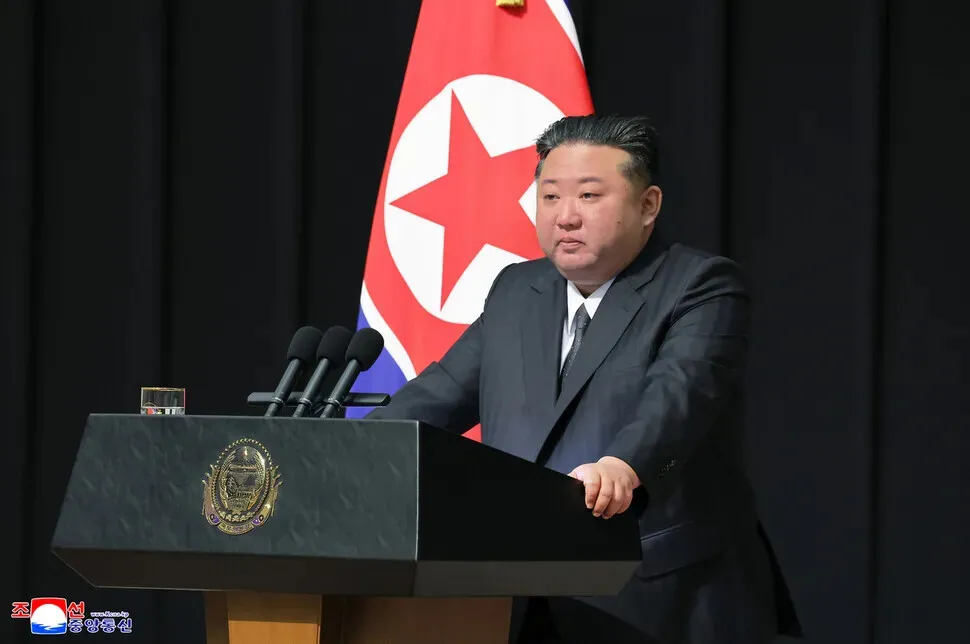
North Korean leader Kim Jong-un departed from Pyongyang on his bulletproof train on Monday to attend China’s “Victory Day” celebration on Wednesday, which commemorates China's victory over Japanese aggression during WWII. Kim’s train reportedly arrived in Sinuiju, on the border with China, around sunset.
Kim has made four previous visits to China in 2018 and 2019, traveling by train on his first and fourth visits and by airplane on his second and third.
Kim could make the 782-kilometer flight from Pyongyang to Beijing in 80 minutes in his Chammae-1 official airplane. But a train must follow a circuitous course that runs for 1,333 kilometers and takes around 20 hours, or 18 hours with no stops. In other words, traveling by train takes as much as 15 times longer than by airplane.
So why is Kim passing over the quick option of flying to Beijing? Many say the slower train journey offers several advantages. For one thing, it allows Kim to dodge potentially embarrassing comparisons between his rickety old plane and the shiny new models flown by such leaders as Russian President Vladimir Putin. For another, it casts into relief the “special treatment” Kim can expect from China.
The Chammae-1 (named for the goshawk, North Korea’s national bird) is an Ilyushin Il-62M, an old Soviet airplane produced between 1974 and 1995. Such an outdated and discontinued airplane is hardly the kind of aircraft that befits a national leader. While the Chammae-1’s date of manufacture is not known for certain, sources say it was probably made in the 1980s.
If Kim were to fly the Chammae-1 to Beijing, he would have to follow multilateral protocol, rather than bilateral protocol, during the Victory Day events. That would make it difficult to avoid unflattering comparisons between his official airplane and those sported by other world leaders.
“Putin’s presidential aircraft is an Ilyushin Il-96, which is the latest model. North Korea will want to sidestep comparisons with its out-of-date and run-down Chammae-1 presidential airplane for reasons of national prestige,” said Ahn Byung-min, the chair of the North Korea Economic Forum and an expert on North Korean transportation.
Despite the train’s slow speed, it can help bolster Kim’s image as a hard-working leader — an image often expressed through propaganda depictions of leaders subsisting on “rice balls and catnaps.” The train can also highlight that Kim is receiving special attention from China.
It takes about four hours and 30 minutes for Kim’s armored train to travel 225 kilometers from Pyongyang to the border station of Sinuiju without making any stops.
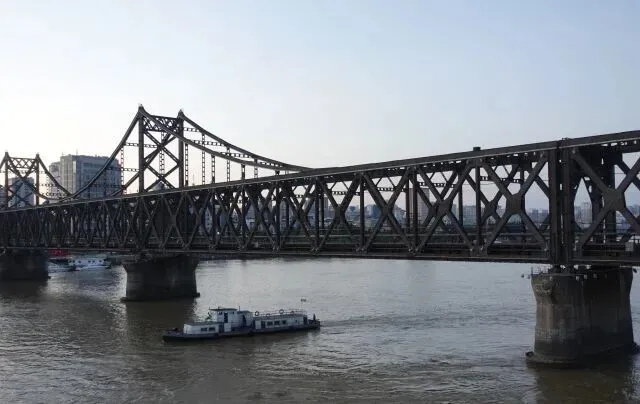
Once the train crosses the Sinuiju rail bridge over the Yalu River and enters China, it will be escorted by a Dongfeng, or DF, locomotive, an official Communist Party of China train. In effect, Kim will be treated as a guest of the state from the moment his train crosses the Yalu River.
Before Kim reaches Beijing, welcome events for his visit may be held at various points along the Chinese railroad, including Dandong Station, on the Chinese side of the border. Presuming there are no stops, it will take the train about 13 hours and 30 minutes to travel the 1,103 kilometers between Dandong and Beijing. Kim’s bulletproof train travels around 45-50 km an hour.
Kim could use his train in lieu of a hotel while in Beijing, an option that would not be available if he had flown.
Some foreign policy sources say that Kim could stay at the Diaoyutai State Guesthouse, as he did during his visit to China in 2018, but an intelligence source reported no indications that the North Korean protocol team was arranging a hotel for Kim.
“Kim may sleep in his train or use the North Korean Embassy while in Beijing,” the source said.
The North Korean Embassy in China carried out some repairs not long before Kim’s visit to China. The embassy’s exterior walls were repainted, and a round plaque was installed above the entrance. The large portrait of Kim Jong-un that had been hanging on an exterior frame has also been replaced by a photograph of his grandfather and the founder of North Korea, Kim Il-sung.
By Lee Je-hun, senior staff writer
Please direct questions or comments to [english@hani.co.kr]

Editorial・opinion
![[Editorial] Mockery of Gwangju at high school ball game shouldn’t be treated lightly](https://flexible.img.hani.co.kr/flexible/normal/500/300/imgdb/original/2026/0701/1817828951697517.jpg "[Editorial] Mockery of Gwangju at high school ball game shouldn’t be treated lightly") [Editorial] Mockery of Gwangju at high school ball game shouldn’t be treated lightly
[Editorial] Mockery of Gwangju at high school ball game shouldn’t be treated lightly![[Column] Does profit-driven investment by chaebol make them ‘national heroes’?](https://flexible.img.hani.co.kr/flexible/normal/500/300/imgdb/original/2026/0701/8317828953365056.jpg "[Column] Does profit-driven investment by chaebol make them ‘national heroes’?") [Column] Does profit-driven investment by chaebol make them ‘national heroes’?
[Column] Does profit-driven investment by chaebol make them ‘national heroes’?- [Column] Korea at a crossroads: ‘Yoon Again’ or real change?
- [Column] Stuck in Strait of Hormuz, US can no longer pivot to Asia
- [Column] The harder US pushes N.Korea to denuclearize, the greater the risk to S. Korea
- [Correspondent’s column] The new generation of ‘sewer socialists’ are in it to win it
- [Editorial] Who benefits from tug-of-war over jurisdiction in the DMZ?
- [Column] Inequality in Korea hits high not seen since colonial era
- [Editorial] Unity doesn’t mean embracing defenders of insurrection
- [Editorial] Stiff sentence for ex-justice minister shows abetting insurrection won’t go unpunished
Most viewed articles
- 1Korea on pace to record $1 trillion in exports in 2026, joining world’s top 4
- 2[Column] Korea at a crossroads: ‘Yoon Again’ or real change?
- 3Prosecution begins its investigation of bank sale to Lone Star
- 4Police refer Morse Tan to prosecutors on suspicion of defaming Korean president
- 5[Column] Does profit-driven investment by chaebol make them ‘national heroes’?
- 6After Starbucks, anti-Gwangju mockery rears its head at high school baseball game
- 7Student athletes suspended from competitive play after mocking Gwangju massacre
- 8‘All doors open if you knock long enough’: Lee vows to achieve peace with North Korea
- 9[News analysis] Can Lee and Moon’s push for unity get Democrats on the same page?
- 10US Republican lawmakers claim Korea’s NIS coerced Coupang