hankyoreh
Links to other country sites 다른 나라 사이트 링크
The American elephant in the room of the debate over two separate Korean states
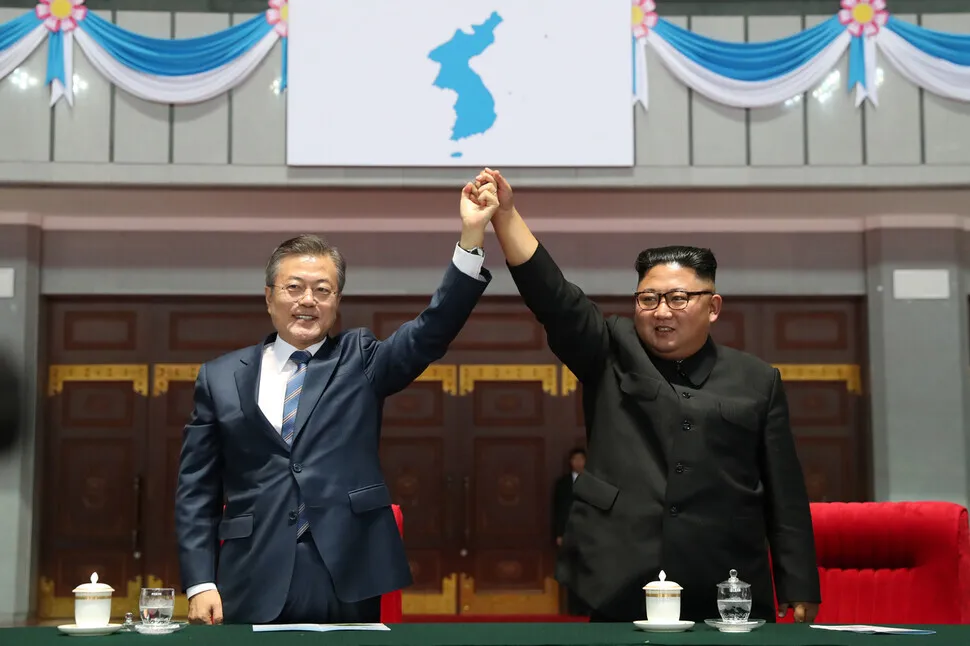
The same phrase can elicit different responses, depending on who says it. The idea that South Korea and North Korea are two de facto separate countries is universal, not only in the two Koreas but throughout the international community.
The problem arose when North Korean leader Kim Jong-un characterized inter-Korean relations to be “two states hostile to each other” and “belligerent states” during a plenary meeting of the Central Committee of the Workers’ Party of Korea (WPK) on Dec. 30, 2023.
Kim didn’t stop there. He overtly referred to reunification through military force, declaring, “We need to swiftly respond to a possible nuclear crisis and mobilize all physical means, including nuclear force, in a bid to accelerate preparations for the great event of putting the entire territory of South Korea under our control.”
Fundamentally, Kim didn’t say anything new. Yet his comments renewed the debate over inter-Korean relations and the idea of accepting North Korea and South Korea as two separate states. During a ceremony in Gwangju to celebrate the six-year anniversary of the 2018 Pyongyang Joint Declaration on Sept. 19, Im Jong-seok, the chief of staff under Moon Jae-in, declared, “Let’s not reunify. Wouldn’t it be better for us to just live separately, respecting and helping one another and being happy together?”
To justify his “forfeiture” of unification, Im cited the realities of the current situation: the North’s official change of attitude toward South Korea, the Yoon Suk-yeol administration’s hawkish policies on inter-Korean relations, and the growing disillusion with the idea of a united Korean nation among South Koreans — especially younger generations.
There are many potential interpretations of the “two-state” declaration, but the idea of abandoning the hope for unification — to simply “seal off the unification conversation and see how things are 30 years later” — lacks persuasiveness both emotionally and logically, as well as from a policy perspective. It’s being attacked by both conservatives and liberals, with the former calling it a violation of the constitutional clause that calls for the Korean Peninsula to be reunified under a free, democratic system. The progressives are calling it an anti-national narrative that abandons the sacred value of realizing a single, unified Korea.
The American elephant in the room
The role of the US is a factor that is often overlooked in discussions about unification. There was no mention of the US in Im’s recent speech, which requires significant patience to read through until the end. The same is true of mainstream media arguments and a debate held in the National Assembly on Sept. 27. Some progressive online media outlets are making themselves heard, but the mainstream media, political parties, government and National Assembly have all remained silent on the US issue, as if they had all agreed to avoid it.
But is any substantive discussion about unification, peace or security really possible without addressing the elephant in the room? All are aware of it, but it appears everyone has made a tacit agreement to not bring up the US.
Let’s be honest. The North Korean concept of unification by force represents forcibly subduing South Korea “in the event of an emergency,” while the South’s stance is bringing about unification by force “if the North invades.” In other words, the South cannot engage in unification by force unless the North invades, and no “emergency” can arise for the North unless the South invades first.
In addition, without wartime operational control it would be impossible for South Korea to invade the North without first obtaining “permission” from the US. However, the picture changes if the US becomes involved. The North could experience an “emergency” due to armed conflict with the US, and at that time the South could attempt unification by force through combined operations with US forces. The problem is that this kind of unification would essentially spell the end of the Korean people.
The idea of peaceful unification is also unrealistic without the US. The official “National Community Unification Formula” that has existed since the Kim Young-sam administration is a three-stage doctrine that consists of reconciliation and cooperation, a North-South commonwealth, and a single nation-state. During the first two stages, both the North and South retain their “national character.” Although the Kim Dae-jung administration made inroads into the reconciliation and cooperation stage, there was a repeated cycle of progress and setbacks up until the Moon Jae-in administration, and relations have now returned to a situation akin to the Cold War era. Throughout this almost 30-year rollercoaster, is it even possible to discuss anything without including the US?
The fact that independent reconciliation and cooperation between North and South Korea runs counter to US interests has been common knowledge for a long time. In addition, Korea remains politically, militarily and economically subordinate to the US, and there is a widespread sense of shame in Korea that our desire and determination to achieve independence is fading away.
Of course, many interpret this situation as an issue of pride. Former US President Donald Trump once summed all of this up in a single sentence: “They do nothing without our approval.”
This remark was a clear fake pitch in response to comments made by Minister of Foreign Affairs Kang Kyung-hwa in the National Assembly on Oct. 10, 2018, when inter-Korean relations were flying high. Kang mentioned she was in communication with relevant departments to consider lifting the May 24 measures that were originally put in place over the ROKS Cheonan sinking.
Later that year on Nov. 20, a Korea-US working group was launched to arbitrate on matters including denuclearization, inter-Korean cooperation and sanctions on North Korea. However, a more fitting name for this body would have been the “Korea-US checking group.” What happened subsequently is a historical disgrace.
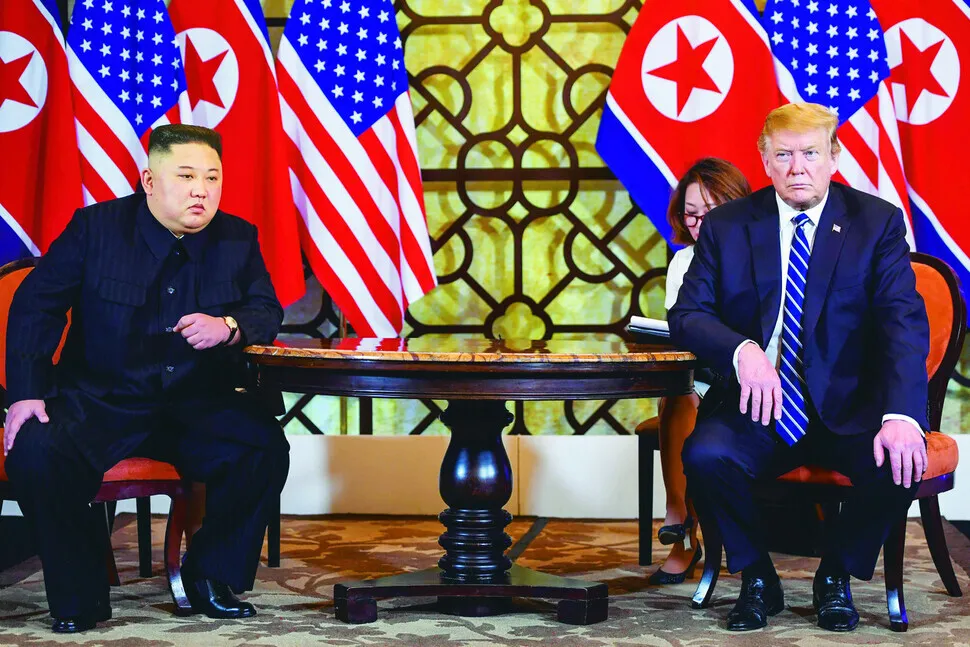
A stopped clock after US-North Korea talks break down
The concept of “unification by absorption” took root, lying somewhere between unification by force and peaceful unification. This referred to South Korea “requisitioning” North Korea in the event that the North experienced a sudden internal collapse or “surrendered” to the South due to the extreme discrepancy in national power.
While the chance of this happening was already minute, even if it did occur, could South Korea truly completely absorb the North on its own? There is no chance. During North Korea’s collapse, the US would be sure to intervene citing reasons such as processing nuclear weapons, and as a friend of North Korea, China would not simply turn a blind eye.
I am filled with a mix of curiosity and anger. It appears that former President Moon Jae-in and his advisers remain stuck in the era before the breakdown of the North Korea-US Hanoi summit in February 2019. There has been no explanation, reflection or apology for how inter-Korean relations broke down in the wake of that event. This is a truly paradoxical cognitive construction.
Are they going to simply toot their own horn over a “military agreement” that has already fallen apart while ignoring the promise made to 150,000 North Korean citizens in Pyongyang’s Rungrado 1st of May Stadium on Sept. 19, 2018? Shouldn’t they be upfront about how this went beyond the swindling of South Korean citizens and became a scheme to deceive the entire Korean people? If a fund manager enjoyed success with his initial investment but ultimately squandered all the money and left investors in piles of debt, he would be treated as mentally ill or a criminal if he kept harping on about the first year of success.
Isn’t one of the final acts of service Moon could offer the Korean public as a former president to fully explain how the “Seoul Spring” of 2018 became so ruthlessly devastated during his term in office? The US must be involved somehow. That is what makes him afraid.
There is a great saying that one should remain silent about unspeakable things. However, however, however. The US is not something unspeakable, and if the silence is not nonsense, then all it will breed is acquiescence.
In the historic 1972 July 4 South-North Joint Communiqué that has now been relegated to nothing more than an ancient document, it was the superior authority (President Park Chung-hee)’s idea to put the principle of achieving unification “independently” first. Everyone has known for a long time that without independence, there can be neither peace nor unification.
By Moon Jang-nyeol, former professor at Korea National Defense University
Please direct questions or comments to [english@hani.co.kr]

Editorial・opinion
![[Column] Xi Jinping exploits growing rift in Transatlantic alliance](https://flexible.img.hani.co.kr/flexible/normal/500/300/imgdb/original/2026/0408/1017756384434781.jpg "[Column] Xi Jinping exploits growing rift in Transatlantic alliance") [Column] Xi Jinping exploits growing rift in Transatlantic alliance
[Column] Xi Jinping exploits growing rift in Transatlantic alliance![[Column] Trump’s war boomerangs on US hegemony and alliances](https://flexible.img.hani.co.kr/flexible/normal/500/300/imgdb/original/2026/0407/6417755465363376.jpg "[Column] Trump’s war boomerangs on US hegemony and alliances") [Column] Trump’s war boomerangs on US hegemony and alliances
[Column] Trump’s war boomerangs on US hegemony and alliances- [Column] Negotiating with bombs
- [Column] What the debate over Atlas and robots in factories missed
- [Editorial] There’s no more relying on US after Iran war
- [Column] A year on from ‘Liberation Day,’ is America any greater?
- [Editorial] US threat to ‘reexamine’ NATO shows Korea can’t delay defense self-reliance
- [Column] Was Seoul’s choice to pursue dialogue, not war, in 1994 a ‘strategic error’?
- [Column] Is the PPP’s far-right shift a path to self-destruction
- [Column] Putin, Trump and Netanyahu: All tactics, no strategy
Most viewed articles
- 1[Column] Xi Jinping exploits growing rift in Transatlantic alliance
- 2[News analysis] North Korea says it wants no clashes with South — but no talks either
- 3[Column] Iran, from Heidegger to Kant
- 4China, Russia veto UNSC resolution aimed at opening Strait of Hormuz
- 5Real-life heroes of “A Taxi Driver” pass away without having reunited
- 6North Korea welcomes South Korean leader’s expression of regret over civilian drone incursion
- 7US will halt attacks on Iran for 2 weeks, Trump says
- 8‘Korea didn’t help us’: Trump blasts allies for not coming to US’ aid in Strait of Hormuz
- 9Seoul spy agency calls Kim Jong-un’s daughter ‘heir apparent’
- 10[Column] Trump’s war boomerangs on US hegemony and alliances