hankyoreh
Links to other country sites 다른 나라 사이트 링크
N. Korea to attempt satellite launch before end of month, says Japan
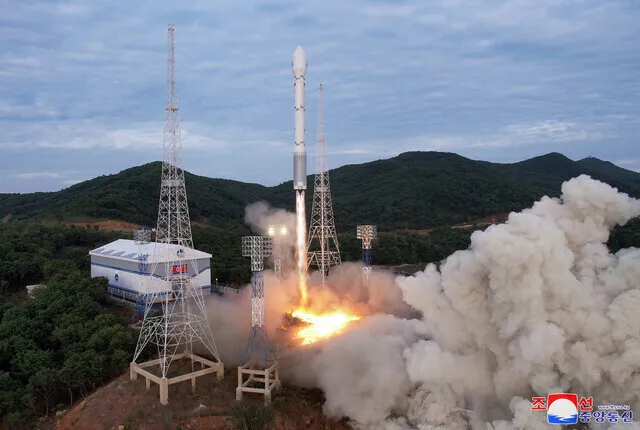
Japan says that North Korea has sent notification that it plans to launch a satellite between Aug. 24 and Aug. 31, a move that Tokyo has urged be called off. North Korea appears to be making a second attempt to launch a military reconnaissance satellite after failing to place one in orbit in May.
“We will work with relevant countries such as the US and South Korea to strongly demand that North Korea stop launching [the satellite],” Japanese Prime Minister Fumio Kishida said in a directive on North Korea's satellite launch notification on Tuesday.
“We will be prepared for any unforeseen circumstances,” he added. The Japanese government is collecting and analyzing information from a task force set up at the prime minister’s office.
After being notified of the North Korean satellite launch, the Japan Coast Guard issued a navigational warning for three areas where debris is expected to fall: two in areas off Korea’s western coast and one off the coast of the Philippines, all of which are outside Japan’s exclusive economic zone (EEZ), and asked ships passing through the area to move cautiously in these areas.
“North Korea failed to launch a military reconnaissance satellite in May 2023 and vowed to launch a second one as soon as possible,” said Japanese Defense Minister Yasukazu Hamada. He added that his ministry is maintaining the order instructing the Japan Self-Defense Forces to intercept and destroy the projectile if it falls into Japanese territory.
Off the coast of Japan, Aegis-equipped ships with high-performance radars and interceptors capable of tracking ballistic missiles are on standby around the clock. On the ground, Patriot (PAC)-3s have been deployed to the main island of Okinawa and the main islands of the Nansei Islands, including Miyako, Ishigaki and Yonaguni.
Japan has been on high alert, saying the technology used to launch satellites and ballistic missiles is virtually identical.
“North Korea has made five previous similar announcements. It fired what experts believe were ballistic missiles between the first and third day of each of its declared launch windows,” reported NHK, a Japanese broadcaster.
Regarding North Korea’s reconnaissance satellite launches, the broadcaster emphasized that North Korea “intends to use satellites to not only identify the movements of US carrier strike groups in real time, but also to attack with ballistic missiles. This seems to be in order to make the US military hesitate to commit forces to the Korean Peninsula in case of an emergency.”
In May, North Korea launched a military reconnaissance satellite, the Malligyong-1, which crashed into the waters west of the Korean Peninsula after the launch vehicle’s engine failed.
By Kim So-youn, Tokyo correspondent
Please direct questions or comments to [english@hani.co.kr]

Editorial・opinion
![[Column] Negotiating with bombs](https://flexible.img.hani.co.kr/flexible/normal/500/300/imgdb/original/2026/0406/7717754651470434.jpg "[Column] Negotiating with bombs") [Column] Negotiating with bombs
[Column] Negotiating with bombs![[Column] What the debate over Atlas and robots in factories missed](https://flexible.img.hani.co.kr/flexible/normal/500/300/imgdb/original/2026/0405/4917753549834215.jpg "[Column] What the debate over Atlas and robots in factories missed") [Column] What the debate over Atlas and robots in factories missed
[Column] What the debate over Atlas and robots in factories missed- [Editorial] There’s no more relying on US after Iran war
- [Column] A year on from ‘Liberation Day,’ is America any greater?
- [Editorial] US threat to ‘reexamine’ NATO shows Korea can’t delay defense self-reliance
- [Column] Was Seoul’s choice to pursue dialogue, not war, in 1994 a ‘strategic error’?
- [Column] Is the PPP’s far-right shift a path to self-destruction
- [Column] Putin, Trump and Netanyahu: All tactics, no strategy
- [Column] Iran war heralds a new age of every country for itself
- [Editorial] Another avoidable factory fire kills 14 in Daejeon
Most viewed articles
- 1Trump extends deadline for Iran to open Strait of Hormuz by one day
- 2[Exclusive] Korea’s Lee orders review of humanitarian aid for Iran to extricate stranded ships
- 3‘Somebody stop this madman’: Strikes on nuclear plants raise risk of disaster in Iran
- 4Approval of China’s leadership outstrips that of US by largest margin seen yet
- 5[Column] Is “Afghan Girl” doing well?
- 6Lee says Korea will reduce burden on US by boosting defense spending, regaining OPCON
- 7South Korean military chopper accidentally entered DMZ while fighting fire in March
- 8Team behind ‘KPop Demon Hunters’ say sequel will center ‘Koreanness’
- 9[Column] Negotiating with bombs
- 10[Korea travels] Spring is in the air in Donghae, where ocean vistas take your breath away