hankyoreh
Links to other country sites 다른 나라 사이트 링크
S. Korea confirms secondary infection involving crew members of Russian ship at Busan port
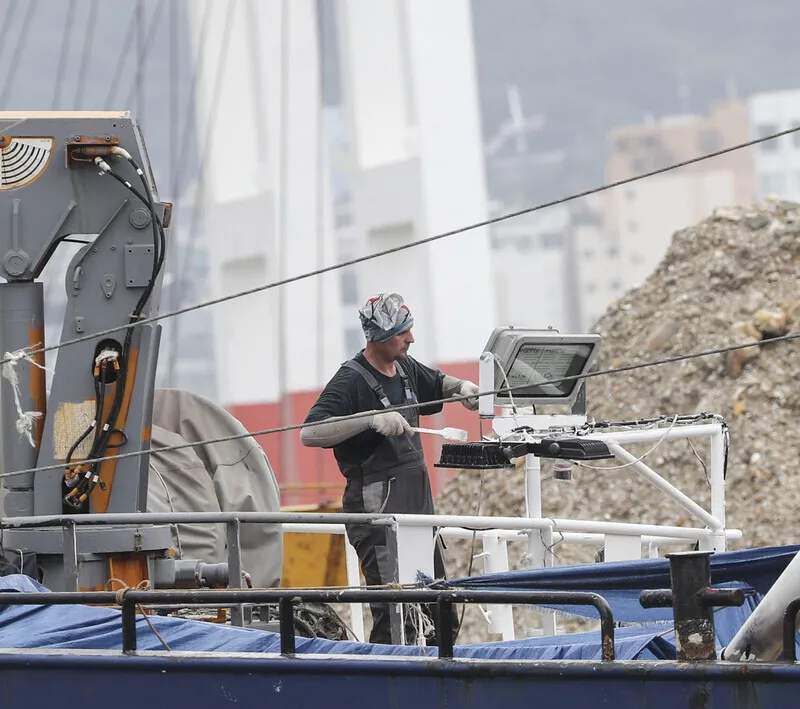
Amid a series of COVID-19 infection clusters involving Russian ships docked at the Port of Busan, a case of secondary transmission was confirmed with the diagnosis of an individual living with a mechanic who was infected while working on the Petr 1, which docked at the port on July 8. The South Korean government acknowledged the inadequacy of the response measures and announced plans to intensify disease control efforts for ocean vessels.
According to an announcement by the Korea Centers for Disease Control and Prevention (KCDC), the number of new infections tallied for July 26 comprised 46 imported cases and 12 community cases. The numbers for the day before stood at 86 and 27, respectively. Over the weekend, a total of 132 cases came from overseas. Thirty-two of them were crew members on the Petr 1, while 74 were construction workers who had returned from Iraq. In the case of the Petr 1, a total of eight ship mechanics (seven South Koreans) were also diagnosed, as well as another person who had been in contact with one of them.
“We’ve been preparing for the Russian vessels with a sense of wariness, but adequate preparations were not made for the possibility of South Korean workers becoming infected at the shipyard where [the ships] were sent for repairs,” said Park Neung-hoo, health minister and first deputy director of the Central Disaster and Safety Countermeasures Headquarters (CDSCHQ).
“This response appears to have been poorly handled,” he added.
With numerous diagnoses since late July involving crew members on arriving vessels, the South Korean government is weighing whether to designate Russia as subject to intensified disease controls. Crew members of vessels in countries subject to the controls would be required to present a negative test result for the virus issued within 48 hours of departure. As of 12 am on July 27, testing for travelers arriving from countries subject to intensified disease controls was increased from one test administered within three days after arrival to two tests, one of them within three days after arrival and the second on the 13th day after entering quarantine.
Principle of reciprocality in determining which foreign arrivals have to pay for treatmentThe South Korean government is pushing an amendment to the Infectious Disease Control and Prevention Act that would allow foreign nationals to be charged in full for hospitalization and treatment costs when diagnosed during the arrival or quarantine process. The principle of “reciprocality” is to be a priority consideration in deciding whether individuals are actually charged.
“Among the 22 countries with regulations on treatment costs for foreign nationals, 15 of them -- including Australia, Brazil, and the US -- support the costs of treatment for foreigners, while many countries do not have clear regulations,” Park said.
“If South Korea emphasizes the principle of reciprocality, there will be more opportunities for South Korean nationals to receive free treatment overseas,” he predicted.
The diagnosed workers arriving from Iraq have been transported to hospitals or rehabilitation centers, where they are currently undergoing treatment. Another 215 arriving passengers who tested negative are to remain in quarantine until Aug. 7.
By Choi Ha-yan, staff reporter
Please direct comments or questions to [english@hani.co.kr]

Editorial・opinion
![[Editorial] Korea awaits verdict that will bring Yoon to justice](https://flexible.img.hani.co.kr/flexible/normal/387/232/imgdb/original/2026/0114/2717683786156022.jpg "[Editorial] Korea awaits verdict that will bring Yoon to justice") [Editorial] Korea awaits verdict that will bring Yoon to justice
[Editorial] Korea awaits verdict that will bring Yoon to justice![[Editorial] Starting small will be key for Lee’s big vision for cooperation with North Korea](https://flexible.img.hani.co.kr/flexible/normal/500/300/imgdb/original/2026/0114/1717683780759382.jpg "[Editorial] Starting small will be key for Lee’s big vision for cooperation with North Korea") [Editorial] Starting small will be key for Lee’s big vision for cooperation with North Korea
[Editorial] Starting small will be key for Lee’s big vision for cooperation with North Korea- [Column] Surviving our era beyond the looking glass
- [Column] Welcome to the age of corridors
- [Correspondent’s column] Risks and opportunities in Xi’s gesture to Korea
- [Column] The pretexts of the powerful
- [Column] Why do working-class young people fall for the far right?
- [Editorial] A step in the right direction for South Korea and China
- [Column] Lee’s efforts to write a hopeful new chapter for inter-Korean relations
- [Column] What ‘innovation’ by Coupang’s Kim Bom-suk missed
Most viewed articles
- 1[Interview] Judith Butler: Repressive acts by anti-democratic regimes are ‘confessions’ of fear
- 2‘KPop Demon Hunters’ takes home Golden Globes for animated film, best original song
- 3Korea, China and Japan must find ‘common ground’ and communicate, says Lee
- 4Yoon offers more rationalization, not remorse, in final statement of insurrection trial
- 5Korea, Japan agree to identify remains of those killed in Chosei mine disaster
- 6Special counsel demands death penalty for Yoon in insurrection trial
- 7Why prosecutors are seeking the death penalty for Korea’s former president
- 8[Editorial] Korea awaits verdict that will bring Yoon to justice
- 9Naver unveils HyperCLOVA X in bid to become early leader in Korea’s AI ecosystem
- 10Lee proposes 4 major projects to China, including Seoul-Pyongyang-Beijing high-speed rail