hankyoreh
Links to other country sites 다른 나라 사이트 링크
S. Korea records over 60 new COVID-19 for 3 straight days
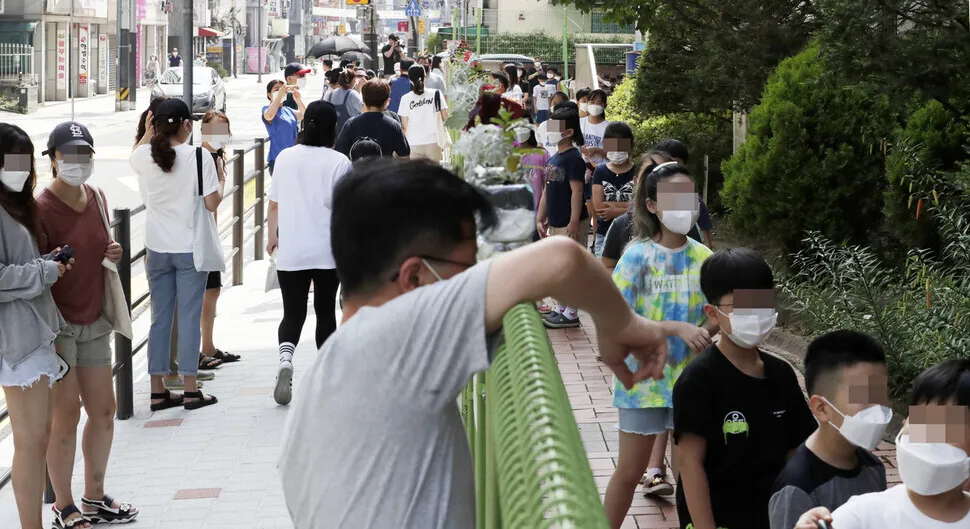
Despite the number of patients newly diagnosed with the novel coronavirus exceeding 60 for three straight days, disease control authorities said on July 5 that the current level of social distancing will not be graded to “Level 2.” However, they acknowledged that the country is approaching a “serious crisis situation” despite still being at Level 1, otherwise known as “everyday disease prevention.” It was the first time South Korea recorded 60 or more new cases for three consecutive days since the number of daily cases dipped to 47 on Apr. 6.
As of 12 am on July 5, the number of new COVID-19 cases counted by the Korea Centers for Disease Control and Prevention (KCDC) was up by 61 from the day before. Among 43 community infections, Gwangju recorded 15 cases, while Seoul recorded 14, Daejeon eight, and Gyeonggi Province four. Small cluster infections were reported in healthcare institutions, call centers, and banks -- prompting the Central Disaster and Safety Countermeasures Headquarters (CDSCHQ) to describe the battle against COVID-19 as “a game of whack-a-mole.” The analogy refers to a situation where the number of infections emerging in scattered locations makes it difficult to keep up with the virus’ spread.
The government’s objective of maintaining a daily average of 50 or fewer new cases over a two-week period, its benchmark for maintaining a Level 1 social distancing system, is under threat. For the two weeks from June 21 to July 4, the number of daily cases averaged 46.9. That number has been over 50 for the past five days. But the government has explained that the “50” standard is based mainly on the number of community infections, since imported cases from overseas are either detected during entry procedures or isolated early on to prevent them leading to secondary infections within the community. Based on the number of community infections alone, the number of new diagnoses has surpassed 50 only once in recent weeks, with 52 diagnoses on July 3.
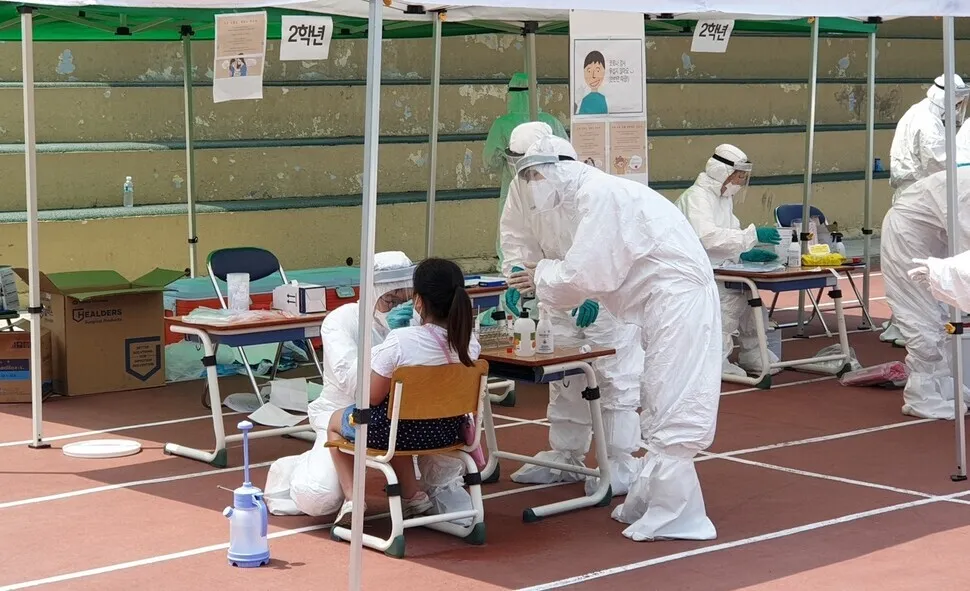
Other standards for maintaining Level 1 social distancing – less than 5% of cases involving unknown transmission routes, 80% of more cases being managed under self-quarantine measures, and keeping cluster infections under control -- have long since fallen by the wayside. As of July 4, fully 13.2% of new diagnoses in the preceding two weeks involved unknown transmission routes, with less than 80% of cases involving people under quarantine. In regions outside of the Seoul Capital Area -- where healthcare resources are relatively lacking – the average number of daily cases has risen from 3.4 (June 7-20) to 11.7 (June 21-July 4).
“The sharp rise in patients in regions that don’t have the proper disease control systems in place has forced us to give serious consideration to upgrading to Level 2 social distancing,” explained Hong Yun-chul, a professor of preventive medicine at the Seoul National University College of Medicine.
But the four standards for distinguishing social distancing levels are more like guidelines, with the final decision in the hands of disease control authorities. Those authorities are currently analyzing genetic base sequences for patients in different regions to check for mutations in the virus and examine the rate of transmission. These analyses are also used as a basis for decisions on whether to upgrade social distancing levels. CDSCHQ First Deputy Director Park Neung-hoo explained, “Since the risk levels are not identical for every region, we think the appropriate strategy is to establish the right distancing level for each region in consideration of the proportion of new diagnoses relative to the local population and the capacity of community healthcare systems.”
On July 5 and July 2, respectively, South Jeolla Province and Gwangju moved independently to upgrade to Level 2 distancing and prohibit indoor gatherings of 50 or more people.
By Hwang Ye-rang, staff reporter
Please direct comments or questions to [english@hani.co.kr]

Editorial・opinion
![[Editorial] Korea awaits verdict that will bring Yoon to justice](https://flexible.img.hani.co.kr/flexible/normal/387/232/imgdb/original/2026/0114/2717683786156022.jpg "[Editorial] Korea awaits verdict that will bring Yoon to justice") [Editorial] Korea awaits verdict that will bring Yoon to justice
[Editorial] Korea awaits verdict that will bring Yoon to justice![[Editorial] Starting small will be key for Lee’s big vision for cooperation with North Korea](https://flexible.img.hani.co.kr/flexible/normal/500/300/imgdb/original/2026/0114/1717683780759382.jpg "[Editorial] Starting small will be key for Lee’s big vision for cooperation with North Korea") [Editorial] Starting small will be key for Lee’s big vision for cooperation with North Korea
[Editorial] Starting small will be key for Lee’s big vision for cooperation with North Korea- [Column] Surviving our era beyond the looking glass
- [Column] Welcome to the age of corridors
- [Correspondent’s column] Risks and opportunities in Xi’s gesture to Korea
- [Column] The pretexts of the powerful
- [Column] Why do working-class young people fall for the far right?
- [Editorial] A step in the right direction for South Korea and China
- [Column] Lee’s efforts to write a hopeful new chapter for inter-Korean relations
- [Column] What ‘innovation’ by Coupang’s Kim Bom-suk missed
Most viewed articles
- 1[Interview] Judith Butler: Repressive acts by anti-democratic regimes are ‘confessions’ of fear
- 2‘KPop Demon Hunters’ takes home Golden Globes for animated film, best original song
- 3Korea, China and Japan must find ‘common ground’ and communicate, says Lee
- 4Yoon offers more rationalization, not remorse, in final statement of insurrection trial
- 5Korea, Japan agree to identify remains of those killed in Chosei mine disaster
- 6Special counsel demands death penalty for Yoon in insurrection trial
- 7Why prosecutors are seeking the death penalty for Korea’s former president
- 8[Editorial] Korea awaits verdict that will bring Yoon to justice
- 9Naver unveils HyperCLOVA X in bid to become early leader in Korea’s AI ecosystem
- 10Lee proposes 4 major projects to China, including Seoul-Pyongyang-Beijing high-speed rail