hankyoreh
Links to other country sites 다른 나라 사이트 링크
[Interview] S. Korean hospitals more prepared for infectious disease control after past outbreaks
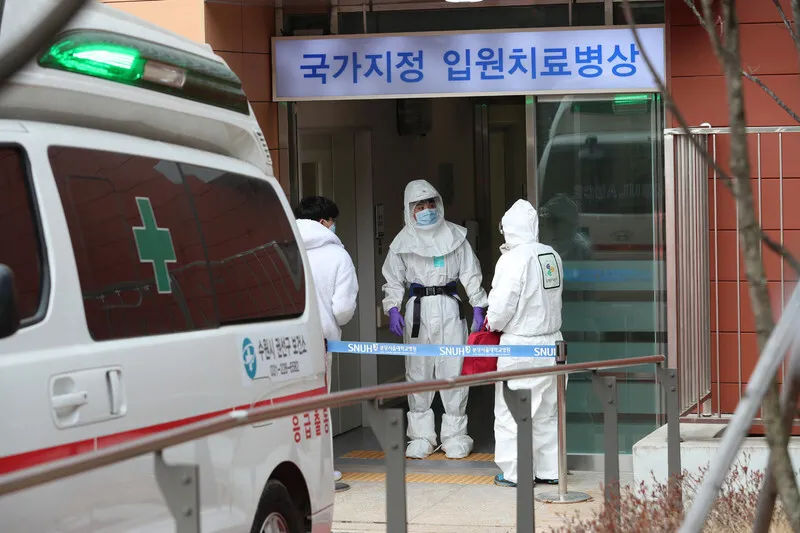
Shin Myeong-jin, head of the infection control unit at the Seoul National University Bundang Hospital, is a veteran nurse who has dealt with all four serious outbreaks of infectious disease in South Korea over the past 17 years — SARS (severe acute respiratory syndrome), H1N1 influenza, MERS (Middle East respiratory syndrome), and now COVID-19, the disease caused by the novel coronavirus.
“Medical personnel talk about a six year cycle for infectious diseases. Everyone’s nervous about COVID-19, which struck earlier than expected,” Shin said during an interview with the Hankyoreh on Feb. 14.
There are currently three confirmed COVID-19 patients being treated at the hospital: South Korea’s 12th coronavirus patient, a Chinese national who entered South Korea from Japan; the 14th patient, his wife; and the 25th patient, who was infected by family members who’d visited China’s Guangdong Province. The fourth patient was released from the hospital on Feb. 9. A total of 56 suspected patients were previously hospitalized in quarantine rooms there.

The infection control unit, where Shin works, serves to coordinate efforts to prevent infection within the hospital. Its primary objective is ensuring that medical personnel aren’t infected. As recently as the time of the MERS outbreak, the idea of “Level D protection gear” -- including clothing, masks, and slippers to prevent contact with viruses -- was unfamiliar to the medical staff at SNU Bundang Hospital, which did not have a nationally designated isolation ward. But as MERS spread and the hospital suddenly began encountering more and more patients, they were forced into a situation of “literally having to hastily cobble together [protective gear sets] by looking at the manual and hand them out to staff,” Shin explained. The sets supplied by Korea Centers for Disease Control and Prevention (KCDC) at the time either were the wrong size or were missing hair covers and other parts. The improved gear at SNU Bundang Hospital was well-produced enough that public health authorities now use it as a reference.
“Before MERS, our training amounted to ‘how to isolate suspected cases,’ but since then we’ve done training for different scenarios, such as infections within multi-person rooms in the hospital or reacting to a fire,” Shin said.
“Thanks to that, we were able to respond calmly when the first suspected COVID-19 patient arrived,” she added.
Even so, dealing with new infections has been fraught with tension. Wearing protective gear the wrong way or removing it exposes the skin and mucous membranes to pathogens. Fatigue has also increased recently among staff tasked with treatment in the negative pressure isolation ward for both confirmed patients and suspected ones awaiting test results.
“We currently have seven of nine negative pressure wards operating, but with a shortage of beds and issues of staff burnout, we’re worried how we are going to respond if the number of patients with severe pneumonia increases,” Shin said.
“For the sake of efficient allocation of resources, state-designated hospitalization wards should be handling treatment for patients with severe symptoms, and local governments and public medical centers should be setting up a separate system for dealing with milder symptoms and suspected patients,” she suggested.
Improved public awareness and professional preparedness reduce rate of spreadShin described COVID-19 as “presenting more like a novel influenza than MERS.” Regarding reasons for the spread being less rapid than at the time of the flu outbreak in 2009, she noted an increase in specialized infection control personnel and improved public awareness. In 2016, the South Korean government instituted infection control subsidies for healthcare institutions and ordered the assignment of one or more specialized infection control nurses per 150 beds. According to observers, disparities in infection control staffing at hospitals have shrunk over the past five years as a result. The number of specialized infection control nurses rose from only around 200 at the time of the MERS outbreak in 2015 to around 400 last year.
“At the time of the 2019 flu outbreak, there wasn’t as much of an emphasis on prevention by members of the public, such as wearing a mask, washing your hands, or avoiding multi-user facilities,” Shin said.
“After the MERS outbreak, patients within the hospital have recently been cooperative with things like limiting entry to guardians who have visited risk countries or recommendations on the use of caregivers,” she added.
By Seon Dam-eun, staff reporter
Please direct comments or questions to [english@hani.co.kr]

Editorial・opinion
![[Editorial] Korea awaits verdict that will bring Yoon to justice](https://flexible.img.hani.co.kr/flexible/normal/387/232/imgdb/original/2026/0114/2717683786156022.jpg "[Editorial] Korea awaits verdict that will bring Yoon to justice") [Editorial] Korea awaits verdict that will bring Yoon to justice
[Editorial] Korea awaits verdict that will bring Yoon to justice![[Editorial] Starting small will be key for Lee’s big vision for cooperation with North Korea](https://flexible.img.hani.co.kr/flexible/normal/500/300/imgdb/original/2026/0114/1717683780759382.jpg "[Editorial] Starting small will be key for Lee’s big vision for cooperation with North Korea") [Editorial] Starting small will be key for Lee’s big vision for cooperation with North Korea
[Editorial] Starting small will be key for Lee’s big vision for cooperation with North Korea- [Column] Surviving our era beyond the looking glass
- [Column] Welcome to the age of corridors
- [Correspondent’s column] Risks and opportunities in Xi’s gesture to Korea
- [Column] The pretexts of the powerful
- [Column] Why do working-class young people fall for the far right?
- [Editorial] A step in the right direction for South Korea and China
- [Column] Lee’s efforts to write a hopeful new chapter for inter-Korean relations
- [Column] What ‘innovation’ by Coupang’s Kim Bom-suk missed
Most viewed articles
- 1[Interview] Judith Butler: Repressive acts by anti-democratic regimes are ‘confessions’ of fear
- 2‘KPop Demon Hunters’ takes home Golden Globes for animated film, best original song
- 3Korea, China and Japan must find ‘common ground’ and communicate, says Lee
- 4Yoon offers more rationalization, not remorse, in final statement of insurrection trial
- 5Korea, Japan agree to identify remains of those killed in Chosei mine disaster
- 6Special counsel demands death penalty for Yoon in insurrection trial
- 7Why prosecutors are seeking the death penalty for Korea’s former president
- 8[Editorial] Korea awaits verdict that will bring Yoon to justice
- 9Naver unveils HyperCLOVA X in bid to become early leader in Korea’s AI ecosystem
- 10Lee proposes 4 major projects to China, including Seoul-Pyongyang-Beijing high-speed rail