hankyoreh
Links to other country sites 다른 나라 사이트 링크
[Column] How can we make “Hell Joseon” more liveable?
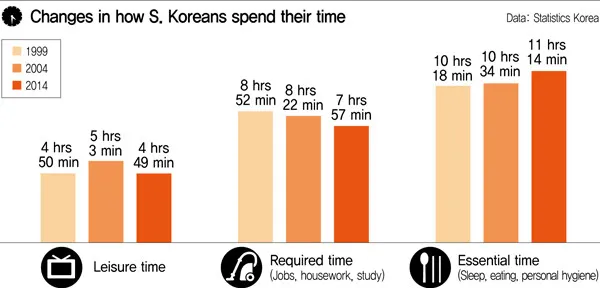
Last week, Statistics Korea came out with an important report offering insights into South Koreans’ everyday lives. The findings were from a study on changes between 1999 and 2014 in the way people spend their time. The report made it appear that those time usage patterns had improved quite a bit over the past 16 years.
One number that jumped out was a 12-minute increase in the average time spent sleeping - from 7 hours and 47 minutes in 1999 to 7 hours and 59 minutes in 2014. The increase is welcome news, since it means people have that much more time for rest. The report also said time spent eating meals and snacks increased by 23 minutes from one hour and 33 minutes a day to one hour and 56 minutes, while personal care time for hygiene and appearance rose from 58 minutes to 78 minutes. This could be seen as a positive change; everyone wants the option of leisurely eating and the ability to spend as much time as possible taking care of themselves. Even more positive is the fact that “required time,” including areas like work and study, fell from 8 hours and 52 minutes in 1999 to 7 hours and 57 minutes - a decrease of 55 minutes. That certainly is good news, since less required time means more free time.
But for all these improvements, time usage patterns for South Koreans remain poor. The report also included details on commuting times: 71 minutes a day for employed persons outside the Seoul metropolitan area, 96 minutes for those within it. People commute to the workplace, so in essence that time should be considered part of working hours. In that sense, South Koreans spent all too much time in work-related activities. Employed persons in the greater Seoul area spent 9 hours and 33 minutes a day on required time and commuting. That’s not all: if we consider that the 7 hours and 59 minutes of sleeping time are meant to help recharge our working capabilities, that would mean those Seoul-area workers are spending 18 hours and 21 minutes a day for work. That may explain why average leisure time in 2014 - 4 hours and 49 minutes - was actually down from 1999.
The problem is that South Koreans’ required time, and their official working hours in particular, is simply too much. A report last year by the Organization for Economic Co-operation and Development (OECD) calculated an average yearly working time of 1,770 hours for member countries in 2014. South Korea’s yearly hours came in at 2,124 - second only to Mexico with 2,228. Those 2,124 hours are 354 more than the OECD average, which translates into more than 44 eight-hour workdays. The country in the OECD with the fewest annual working hours was Germany with 1,371, or 753 fewer than South Korea. This means South Koreans are working 94 days more than Germans.
Lately, many in South Korea have been talking about how we have turned into “Hell Joseon.” There’s a widespread perception that the environment has become unlivable. And the biggest factors that are plunging people into that hell are usually difficulty finding or keeping work. In a capitalist society, losing opportunities for work means failing to secure an income. In a society where social services are lacking, losing opportunities for work and failing to secure an income mean a very difficult life. Yet what these lifestyle pattern statistics show is that quality of life isn’t improving even for the ones who do get those opportunities. There are only 24 hours in a day, and when you have to spend most of that working long hours and doing related activities, it leaves much less time for living like a human being. Not only that, but wages have failed to rise very much in recent years.
Living a humane life requires more free time. This means that even if working hours are cut, a sufficient income is guaranteed for people to spend as they like. Unless we have that time available, this is not a livable society, no matter how high the employment rate is. We need to create a society where the amount of time spent working is historically short, yet where a basic income is ensured - a society where we have enough free time. With this month‘s general election results changing the political landscape, it will be interesting to see how this issue is addressed.
By Kang Nae-hee, Dean of Free University
Please direct questions or comments to [english@hani.co.kr]

Editorial・opinion
![[Column] From complete denuclearization of North Korea to managing nuclear risk](https://flexible.img.hani.co.kr/flexible/normal/500/300/imgdb/original/2026/0601/8617803026931084.jpg "[Column] From complete denuclearization of North Korea to managing nuclear risk") [Column] From complete denuclearization of North Korea to managing nuclear risk
[Column] From complete denuclearization of North Korea to managing nuclear risk![[Editorial] Korea is a model US ally on defense. It’s time it regains wartime OPCON.](https://flexible.img.hani.co.kr/flexible/normal/500/300/imgdb/original/2026/0601/5617803042425466.jpg "[Editorial] Korea is a model US ally on defense. It’s time it regains wartime OPCON.") [Editorial] Korea is a model US ally on defense. It’s time it regains wartime OPCON.
[Editorial] Korea is a model US ally on defense. It’s time it regains wartime OPCON.- [Editorial] Election fraud conspiracy theorists are the real threats to Korea’s democracy
- [Column] Israel: The definition of a democratic fascist regime
- [Column] The tyranny of merit and the distribution of profit in the AI era
- [Editorial] Working groups on Korea-US fact sheet must yield tangible results
- [Editorial] Head of USFK continues to cross the line with inappropriate political remarks
- [Editorial] A disgraced former president like Park Geun-hye has no place on the campaign trail
- [Editorial] Korea’s online hate problem calls for platform regulation and anti-discrimination law
- [Reporter’s notebook] Trump’s primary purge of ‘traitors’ won’t win him anything
Most viewed articles
- 1[Column] From complete denuclearization of North Korea to managing nuclear risk
- 2[Editorial] Korea is a model US ally on defense. It’s time it regains wartime OPCON.
- 3[Editorial] Head of USFK continues to cross the line with inappropriate political remarks
- 4[Column] Israel: The definition of a democratic fascist regime
- 5[Editorial] Working groups on Korea-US fact sheet must yield tangible results
- 6Little-known former US official sets off flurry of election misinfo in Korea
- 7[Column] The tyranny of merit and the distribution of profit in the AI era
- 8Ripped from families for not being ‘Korean enough,’ mixed-race adoptees seek truth and justice
- 9Korean activists say Israeli captors physically and sexually assaulted flotilla activists
- 10South Korea is ready for OPCON handover, defense chief tells US lawmakers