hankyoreh
Links to other country sites 다른 나라 사이트 링크
Park Won-soon reelected mayor; could be the next president?
 Add as preferred source on Google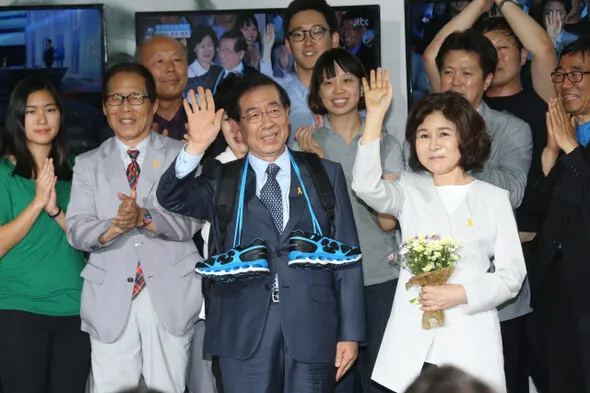
By Lee Se-young, staff reporter
No tension could be felt. At 5:50 pm, just before the polls closed in the June 4 municipal elections, campaign staffers and supporters crowding the campaign headquarters of Park Won-soon, Seoul mayoral candidate for the New Politics Alliance for Democracy, in Seoul’s Jongno district, were buzzing with excitement. While they were chanting the countdown to the announcement of the exit poll results, a message appeared on the television monitor projecting Park’s victory in the election. The room erupted into applause and shouts of exultation.
After his victory was confirmed, Park shared his feelings. “My victory is a victory for all of the citizens of Seoul who called for fundamental change after the Sewol tragedy. Now, I will forge ahead toward a new day,” Park said
“Together with all citizens, I will create the change that they want. We will create hope together, while abiding by principles and fundamentals,” he added.
Members of the incumbent’s campaign suggested that one of the reasons Park won was that he had earned the support of Seoul citizens with his “municipal government based on life and values,” which he launched while in office. By minimizing large-scale development projects such as the so-called “new towns” and public works projects designed to establish a legacy, while also communicating with the people and leading the implementation of the “social economy” and other alternative models for the city’s economy, Park was able to win the hearts of the middle and working classes, who were sick of the obsession with growth and development that took place under his predecessor, former mayor Oh Se-hoon.
“Park came out on top in this fight. Over the past two years and seven months since he was elected in a mayoral by-election, Park ran the city in a way that was completely different from previous mayors,” said Lee Cheol-hee, director of the Dumun Political Strategy Institute.
But other analysts suggest that Park’s unique approach to running the city during his first term is not the only factor in his victory. “If running the city was the baseball pennant race, this election is the Korean Series,” said Han Gwi-yeong, researcher at the Hankyoreh Institute for Social Policy. “Coaching the team well in the pennant race and winning the Korean Series are two totally different things.”
In fact, polls from March and April did not show Park with a clear lead over Saenuri Party candidate Chung Mong-joon. At the time, Park’s lead over Chung was within the margin of error, a result of the big jump in support for Chung as the three Saenuri Party candidates duked it out in the primaries.
But the turning point was the Apr. 16 sinking of the Sewol ferry. The Sewol tragedy spread disenchantment with the doctrine of economic growth and the complacency and corruption rife within government. It also brought into the spotlight the uniqueness of the people-centered city government that Park had been advocating.
“As the structural causes of the tragedy came to light, it appears that the citizens were reminded of Park Won-soon, and the perception spread that Park would be able to do a good job,” said Han Gwi-yeong. In the wake of the Sewol disaster, citizens’ feelings were also put off by remarks made by family members of Chung Mong-joon, who referred to the Sewol family members as “uncivilized.”
But there are mixed views about whether Park’s victory in this election will smooth the way for his plans during his second term as mayor of Seoul - and for the larger goal of eventually running for president. Lee Cheol-hee is optimistic on the subject. “Since he has been given four years in which to elaborate his own values and philosophy, he will enjoy stability and get results as he runs the city,” Lee said.
However, Chung-Ang University Shin Jae-wook suggested that something important is missing from Park’s city management. In Shin’s opinion, Park’s governance has followed the Japanese local government model, which seeks to create small changes from the bottom up and then incorporate these into society as a whole. But if Park is unable to create the political opportunity structure to support these bottom-up changes, there is a considerable risk that these efforts will be wasted, ultimately accomplishing nothing.
Experts were also cautious about the prospects of Park running for president in the future. “It’s true that he has an advantage over his competitors [Moon Jae-in and Ahn Cheol-soo], who have to endure the tempests of the political world. But since he is trapped in his own domain, he may not be able to gain the momentum to rise above it,” said Lee Cheol-hee.
“There is a manifest difference between the realms of the social reformer and administrator and the domain of the politician,” said Kim Ho-gi, professor at Yonsei University. But Kim also cautiously expects Park’s political future to depend on how the opposition party changed in days to come.
Please direct questions or comments to [english@hani.co.kr]

Editorial・opinion
![[Editorial] Seoul mayor risks losing office, but he’s already lost voters’ trust](https://flexible.img.hani.co.kr/flexible/normal/500/300/imgdb/original/2026/0723/2217847949281733.jpg "[Editorial] Seoul mayor risks losing office, but he’s already lost voters’ trust") [Editorial] Seoul mayor risks losing office, but he’s already lost voters’ trust
[Editorial] Seoul mayor risks losing office, but he’s already lost voters’ trust![[Column] Korea’s brave new world: Tanking employment and soaring home prices](https://flexible.img.hani.co.kr/flexible/normal/500/300/imgdb/original/2026/0723/1917847946266774.jpg "[Column] Korea’s brave new world: Tanking employment and soaring home prices") [Column] Korea’s brave new world: Tanking employment and soaring home prices
[Column] Korea’s brave new world: Tanking employment and soaring home prices- [Editorial] Korean Peninsula once again becomes the front line of a geopolitical rivalry
- [Editorial] Regulatory action needed after another preventable warehouse fire
- [Column] Seeking the Korean soldiers who showed mercy during Vietnam massacres
- [Reporter’s notebook] Trump’s White House windfall
- [Column] Will Lee’s NATO partnership end differently than Yoon’s support for Ukraine?
- [Editorial] For Korea’s disputes with the US, the only way out is through
- [Column] Trump’s war at home
- [Column] Another sign of an empire in decline
Most viewed articles
- 1Peace, not denuclearization, now South Korea’s priority in policy toward North
- 2[Column] Korea’s brave new world: Tanking employment and soaring home prices
- 3World’s top human Go player beats world’s top Go AI
- 4Korea posts GDP growth rate of 3.7% YoY in second quarter
- 5SK Chairman and Roh tae-woo’s daughter expected to divorce
- 6[Column] Trump’s war at home
- 7US unleashes latest round of tariffs, raising duty to 12.5% on Korean goods
- 8[Korea travels] Move over K-BBQ, it’s Korean charcuterie’s time to shine
- 9[Editorial] Seoul mayor risks losing office, but he’s already lost voters’ trust
- 10Lee urges measures for abortion pill access, calling government inaction ‘irresponsible’