hankyoreh
Links to other country sites 다른 나라 사이트 링크
The plight of one ethnic Korean Chinese woman echoes the plight of many
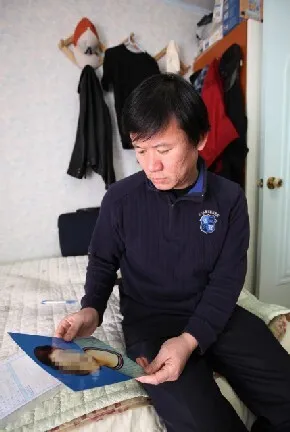
“Kim,” 40, is an ethnic Korean woman from China who works as an assistant at Korean fixed menu restaurant “G” in Seoul’s Yangjae-dong, Gangnam-gu. On the night of October 24, like any other time, she finished up her work putting the restaurant in order and laid her weary body down in a small room in the corner of the restaurant. How many hours had it been? A 28-year-old staff member at the same restaurant snuck in the restaurant door, threatened Kim with a sharp instrument and attempted to sexually assault her. Kim resisted vehemently, opening a third-floor window and jumping out of it. She lay at the brink of death with a skull fracture for 10 days before passing away. This happened not one month after she started working at the restaurant. Her husband, Nam In-su, 41, came running from China and beat his chest as he cried, “I told her before that it wasn’t safe to sleep in the restaurant, and because of that damn money...”
Kim, whose home was Yanji in China’s Jilin Province, came to Korea because of her son, 15. The son has multiple disabilities, suffering from cerebral palsy since birth. Kim wanted to send him to special education, which costs around 1,000 yuan per month, equivalent to over 200,000 won in Korean money. Nam said, “My wife always said she would have no regrets if she could just open a store or something for our son after teaching him letters and numbers.”
Kim slept at restaurants continuously after coming to Korea two years ago, as this allowed her to greatly reduce the burden of housing and transportation expenses. Many of her fellow ethnic Korean immigrants had prepared spaces in gosiwon (small rooms typically used by students for study) because of threats like sexual assault, but Kim is said to have rejected this, saying, “With that kind of money I could send my son to a special school.” Kim’s remains have lain in state at the morgue of the Samsung Medical Center in Seoul for over one month since her death. This is because the 30 million won in surgery costs and the expenses from the installation of her remains have not been resolved. With Chinese nationality, Kim does not qualify for relief from the government for crime victims, nor is her family in any position to demand compensation from the assailant, who is as penniless as Kim was. Nam said, “I didn’t know it would be this hard even for her to leave this sorry world behind.”
Migrant worker groups commented that a considerable number of ethnically Korean Chinese women essentially doing auxiliary work in Korean service industries are exposed to the danger of sexual assault when they resolve board and lodging issues by sleeping at their place of employment.
Reverend Kim Hae-sung, director of the Korean-Chinese Workers House, said, “We recently did a survey of 33 ethnically Korean Chinese women, and 19 of them answered that they had experienced sexual violence.” There has long been talk among ethnically Korean women about the dangers of eating and sleeping at workplaces like restaurants, but in many cases the assailants prevent them from saying anything by threatening to inform their families, Rev. Kim added.
Three of the six victims in the Gangnam gosiwon arson/murder incident last October were ethnically Korean Chinese women working at places such as nearby restaurants. Rev. Kim expressed concern, saying, “The foundation for ethnically Korean women’s livelihood itself is in a blind spot of safety and crime.”
Please direct questions or comments to [englishhani@hani.co.kr]
Editorial・opinion
![[Column] Even after Trump’s gone, the good old days aren’t coming back](https://flexible.img.hani.co.kr/flexible/normal/500/300/imgdb/original/2026/0319/7017739093246651.jpg "[Column] Even after Trump’s gone, the good old days aren’t coming back") [Column] Even after Trump’s gone, the good old days aren’t coming back
[Column] Even after Trump’s gone, the good old days aren’t coming back![[Editorial] Korea must rally nations to unite against Trump’s bullying](https://flexible.img.hani.co.kr/flexible/normal/500/300/imgdb/original/2026/0318/5317738209168584.jpg "[Editorial] Korea must rally nations to unite against Trump’s bullying") [Editorial] Korea must rally nations to unite against Trump’s bullying
[Editorial] Korea must rally nations to unite against Trump’s bullying- [Editorial] Korea must say no to sending soldiers into Trump’s war
- [Column] What do norms mean in times of war?
- [Column] The megalomanic dictator with tariffs in one hand, missiles in the other
- [Editorial] Korea can’t let US trade probes strong-arm it into concessions
- [Editorial] Trump’s baseless claim that Iran bombed girls’ school crosses line
- [Correspondent’s column] JD Vance’s 67-hour disappearance
- [Column] Withstanding Trump’s predatory hegemony
- [Editorial] US dragging Kurds into its war with Iran would be a disaster
Most viewed articles
- 1‘Golden’ acceptance speech interruption draws criticism over ‘disrespect’ at Oscars
- 2Former bodyguard’s dark tale of marriage to Samsung royalty
- 3[Column] Even after Trump’s gone, the good old days aren’t coming back
- 4Is Trump trying to use reverse psychology to get allies to support Iran war?
- 5Trump adviser causes stir by suggesting Israel might nuke Iran
- 6[Editorial] Korea must rally nations to unite against Trump’s bullying
- 7All study and no play makes Korean teens less physically active than their grandparents
- 8Energy facilities become latest targets in intensifying Middle East war
- 9BTS taps into history of ‘Arirang’ in teaser for new album
- 10Trump inflates USFK numbers, pressures Seoul to ‘defend’ US in Strait of Hormuz