hankyoreh
Links to other country sites 다른 나라 사이트 링크
Area by handball gym in Seoul’s Olympic Park turns into base for disorganized election denial movement

Democratic Party lawmakers visiting the protest at the handball stadium at Olympic Park, in Seoul’s Songpa District, had to beat a hasty retreat.
After meeting with members of the Korean Sport & Olympic Committee and sports organizations with offices at the handball stadium, Reps. Cheon Jun-ho, Jeon Yong-gi and Lim O-kyeong approached the blockaded Gate 2-1 that sports organization employees unsuccessfully tried to enter the previous day.
But protesters rushed over and soon surrounded the lawmakers.
“Where do you think you’re trying to sneak into?” angry protesters shouted. “Commies like you should go back to North Korea.”
The blockade of the ballot counting center, which was set off by the unprecedented shortage of ballots at multiple polling stations during Korea’s June 3 local elections, is now in its 13th day. In effect, the protest has escalated into a standoff with no end in sight.
On Wednesday, sports group employees were unable to access their offices at the handball stadium, preventing groups unrelated to the debate from carrying out administrative work and disrupting athletic operations.
Since the protest has no leaders or organizers, there’s nobody with whom to discuss gaining access to the offices. That suggests the standoff will continue, with no sign of an offramp.
Organizations affiliated with the Korean Sport & Olympic Committee are struggling to help Korean teams prepare to compete in international tournaments.
A spokesperson for the Korea Underwater Association said that as of Wednesday, employees were still unable to retrieve materials needed for the CMAS World Championship Finswimming Indoor, a tournament that is being held in Incheon on June 22.
The previous day, the Korean national fencing team, which could not collect personal equipment because of the protest, had to borrow equipment from other sources before leaving the country for an Asian competition.
“We are also patriots and citizens with the right to vote. We ask that you pay heed to the voices of sports groups fighting for their very survival and permit us to do the bare minimum of administrative work,” said Ryu Seung-min, the president of the Korean Sport & Olympic Committee, during a radio interview on Wednesday.
But since nobody is organizing the protests, the police and sports groups are struggling to find meaningful counterparts for the negotiations.
The previous day, lawmakers from the main opposition People Power Party arranged for sports organization employees to enter the building through talks with some of the protestors. But that initiative was foiled when another protester wearing an American flag like a skirt physically blocked the entrance.
“It’s a chaotic situation: there’s no leadership among the protesters, and the positions of the young people, YouTubers and far-right-leaning older adults are constantly in tension. When we make an effort to deliberate with one group, other people will show up and dispute their right to negotiate, which sends us back to square one,” a member of a sports organization complained.
The protesters initially wanted the ballot boxes to be inspected. But their slogans have gone beyond “hold a revote” to “investigate election fraud” and “hold a joint investigation with the US.”
As a result, the area around Olympic Park has become ground zero of election denialism in Korea.
On Wednesday, a 30-something woman in a red hat stood at the exit leading to the handball stadium at Olympic Park station on the Seoul Metro, where she held court on the supposed election fraud with protesters in their 60s and 70s.
“The balloting machines used by the National Election Commission contain the same chips used in casinos. Those chips are totally susceptible to hacking and manipulation, which is evidence that election fraud occurred,” the woman said, arousing cheers from the crowd.
There was an altercation during a speech by far-right YouTuber Jeon Han-gil, who said that “everybody who attempts to sweep election fraud under the rug is a public enemy.” Enthusiastic protesters dragged off a middle-aged man who was raising objections to Jeon’s claims.
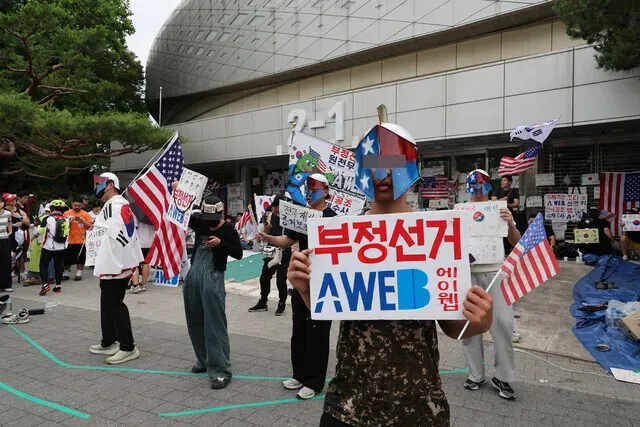
As more people outraged over voters’ disenfranchisement are fed up with the situation at the protest and the wild claims being floated there, the protesters seem to be splintering into different groups.
In a 330-member chatroom organized to protest voters’ disenfranchisement, there is constant bickering between those who want to focus on the shoddy election management rather than conspiracy theories about election-rigging and those who maintain there’s a real possibility of election fraud.
“Whatever your opinion, it was a mistake not to even hand over equipment to fencing athletes who were leaving for the Asian games,” said a 72-year-old individual surnamed Lee who joined the protest at Olympic Park on Wednesday for the first time.
Experts stressed that while the political establishment ought to work harder to seek a solution to the standoff, the authorities should deal firmly with unacceptable behavior by the protesters.
“The best scenario is for the National Assembly to move together to reach a bipartisan agreement. The National Assembly needs to take the lead in investigating the incident and developing preventive measures that will be acceptable to the protesters,” said Seol Dong-hoon, a professor of sociology at Jeonbuk National University.
“Even attempting to negotiate with individuals who could be seen as engaging in illegal acts [such as violence and disruption of business operations] could be seen as providing them with legitimacy. Police commanders on the scene should be given the discretion to take positive action in response to illegal situations,” said Jeon Sang-jin, a professor of sociology at Sogang University.
By Chung In-seon, staff reporter; Jeong Bong-bi, staff reporter; Cho Hae-yeong, staff reporter
Please direct questions or comments to [english@hani.co.kr]

Editorial・opinion
![[Editorial] Intelligence rift between Korea, US cannot be allowed to fester](https://flexible.img.hani.co.kr/flexible/normal/500/300/imgdb/original/2026/1011/9017916830932185.jpg "[Editorial] Intelligence rift between Korea, US cannot be allowed to fester") [Editorial] Intelligence rift between Korea, US cannot be allowed to fester
[Editorial] Intelligence rift between Korea, US cannot be allowed to fester![[Column] A glimmer of hope for inter-Korean dialogue from Kim Yo-jong](https://flexible.img.hani.co.kr/flexible/normal/500/300/imgdb/original/2026/1009/9317915093130011.jpg "[Column] A glimmer of hope for inter-Korean dialogue from Kim Yo-jong") [Column] A glimmer of hope for inter-Korean dialogue from Kim Yo-jong
[Column] A glimmer of hope for inter-Korean dialogue from Kim Yo-jong- [Column] US and Korea: From an alliance of values to an alliance of extortion
- [Editorial] Top priority in North Korean POW case should be human rights, not politics
- [Column] Fixing the blurred border between South and North Korea
- [Editorial] Shark sighting in Busan is a warning from nature
- [Column] Is AI about to destroy humanity?
- [Column] Harari’s 2030s: A new age of repressive desublimation
- [Guest essay] This Chuseok, think of the seasonal workers who plant and pick your food
- [Editorial] To build back public confidence, Lee must address issues affecting everyday Koreans
Most viewed articles
- 1North Korea stresses irreversible nuclear power status before UN
- 2[Editorial] Intelligence rift between Korea, US cannot be allowed to fester
- 3One border, 3 lines: Why another DMZ mine blast could be waiting to happen
- 4This Korean professor’s words at his former student’s lesbian wedding will warm your heart
- 5[Column] A glimmer of hope for inter-Korean dialogue from Kim Yo-jong
- 6South Korea’s recall of Ukraine envoy raises stakes in diplomatic dispute
- 7Moon has phone conversation with Xi Jinping ahead of his call with Biden
- 8Korean anti-war activist captured by Israel says she was beaten, causing partial hearing loss
- 9Seoul to recall ambassador to Ukraine amid feud over North Korean POW disclosure
- 10Lee underscores ‘self-reliant defense’ after successful launch of homegrown HGV