hankyoreh
Links to other country sites 다른 나라 사이트 링크
Yoon becomes first Korean president convicted of treason for sending drones to Pyongyang
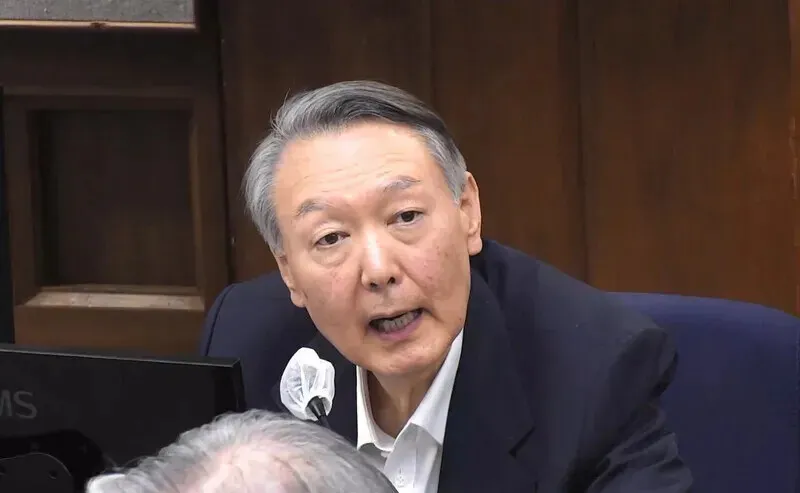
The court’s decision to hand a heavy sentence to former South Korean President Yoon Suk-yeol for ordering unmanned drones to infiltrate Pyongyang to elicit a reaction and thus manufacture a pretext for declaring martial law is expected to have implications for his appeal in his insurrection case, where key details, including the timing of his decision to impose martial law, are still being contested.
As this marks the first time in Korea’s modern history that its commander-in-chief has been found guilty of treason, the forthcoming rulings by the appellate court and the Supreme Court are expected to garner significant attention.
On Friday, the Seoul Central District Court found Yoon guilty of the charge of “benefiting the enemy,” which falls under treason in Korea’s criminal code, and sentenced him to 30 years behind bars. Convicted alongside the disgraced former president was Kim Yong-hyun, his defense minister at the time of the insurrection, who also received a sentence of 30 years.
The court concluded that the operation to send drones into Pyongyang had been an operation conducted to achieve private objectives — namely, to provide the grounds for the declaration of martial law — not a justifiable response to North Korea’s provocations in the form of trash-filled balloons.
As such, the court found that Yoon attempted to provoke North Korea into an armed response to deliberately create a state of emergency to justify a declaration of martial law.
The court further found that this resulted in the unnecessary depletion of South Korean military resources and the exposure of South Korea’s military capabilities to the North following the crash of those drones, thereby harming Seoul’s military interests, which is a key factor in identifying treasonous offenses.
This ruling is expected to influence Yoon and others’ appeals in their trial on charges of orchestrating an insurrection with their abortive self-coup on Dec. 3, 2024. In that case, the lower court had determined that the decision to declare martial law was made on Dec. 1, 2024.
However, this more recent court decision effectively moved up the timeline by three months when it acknowledged that Yoon had been actively pursuing measures to set the stage for a martial law declaration since at least September 2024 by preparing for the drone incursions in October and November of that year.
When Yoon was first indicted on charges of insurrection, the special counsel team investigating him had accused him of plotting to declare martial law as early as October 2023.
The current independent probe led by special counsel Kwon Chang-young is also investigating the insurrection case under the belief that Yoon and his accomplices had begun laying the groundwork for martial law starting in November 2023.
An official with the special counsel team investigating the insurrection told the Hankyoreh that the ruling was “significant” in part because it had “clearly established that the drone operations were part of the preliminary stage of the insurrection.”
“The lower court in the insurrection case concluded that Yoon decided to exercise emergency powers shortly before the declaration of martial law, citing the deadlock within the National Assembly as justification. This ruling, however, reached a different conclusion and is expected to have an impact on other trials related to the insurrection,” they added.
Legal experts have interpreted the ruling as underscoring the perceived severity of Yoon’s drone scheme.
“If Yoon had limited himself to the kinds of standard measures expected of a commander-in-chief, a treason conviction would have been unlikely. The court, however, found that the president and the defense minister — both responsible for national security and public safety — put those very interests at risk for political ends,” assessed Yang Hong-seok, an attorney.
This ruling is the first to acknowledge that pushing South Korea to the precipice of military conflict constitutes “benefiting the enemy.” In prior treason cases, most involved providing direct military benefits to North Korea. This point is expected to be hotly contested during the appeal trial.
“As this is the first time that a president has been found guilty of benefiting an enemy, a dispute over the logic behind the lower court’s judgment on what constitutes ‘benefiting the enemy’ is expected in the appellate trial,” one presiding judge in the metropolitan area pointed out.
Yoon’s legal team immediately filed for an appeal.
“This ruling has completely shunned the reality behind South Korea’s state of security, and the country’s principal duty to safeguard the liberal democratic system,” his legal representatives said.
By Kim Su-yeon, staff reporter; Park Ji-young, staff reporter
Please direct questions or comments to [english@hani.co.kr]

Editorial・opinion
![[Column] Japan and South Korea: An alliance of middle powers?](https://flexible.img.hani.co.kr/flexible/normal/500/300/imgdb/original/2026/0615/4017815116945786.jpg "[Column] Japan and South Korea: An alliance of middle powers?") [Column] Japan and South Korea: An alliance of middle powers?
[Column] Japan and South Korea: An alliance of middle powers?![[Editorial] Korea must use G7 summit to band together with fellow middle powers](https://flexible.img.hani.co.kr/flexible/normal/500/300/imgdb/original/2026/0615/5817815111712322.jpg "[Editorial] Korea must use G7 summit to band together with fellow middle powers") [Editorial] Korea must use G7 summit to band together with fellow middle powers
[Editorial] Korea must use G7 summit to band together with fellow middle powers- [Editorial] Sinking Korean youth employment in AI era requires action, and fast
- [Editorial] Korean students show how to protest ballot fiasco without resorting to conspiracies
- [Column] What do people crying election fraud in Korea even want?
- [Column] Once security assets, US bases are now liabilities to host countries
- [Column] Takaichi is putting Japan’s constitution in crisis
- [Editorial] Losing Seoul mayor’s race should be a wakeup call for Democrats
- [Column] Naming the enemy: The unsettling return of ideological litmus tests in Korea
- [Editorial] No excusing ballot shortage fiasco
Most viewed articles
- 1[Column] Japan and South Korea: An alliance of middle powers?
- 2Korean court rules same-sex union entitled to legal protection in homewrecker suit
- 3[Editorial] For a traitor like Yoon, even 30 years is too lenient
- 4[Editorial] Korea must use G7 summit to band together with fellow middle powers
- 5On anniversary of first inter-Korean joint declaration, Lee says peace is still within reach
- 6Yoon becomes first Korean president convicted of treason for sending drones to Pyongyang
- 7Lee rebukes election fraud claims as ‘absurd conspiracy theories’ and ‘anti-social behavior’
- 8Trump says US has reached deal with Iran, set to be signed on Friday
- 9Record fine for Coupang is only the beginning of its troubles
- 10[Editorial] Sinking Korean youth employment in AI era requires action, and fast