hankyoreh
Links to other country sites 다른 나라 사이트 링크
Forecast for Seoul-Tokyo ties in the Takaichi era: Clear skies for now with storm clouds on horizon
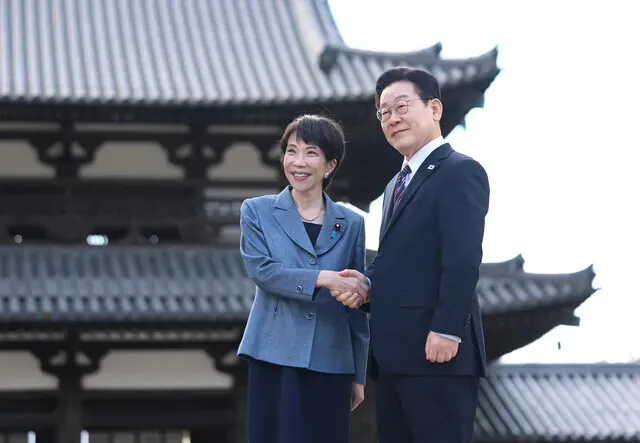
An advocate of building a “strong Japan,” Prime Minister Sanae Takaichi led her Liberal Democratic Party (LDP) to a historic victory in Sunday’s snap parliamentary election. Observers say that this may bode well for Seoul-Tokyo relations in the short term, but is likely to spell trouble down the line.
South Korean President Lee Jae Myung posted on the social media site X on Monday: “I sincerely congratulate [Prime Minister Sanae Takaichi] on the electoral victory in the House of Representatives.”
“During our summit in Nara in January, our countries took the first step toward the next 60 years of a new era. I hope that, going forward, our two countries can cooperate more widely, more deeply based on the trust and bond that we share,” he added.
Speculation abounds regarding how the mandate given to Takaichi, with the LDP taking 316 out of 465 lower house seats, will impact Korea-Japan relations and the diplomatic landscape.
In the meantime, Lee has expressed his intentions to manage bilateral relations through mutual trust established through a restoration of shuttle diplomacy.
Experts predict that despite the landslide parliamentary victory, Takaichi will not do anything to harm or strain relations with Korea. The short-term forecast for bilateral relations in the wake of Takaichi’s overwhelming victory is “clear skies.”
“The recent victory is not a result of anything Takaichi has achieved. A lot of it is hype based on expectations,” assessed Kim Suk-hyun, a senior researcher at the Institute for National Security Strategy.
“Prime Minister Takaichi must first concentrate on reviving the economy, the primary interest among voters. As conflicts between Japan and China intensify, she is likely to refrain from any acts that worsen relations with Korea and drive Korea into the arms of China,” he added.
Cho Yang-hyun, a professor at the Korea National Diplomatic Academy, suggested that recent improvements in Seoul-Tokyo relations mean that flashpoints are likely to be more manageable for the time being.
“The rightward shift of Japan is becoming increasingly clear, but mutual trust with Korea has been established to a certain extent through the shuttle diplomacy of both leaders, so points of conflict can be managed,” Cho noted. “Amid Japan’s clash with China and uncertainties tied to the administration of US President Donald Trump, the structural incentives for Korea-Japan cooperation have increased.”
Regarding concerns about Japan amending its pacifist constitution and about Takaichi visiting Yasukuni Shrine, many observers predict that the prime minister won’t make aggressive moves in the short term.
Takaichi and the LDP have secured the requisite two-thirds of seats in the Japanese House of Representatives (lower house) to approve a constitutional amendment, but the LDP is still a minority in the House of Councillors (upper house), which must also approve constitutional revisions by a two-thirds majority.
There are no immediate political events on the immediate horizon, so there’s no reason for Takaichi to visit Yasukuni to rally the already rallied conservatives.
The upcoming event most likely to test diplomacy with Korea is “Takeshima Day” — a day dedicated to Japan’s claim on the Korean island of Dokdo — which falls on Feb. 22. So far, the Japanese government has not sent officials above the deputy minister level to relevant ceremonies. Analysts say Takaichi is unlikely to break from this convention.
However, Takaichi has expressed intentions to amend the pacifist Article 9 of Japan’s constitution, rearm the country, and revise its three non-nuclear principles, which currently prohibit Japan from possessing or making nuclear weapons or even letting them into the country.
These factors suggest stormy weather ahead in the long term.
“While the LDP’s landslide victory poses no immediate threats to Korea-Japan relations, it creates incredibly complicated structures in the long term,” commented Kim Suk-hyun.
The researcher went on to express concerns about Takaichi’s moves to bolster deterrence against China by fortifying the trilateral alliance with the US and South Korea, which will put the latter party in a position of having to make a difficult decision.
“To deter China, Takaichi will bring in the US and strongly insist on trilateral military cooperation with the US and Korea. China will emphasize the ‘resistance’ narrative against Japan to draw in Korea and impede such trilateral cooperation,” he added.
“Korea needs to maintain a good balance in its relations with both Japan and China,” he concluded.
Lee’s emphasis on Korea’s bilateral cooperation with Japan and trilateral cooperation with the US, while highlighting the need to find “common ground” between Korea, China and Japan, during his summit with Takaichi last month, is likely to serve as an important guidepost for his diplomatic approach going forward.
By Park Min-hee, senior staff writer; Goh Gyoung-ju, staff reporter
Please direct questions or comments to [english@hani.co.kr]

Editorial・opinion
![[Column] Negotiating with bombs](https://flexible.img.hani.co.kr/flexible/normal/500/300/imgdb/original/2026/0406/7717754651470434.jpg "[Column] Negotiating with bombs") [Column] Negotiating with bombs
[Column] Negotiating with bombs![[Column] What the debate over Atlas and robots in factories missed](https://flexible.img.hani.co.kr/flexible/normal/500/300/imgdb/original/2026/0405/4917753549834215.jpg "[Column] What the debate over Atlas and robots in factories missed") [Column] What the debate over Atlas and robots in factories missed
[Column] What the debate over Atlas and robots in factories missed- [Editorial] There’s no more relying on US after Iran war
- [Column] A year on from ‘Liberation Day,’ is America any greater?
- [Editorial] US threat to ‘reexamine’ NATO shows Korea can’t delay defense self-reliance
- [Column] Was Seoul’s choice to pursue dialogue, not war, in 1994 a ‘strategic error’?
- [Column] Is the PPP’s far-right shift a path to self-destruction
- [Column] Putin, Trump and Netanyahu: All tactics, no strategy
- [Column] Iran war heralds a new age of every country for itself
- [Editorial] Another avoidable factory fire kills 14 in Daejeon
Most viewed articles
- 1Trump extends deadline for Iran to open Strait of Hormuz by one day
- 2[Exclusive] Korea’s Lee orders review of humanitarian aid for Iran to extricate stranded ships
- 3‘Somebody stop this madman’: Strikes on nuclear plants raise risk of disaster in Iran
- 4Approval of China’s leadership outstrips that of US by largest margin seen yet
- 5[Column] Is “Afghan Girl” doing well?
- 6Lee says Korea will reduce burden on US by boosting defense spending, regaining OPCON
- 7South Korean military chopper accidentally entered DMZ while fighting fire in March
- 8Team behind ‘KPop Demon Hunters’ say sequel will center ‘Koreanness’
- 9[Column] Negotiating with bombs
- 10[Korea travels] Spring is in the air in Donghae, where ocean vistas take your breath away