hankyoreh
Links to other country sites 다른 나라 사이트 링크
Coupang trawled workers’ health records to dodge blame for death tied to overwork
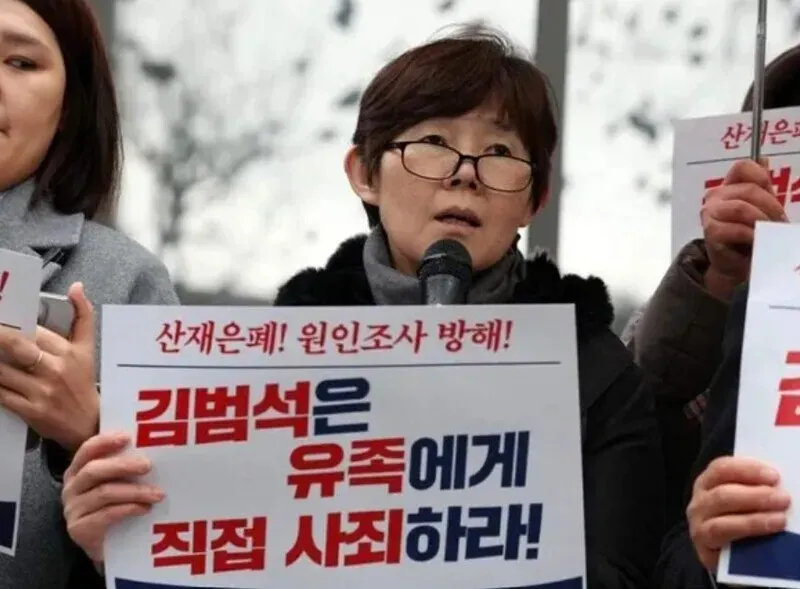
South Korean e-commerce giant Coupang rifled through employees’ health exam records in an effort to refute the claim that overwork caused the October 2020 death of Jang Deok-jun, an individual who worked night shifts at a Coupang logistics center. That move likely violated several laws, including the Personal Information Protection Act.
Internal emails dated Nov. 9-11, 2020, obtained by the Hankyoreh on Wednesday, show a conversation between multiple Coupang executives, including Lee Young-mok, who was head of PR at the time and now serves as vice president; and Eom Sung-hwan, the CEO of Coupang Fulfillment Services (CFS) at the time, who now serves as the Coupang subsidiary’s HR chief.
“The key point of contention in the Daegu case raised by the emergency committee representing courier workers and the bereaved family is that Jang lost 15 kg during his employment,” Lee wrote to Eom.
“Is there a way to verify the yearly weight changes experienced by contract workers at the logistics center who underwent physical examinations?” Lee then asked.
Eom forwarded this email to the head of health and safety at CFS, asking if they could “try to verify.”
At the time, the deceased worker’s family was claiming that Jang’s weight dropped from 75 kg to 60 kg after working excessive hours as a non-regular worker on night shifts for 16 months.
The head of health and safety at CFS ordered a health and safety officer at the company’s logistics center in Daegu, where Jang died, to “review the physical exam data for contracted and regular employees who worked as ‘waters’ and ‘pickers’ [the role Jang performed], then compile and send over the data recording weight change.”
The next day, the Daegu safety and health officer later sent an email to his supervisor with the following:
“Here are changes in weight and obesity level documented by the records from the regular off-site health screenings in October 2019 and August 2020. Currently, there are about 40 regular employees working the afternoon and late-night shifts on the outbound side [working on the seventh floor of the Daegu logistics center]. Except for two individuals, most have gained weight.”
Under the Personal Information Protection Act, information pertaining to physical health is classified as “sensitive information.” Such information should be treated with caution and can only be used with the consent of the individual in question or in situations stipulated by law. The misuse of such data can be considered a violation of the Occupational Safety and Health Act, as the act prohibits the use of health examination results for any purpose other than protecting and maintaining the health of employees.
“The Occupational Safety and Health Act stipulates that employers are provided with the results of health examinations of their workers to ensure support for workers who show abnormalities. Using those results to argue that one worker’s illness was not caused by labor constitutes misuse and violates that very law,” commented certified public labor attorney Kwon Dong-hee, of Work and Human Law Office.
There are also indications that Coupang executives were aware of the illegality of this behavior. An email sent by Lee to the Daegu logistics center’s health and safety officer on Nov. 11, 2020, reads: “Following a review by the legal department regarding access to materials, the immediate disposal of documents related to physical examinations is advised.”
However, Coupang continued to abuse private health check-up data. When addressing the lawsuit for damages filed against it, CFS submitted data analyzing the weight change of 80 regular and non-regular workers from 2021 to 2023 to the court, to address the bereaved family’s claim that Jang suffered from severe weight loss during his employment.
At the time, CFS used the physical examination results of Jang’s colleagues, along with his Coupang and food delivery order history, to argue that Jang’s death was caused by “excessive dieting.”
When reached for comment on the allegations surrounding the unauthorized use of physical checkup data, CFS responded, “We are cooperating faithfully with relevant investigators.”
CFS has yet to reveal whether it obtained employee consent when submitting the examination results to the court.
By Park Tae-woo, staff reporter
Please direct questions or comments to [english@hani.co.kr]

Editorial・opinion
![[Editorial] Trump’s baseless claim that Iran bombed girls’ school crosses line](https://flexible.img.hani.co.kr/flexible/normal/500/300/imgdb/original/2026/0309/4217730446901883.jpg "[Editorial] Trump’s baseless claim that Iran bombed girls’ school crosses line") [Editorial] Trump’s baseless claim that Iran bombed girls’ school crosses line
[Editorial] Trump’s baseless claim that Iran bombed girls’ school crosses line![[Correspondent’s column] JD Vance’s 67-hour disappearance](https://flexible.img.hani.co.kr/flexible/normal/500/300/imgdb/original/2026/0306/2517727866984907.jpg "[Correspondent’s column] JD Vance’s 67-hour disappearance") [Correspondent’s column] JD Vance’s 67-hour disappearance
[Correspondent’s column] JD Vance’s 67-hour disappearance- [Column] Withstanding Trump’s predatory hegemony
- [Editorial] US dragging Kurds into its war with Iran would be a disaster
- [Column] US allies in the Gulf are in flames. Can Korea avoid a similar fate?
- [Editorial] North Korea’s tough talk mustn’t deter Seoul’s efforts to rebuild trust
- [Editorial] Attack on Iranian girls’ school is an indefensible crime against humanity
- [Editorial] Trump’s unjustified war with Iran threatens chaos for us all
- [Column] What a Korean man’s foiled plan to seek assisted death in Switzerland reveals
- [Column] This is what accountability looks like
Most viewed articles
- 1Korea named as target of new Section 301 probe by US
- 2‘Made in USA’: Scraps of missile that killed Iranian children point to US responsibility
- 3[Editorial] No greater sign that South Korea must prioritize building its own defense abilities
- 4US may seek exit from Iran war by moving the goalposts of victory
- 5US Democrats say Trump’s investment pressure has ‘deeply unsettled’ alliance with Seoul
- 6[Column] Misconceptions about America’s war with Iran
- 765% of Korean men say gender equality has gone ‘far enough’; only 42% of women agree
- 8How much is the US willing to risk for the Strait of Hormuz?
- 9Coupang investors insinuate that US is planning Section 301 probe into Korea
- 10[News analysis] Air defense pullout signals new era of US strategic flexibility in Korea