hankyoreh
Links to other country sites 다른 나라 사이트 링크
Tariff hike looms for Korea as trade minister returns from talks in US empty-handed
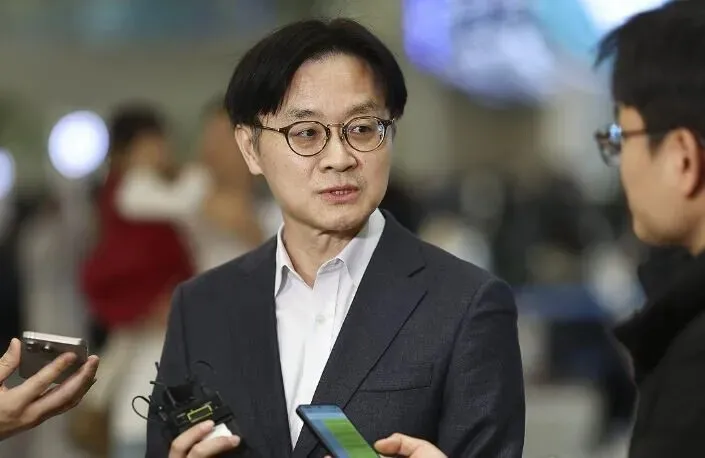
South Korean Trade and Industry Minister Kim Jung-kwan returned to Korea empty-handed after two meetings with US Commerce Secretary Howard Lutnick failed to reach tangible results on the threat of increased tariffs on Korean goods entering the US.
While both sides agreed to continue negotiations, uncertainty remains as there's no telling if US President Donald Trump will follow through on his threat to hike tariffs on Korea.
Kim returned to South Korea via Incheon International Airport on Saturday after meeting with Lutnick on Thursday and Friday in Washington, DC.
Speaking to reporters at the airport, Kim said that his talks with Lutnick provided an “opportunity to deepen mutual understanding,” in regard to Trump’s threat on Jan. 26 that he would raise the tariff on Korean goods entering the US from 15% to 25% over delays in the passage of legislation facilitating investments in the US.
“I think all unnecessary misunderstandings were resolved,” he said.
“I sufficiently explained to [Lutnick] that [the Korean government] has no intention of not implementing our trade agreement or of delaying any relevant procedures,” Kim said.
Kim said that he explained to Lutnick that the National Assembly hasn’t had time to discuss the legislation in question because of standard end-of-year and new-year budget priorities, as well as hearings for Lee’s nominee for the budget and planning minister.
“I told him that the legislation will go through very quickly and that our interests will align with US’ interests going forward,” he added.
Kim’s remarks suggest that the US has, to a certain degree, accepted Seoul’s explanation that legislation regarding the US$350 billion that South Korea has pledged to invest in the US is not being delayed or stalled deliberately.
However, Kim had vowed to “call for a favorable resolution” ahead of his visit to the US, yet returned to Korea without securing any promises or agreements to withhold or withdraw the tariff hike.
“Regarding progress on Korea’s part, there was a considerable amount of frustration expressed regarding the legislation pending for so long in the National Assembly,” Kim acknowledged, hinting that Lutnick and US representatives expressed strong discontent over the legislation not being passed.
In response to a question about whether the US is actually preparing to implement the tariff hike, Kim said that measures to raise tariffs are “already in motion,” adding, “They are drafting statements to run in the government gazette and preparing sanctions.”
“We are planning to hold a video conference with [Lutnick] pretty soon after a round of internal discussions,” Kim said.
When asked about whether legislation aimed at regulating online platforms or the government response to the leak of customer data by Coupang had influenced the US’ announcement, Kim responded that those issues “didn’t come up once” during his conversation with Lutnick.
“I think they have determined that such issues are not significant enough to impact tariffs,” he added.
When considering Kim’s remarks alongside remarks from key insiders in the Trump administration, the US seems to be calling for a swift legislative resolution and the quick implementation of the pledged investments by applying pressure through tariff hikes.
The key issue, then, is whether or not the National Assembly will pass the special act on strategic investments in the US without further delay. The legislation was introduced to the National Assembly in November of last year.
Even during congratulatory remarks during an event to celebrate the art collection of former Samsung Chairman Lee Kun-hee, hosted by the Smithsonian’s National Museum of Asian Art in Washington, DC, on Jan. 28, Lutnick remarked that he’s looking forward to the Korean National Assembly taking the pertinent measures for the implementation of trade agreements.
During a Cabinet meeting on Thursday, Trump remarked that the tariffs are “steep” but that they “could be much steeper.” The remarks can be seen as a threat directed toward trade partners, including South Korea.
The Lee administration’s stance is that it expects the legislation on US investments to be passed by the National Assembly in mid-February. Han Jeoung-ae, the chair of the Democratic Party’s policy committee, announced during a press conference on Sunday that the party would work to pass the legislation before the end of the month at the earliest.
“Once the bill is submitted [to the National Assembly’s Finance, Economy, Planning and Budget Committee] and relayed to the relevant subcommittee, it becomes sufficiently possible for the Finance, Economy, Planning and Budget Committee to begin discussions about the special act on investments in the US,” Han said.
“I dare say the bill will be passed [during a plenary session] sometime around the end of February or early March. If possible, I will work to ensure that we stick to such a schedule,” she added.
Regarding the US not backing down on its tariff hikes, Han said she felt the US government was “perhaps creating unnecessary conflict.”
“If they continue with methods that suddenly raise tariff rates because a bill was not quickly [passed], then we cannot help but harbor concerns about whether we can keep our promises outlined in the US-ROK MOU and joint fact sheet,” Han said, calling the situation “incredibly concerning.”
Meanwhile, Minister for Trade Yeo Han-koo landed in the US on Friday. He is currently engaged in negotiations regarding tariffs and non-tariff trade barriers with the US administration and Congress.
By Lee Bon-young, senior staff writer; Ki Min-do, staff reporter
Please direct questions or comments to [english@hani.co.kr]

Editorial・opinion
![[Editorial] Top priority in North Korean POW case should be human rights, not politics](https://flexible.img.hani.co.kr/flexible/normal/500/300/imgdb/original/2026/0928/6117905733887763.jpg "[Editorial] Top priority in North Korean POW case should be human rights, not politics") [Editorial] Top priority in North Korean POW case should be human rights, not politics
[Editorial] Top priority in North Korean POW case should be human rights, not politics![[Column] Fixing the blurred border between South and North Korea](https://flexible.img.hani.co.kr/flexible/normal/500/300/imgdb/original/2026/0928/8617905750498627.jpg "[Column] Fixing the blurred border between South and North Korea") [Column] Fixing the blurred border between South and North Korea
[Column] Fixing the blurred border between South and North Korea- [Editorial] Shark sighting in Busan is a warning from nature
- [Column] Is AI about to destroy humanity?
- [Column] Harari’s 2030s: A new age of repressive desublimation
- [Guest essay] This Chuseok, think of the seasonal workers who plant and pick your food
- [Editorial] To build back public confidence, Lee must address issues affecting everyday Koreans
- [Column] Korea-Japan cooperation still has a long way to go
- Trump has taken a wrecking ball to America’s democratic institutions
- [Column] Sending troops to Hormuz would be a fatal miscalculation by Seoul
Most viewed articles
- 1Kyiv was first to request confidentiality in North Korean POW transfer, Seoul’s NIS says
- 2Less than half of South Koreans see need to reunify with North, survey finds
- 3Tensions mount over DMZ mine blast as North Korea alludes to military response
- 4How to interpret North Korea’s response to explosions in the DMZ
- 5Trump gloats over Korean investment in Alaska LNG project still under review by Seoul
- 6[News analysis] Trump’s Alaska LNG project announcement smacks of midterm anxiety
- 7[Photo] Annual “prettiest postcard” contest for Hangul Day
- 8S. Korean chaebols comprise 84% of GDP but only 10% of jobs
- 9[Exclusive] Seoul will need 16% rate of return on US investments to recoup principal
- 10Lee’s approach runs risk of normalizing North Korea as a nuclear power