hankyoreh
Links to other country sites 다른 나라 사이트 링크
Lee shares vision for ‘great transformation’ to peace and stable growth in 2026
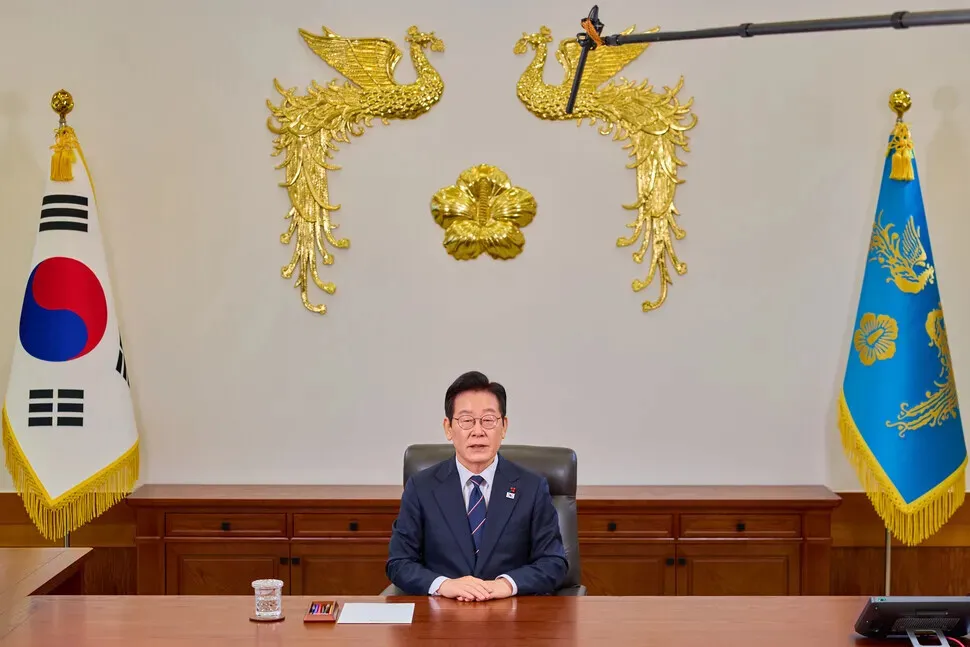
President Lee Jae Myung pledged that in 2026, Korea would move from “unstable growth” under the threat of war to “stable growth” supported by peace.
“As a ‘pacemaker,’ we will actively support the resumption of North Korea-US talks and continue pursuing the restoration of inter-Korean relations this year,” Lee said in his 2026 New Year’s address on Thursday. “Steadfast peace is synonymous with growth, and robust security is the driving force behind prosperity.”
Lee’s remarks suggest his administration will back US President Donald Trump’s hopes of arranging a summit with North Korea around the time of his visit to China in April.
“By converting the cost of hostility into the dividends of peace, we can transform the current ‘Korea risk’ into a ‘Korea premium”’ in the future,” Lee said, adding that the government is “steadfastly implementing measures to ease military tensions and restore trust between the two Koreas and is building consensus with the international community, including the United States and China, on peace and stability on the Korean Peninsula.”
Lee reiterated his desire for 2026 to be “the first year of a great leap forward for the Republic of Korea.”
“We will ensure that the fruits of growth achieved through this giant leap are shared by all, rather than monopolized by a privileged few. To this end, we will make all-out efforts to eliminate the rule-bending and unfair practices that persist throughout society and devote ourselves to building a society free of deceit and unjust privilege,” he said.
During the same speech, Lee outlined “five paths” for this transformation.
First, Lee said he would lead a shift from Seoul-centered growth to regionally led growth.
“Transitioning from a ‘unipolar, Seoul-centered model’ to a ‘five-pole, three specialized-zone framework’ is not a favor to the provinces — it is an essential strategy for national resurgence. The farther a region lies from the Seoul metropolitan area, the stronger and more decisive the support it will receive,” he promised.
Lee added that he would design a system in which regional development is driven by high-tech industrial development, from AI testbed cities and renewable energy clusters to a semiconductor belt in the energy-rich south.
In the speech, Lee emphasized that growth should benefit everybody.
“Although the nation united behind the successful conclusion of tariff negotiations with the United States, it is undeniable that the immediate benefits will be concentrated among certain large corporations,” Lee acknowledged. “Now, the gains achieved through collective national effort must reach SMEs and startups and ultimately translate into tangible benefits for all citizens.”
“As we transition from an employment-focused society to a startup-driven one, the government will spare no effort in enabling young entrepreneurs and business founders to take bold risks and pioneer new paths of innovation,” the Korean president said.
Lee also made a point of emphasizing safety in his New Year’s message.
Noting that Korea has “the highest rate of industrial fatalities among OECD countries,” the president asked, “What meaning does growth hold if family members leave home in the morning and never return in the evening?”
“The costs and consequences of neglecting human life must be made far greater than they are today,” he said.
“We will ensure that safe working environments and a culture of respect for life take firm root by increasing the number of labor inspectors by 2,000 and introducing a new workplace safety guardian system.”
The president further stressed a “great transformation from product-driven growth to attractive growth led by culture.”
“To ensure K-culture does not remain a passing fad, we will strengthen the entire cultural ecosystem, including the fine arts that underpin popular culture,” the president said.
By Seo Young-ji, staff reporter
Please direct questions or comments to [english@hani.co.kr]

Editorial・opinion
![[Editorial] Trump’s baseless claim that Iran bombed girls’ school crosses line](https://flexible.img.hani.co.kr/flexible/normal/500/300/imgdb/original/2026/0309/4217730446901883.jpg "[Editorial] Trump’s baseless claim that Iran bombed girls’ school crosses line") [Editorial] Trump’s baseless claim that Iran bombed girls’ school crosses line
[Editorial] Trump’s baseless claim that Iran bombed girls’ school crosses line![[Correspondent’s column] JD Vance’s 67-hour disappearance](https://flexible.img.hani.co.kr/flexible/normal/500/300/imgdb/original/2026/0306/2517727866984907.jpg "[Correspondent’s column] JD Vance’s 67-hour disappearance") [Correspondent’s column] JD Vance’s 67-hour disappearance
[Correspondent’s column] JD Vance’s 67-hour disappearance- [Column] Withstanding Trump’s predatory hegemony
- [Editorial] US dragging Kurds into its war with Iran would be a disaster
- [Column] US allies in the Gulf are in flames. Can Korea avoid a similar fate?
- [Editorial] North Korea’s tough talk mustn’t deter Seoul’s efforts to rebuild trust
- [Editorial] Attack on Iranian girls’ school is an indefensible crime against humanity
- [Editorial] Trump’s unjustified war with Iran threatens chaos for us all
- [Column] What a Korean man’s foiled plan to seek assisted death in Switzerland reveals
- [Column] This is what accountability looks like
Most viewed articles
- 1Korea named as target of new Section 301 probe by US
- 2‘Made in USA’: Scraps of missile that killed Iranian children point to US responsibility
- 3[Editorial] No greater sign that South Korea must prioritize building its own defense abilities
- 4US may seek exit from Iran war by moving the goalposts of victory
- 5US Democrats say Trump’s investment pressure has ‘deeply unsettled’ alliance with Seoul
- 6[Column] Misconceptions about America’s war with Iran
- 765% of Korean men say gender equality has gone ‘far enough’; only 42% of women agree
- 8How much is the US willing to risk for the Strait of Hormuz?
- 9Coupang investors insinuate that US is planning Section 301 probe into Korea
- 10[News analysis] Air defense pullout signals new era of US strategic flexibility in Korea