hankyoreh
Links to other country sites 다른 나라 사이트 링크
[Book review] The extraordinary resistance of ordinary Koreans on Dec. 3
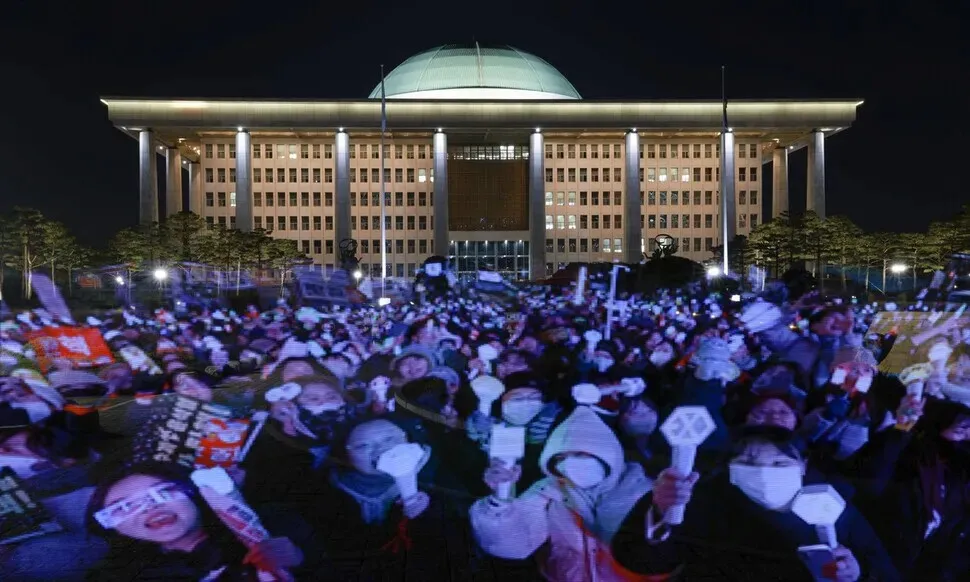
On Dec. 3, 2024, thousands of Koreans descended upon the National Assembly and into the line of possible fire, knowing that they could be headed to their deaths.
Without these people, who stopped armed soldiers with nothing more than their bodies, South Korea’s democracy and the country as we know it would have been toppled by the insurrectionists. All Koreans are indebted to these brave folk.
A month later, in January, when everyone watched with bated breath the arrest of Yoon Suk-yeol and the subsequent trials of him and his conspirators in the insurrection, a group of people quietly began to create a people’s history of how Koreans felt and what they witnessed on the fateful December night.
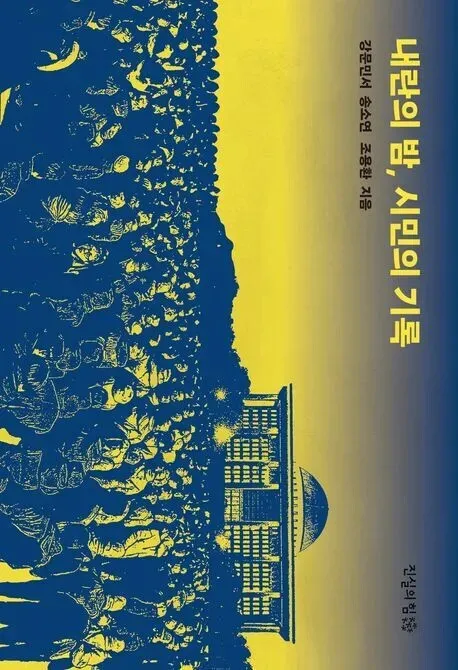
“The Night of Insurrection, Recorded by the People” is a compilation of testimonies from 313 of the roughly 9,000 to 10,000 ordinary Koreans who filled the streets in front of the National Assembly on Dec. 3. The book was created by asking and recording why people went to the National Assembly, what spurred them to action, whose they fought for, and what they wanted to see from the society that they went all out to protect.
“That f*cking asshole!” People abandoned their late-night snacks, their English homework, their workouts, their karaoke spree to jump onto the nearest taxi, bus or subway to get to the National Assembly. The memories of the brutal Gwangju massacre in May 1980 by martial law forces flashed past everyone’s eyes. Some grasped the driving wheel with unsteady, trembling hands. Each new turn of the page brings a new heartbreaking testimony.
One taxi driver, who was waiting to get a request to go to Yeouido, cried as they apologized for “leaving young people with a country in this state.” Many taxi drivers refused to take payment, dropping people off fare free. People who had been anxious while traveling to the National Assembly subway station, terrified that they would be alone, felt relieved by the fact that they were surrounded by strangers in stuffed subway cars all headed into the same unknown. Imagine how you would have seen the barricades preventing soldiers and police officers from entering the National Assembly, formed by ordinary citizens, as you stood on the escalator taking you outside the station.
The book also sheds new light on and questions the narrative that a passive response from the police and military at the time helped bring that night of terror to an end, so predominant as to have been mentioned in the Constitutional Court’s decision upholding Yoon’s impeachment and removing him from office.
In the book, many attest that, save for a small minority, the police officers who had formed a cordon around the National Assembly that night were aggressive in keeping the line, and that the hesitance shown by the martial law forces may not have been the same without ordinary people there showing up in force to resist them.
Their stories go to show that we cannot paper over the issue with compromises when it comes to the ongoing trials of those involved in the insurrection and social responses to the crisis.
By rushing to the National Assembly that night, people did more than save Korea as we knew it before the insurrection. They brought their fight that night to those who have been “living in states of pseudo-martial law” in their daily lives. We should all be thankful for the extraordinary courage of these ordinary people.
By Kim Nam-il, staff reporter
Please direct questions or comments to [english@hani.co.kr]

Editorial・opinion
![[Editorial] Trump’s baseless claim that Iran bombed girls’ school crosses line](https://flexible.img.hani.co.kr/flexible/normal/500/300/imgdb/original/2026/0309/4217730446901883.jpg "[Editorial] Trump’s baseless claim that Iran bombed girls’ school crosses line") [Editorial] Trump’s baseless claim that Iran bombed girls’ school crosses line
[Editorial] Trump’s baseless claim that Iran bombed girls’ school crosses line![[Correspondent’s column] JD Vance’s 67-hour disappearance](https://flexible.img.hani.co.kr/flexible/normal/500/300/imgdb/original/2026/0306/2517727866984907.jpg "[Correspondent’s column] JD Vance’s 67-hour disappearance") [Correspondent’s column] JD Vance’s 67-hour disappearance
[Correspondent’s column] JD Vance’s 67-hour disappearance- [Column] Withstanding Trump’s predatory hegemony
- [Editorial] US dragging Kurds into its war with Iran would be a disaster
- [Column] US allies in the Gulf are in flames. Can Korea avoid a similar fate?
- [Editorial] North Korea’s tough talk mustn’t deter Seoul’s efforts to rebuild trust
- [Editorial] Attack on Iranian girls’ school is an indefensible crime against humanity
- [Editorial] Trump’s unjustified war with Iran threatens chaos for us all
- [Column] What a Korean man’s foiled plan to seek assisted death in Switzerland reveals
- [Column] This is what accountability looks like
Most viewed articles
- 1Korea named as target of new Section 301 probe by US
- 2‘Made in USA’: Scraps of missile that killed Iranian children point to US responsibility
- 3[Editorial] No greater sign that South Korea must prioritize building its own defense abilities
- 4US may seek exit from Iran war by moving the goalposts of victory
- 5US Democrats say Trump’s investment pressure has ‘deeply unsettled’ alliance with Seoul
- 6[Column] Misconceptions about America’s war with Iran
- 765% of Korean men say gender equality has gone ‘far enough’; only 42% of women agree
- 8How much is the US willing to risk for the Strait of Hormuz?
- 9Coupang investors insinuate that US is planning Section 301 probe into Korea
- 10[News analysis] Air defense pullout signals new era of US strategic flexibility in Korea