hankyoreh
Links to other country sites 다른 나라 사이트 링크
Court denies arrest warrant for former PPP floor leader
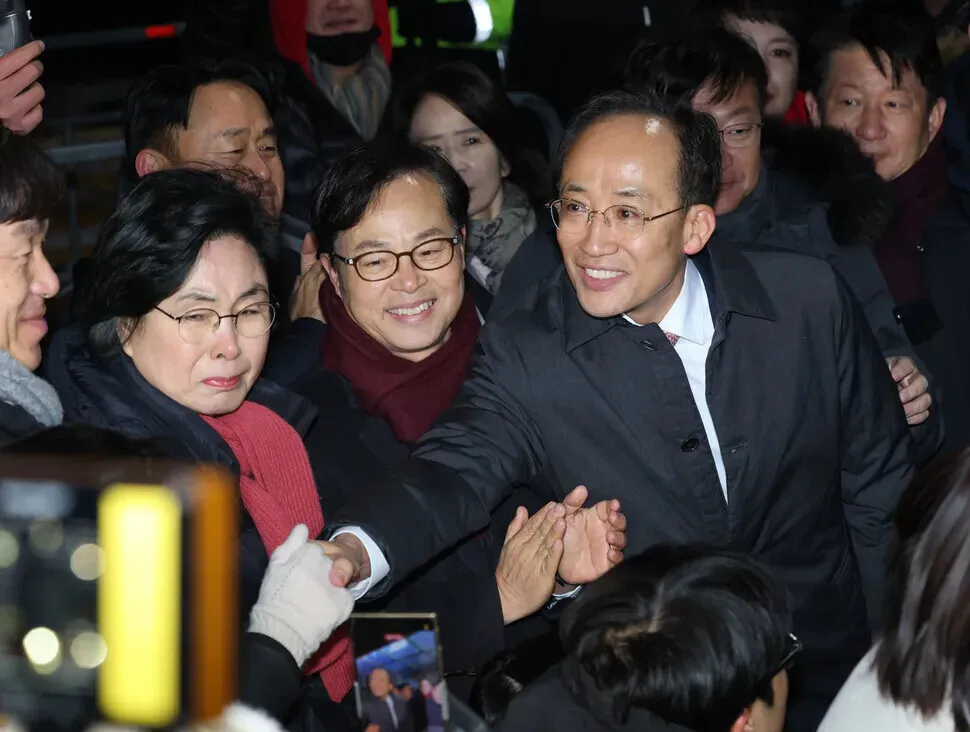
A court on Wednesday morning rejected a request for a warrant to arrest Choo Kyung-ho, a People Power Party lawmaker accused of obstructing the National Assembly’s vote to rescind martial law after it was imposed on Dec. 3, 2024, by Yoon Suk-yeol, the president of South Korea at the time.
This is the latest setback for the independent investigation into last year’s martial law crisis by special counsel Cho Eun-seok, after he and his team of investigators failed to secure detention warrants for former Justice Minister Park Sung-jae, former Prime Minister Hwang Kyo-ahn.
With courts denying detention warrants for these three figures, it is likely that Cho will indict them without detention.
Judge Lee Jeong-jae of the Seoul Central District Court conducted the interrogation of Choo as part of the process for screening the warrant request.
The judge cited the potential for disagreement regarding the charges and legal principles involved for his decision to deny the warrant.
“It is therefore prudent to impose the proper disciplinary actions according to a just judgment that follows a thorough and faithful judicial process,” Lee said.
“There is a need for the defendant to receive legal counsel and due process while being free of detention. Considering the defendant’s residence, past behavior, the investigative process thus far, and the defendant’s demonstrated willingness to appear for questioning, it is difficult to cite concerns about the possibility of the defendant fleeing or destroying evidence,” he added.
“It is difficult to justify detention under the current circumstances,” Lee said.
Choo, who was being held at the Seoul Detention Center following his interrogation by the Seoul Central District Court, was released immediately after the court’s decision.
Choo’s questioning began at 3 pm on Tuesday and involved a fierce debate between the special counsel team and Choo’s attorneys regarding the lawmaker’s alleged interference in the National Assembly’s vote to rescind martial law.
The special counsel team argues that Choo, who was the PPP floor leader at the time, intentionally changed the location of an emergency party meeting in order to obstruct the vote to rescind martial law.
That night, Choo changed the location for his party’s gathering three times — first telling them to gather at the National Assembly before switching the location to the party headquarters a few blocks away, then flip-flopping twice more — a move that investigators say prompted confusion among lawmakers who had already arrived at the legislature and thus interfered with their exercise of their votes. Out of 108 PPP lawmakers at the time, only 18 participated in the vote to lift martial law.
The special counsel probe, in particular, alleged that Choo intentionally sought to obstruct the vote that night. At 12:01 am on Dec. 4, 2024, the National Assembly’s management support division sent a notice to lawmakers over text in the name of Speaker Woo Won-shik asking representatives to gather in the plenary chamber. But minutes later, at 12:03, Choo sent a message to PPP lawmakers telling them to gather at the third floor of the party’s headquarters in Yeouido.
During the warrant review hearing on Tuesday, six prosecutors with the special counsel probe submitted a 618-page opinion and used a 304-slide presentation to underscore the need to take Choo into custody.
Choo’s representatives denied the allegations, saying that the former floor leader had simply changed the location for the lawmakers to convene on account of the lack of access to the National Assembly, and that he had no intention whatsoever of obstructing the vote. Choo’s team argued that the lawmaker had asked fellow party members to meet at the party’s headquarters as a “temporary rendezvous point” for lawmakers who could not enter the legislature due to the police cordon.
The court accepted this argument and dismissed the warrant request.
“We respect the court’s decision, but we cannot agree with it,” the special counsel team said of the ruling.
“Choo saw with his own eyes that the National Assembly was under siege by armed soldiers and that ordinary Koreans were protesting this and confronting these soldiers,” the team said. “As the leader of the ruling party, he did not take any sort of actions to ensure the safety of citizens involved in this standoff, nor did he attempt to safeguard the constitutional order.”
The team said it would move quickly to indict Choo so as to ensure that he is given “proper punishment” in a court of law. The special counsel’s period of investigation will terminate on Dec. 14.
By Kang Jae-gu, staff reporter
Please direct questions or comments to [english@hani.co.kr]

Editorial・opinion
![[Column] Back to the bad old pre‑WWII days](https://flexible.img.hani.co.kr/flexible/normal/500/300/imgdb/original/2026/0203/2317701066525269.jpg "[Column] Back to the bad old pre‑WWII days") [Column] Back to the bad old pre‑WWII days
[Column] Back to the bad old pre‑WWII days![[Guest essay] Will humans be crushed by the AI tide, or carried by it?](https://flexible.img.hani.co.kr/flexible/normal/500/300/imgdb/original/2026/0203/7217701098163121.jpg "[Guest essay] Will humans be crushed by the AI tide, or carried by it?") [Guest essay] Will humans be crushed by the AI tide, or carried by it?
[Guest essay] Will humans be crushed by the AI tide, or carried by it?- [Guest essay] UNC is not the boss here — Korea needs to say so
- [Column] Bond warfare threatens mutually assured destruction
- [Column] How North Korea’s upcoming party congress could change history
- [Column] American democracy is dying, and masked agents are killing it
- [Editorial] As Seoul takes on greater defense duties, UNC must adapt as well
- [Correspondent’s column] Welcome to never-ending tariff negotiation hell
- [Column] Atlas the robot and the A-bomb
- [Editorial] A slap on the wrist for Korea’s former first lady
Most viewed articles
- 1[Column] Dawn of the age of fascism
- 2KOSPI’s rollercoaster ride continues: Index rallies 7% to new high after 5% drop
- 3Non-homeowners suffer most from unfair surges in home prices, says Lee
- 4[Column] Telling workers that automation is unavoidable helps no one
- 5[Letters from Gaza] The war forced my mother to choose between life and limb
- 6[Column] How North Korea’s upcoming party congress could change history
- 7‘Golden’ from ‘KPop Demon Hunters’ wins K-pop its first Grammy
- 8With a click, 220,000+ member Telegram room generates illegal deepfake porn
- 9[Column] Back to the bad old pre‑WWII days
- 10[Guest essay] UNC is not the boss here — Korea needs to say so