hankyoreh
Links to other country sites 다른 나라 사이트 링크
National Assembly speaker calls handshake with Kim Jong-un ‘momentary but meaningful’
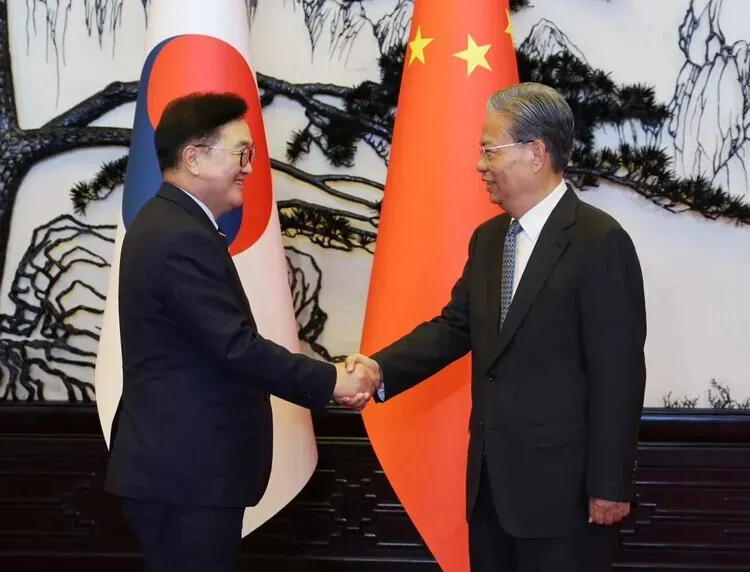
Woo Won-shik, the speaker of the South Korean National Assembly, exchanged greetings with North Korean leader Kim Jong-un during their attendance at China’s “Victory Day” parade in Beijing.
“Considering the current state of inter-Korean relations, I think even a momentary encounter is meaningful,” Woo said after the fact.
Addressing correspondents and reporters at Beijing’s Kempinski Hotel on Thursday, Woo said it was “unfortunate” that a proper conversation wasn’t possible. “But it’s been a while since inter-Korean relations have been severed, so restarting them won’t be easy,” he added.
Woo’s run-in with Kim was the subject of much interest, but the National Assembly speaker waved away overly expectant readings about what the encounter might mean for inter-Korean relations.
As the Lee Jae Myung administration seeks to restore inter-Korean relations, it has refrained from overzealous optimism out of concern that it might put North Korea on the spot.
Woo arrived in Beijing on Tuesday with a delegation of lawmakers, including Park Jie-won, Kim Tae-nyeon, Park Jeung and Hong Kee-won of the Democratic Party and Kim Joon-hyung of the Rebuilding Korea Party, to attend China’s Victory Day parade.
Kim Jong-un arrived in Beijing on the same day. Woo bumped into Kim while both were on their way to the Tiananmen gate to observe the military parade. They shook hands and briefly exchanged greetings. Both Woo and Kim attended the post-parade reception held in the Great Hall of the People, but they were seated apart from each other. Woo said that he did not have a chance to talk to Kim during the reception.
It was at that point that Russia offered to perform the role of mediator in bridging relations between the two Koreas. During the reception, Woo spoke with Russian President Vladimir Putin.
“He asked me, ‘What message shall I deliver to Kim Jong-un regarding inter-Korean relations?’” Woo told reporters.
“I told him, the new administration and National Assembly have prioritized ushering in a new era of peaceful coexistence on the Korean Peninsula, and are working to set the conditions for such a change,” Woo said.
“Please tell him that we hope cultural exchange can be the first step,” Woo said he told the Russian leader.
The cultural exchange that Woo is referring to is the 48th session of the UNESCO World Heritage Committee, scheduled to be held in Busan in July 2026.
“After the committee concludes its session, members will tour UNESCO World Heritage sites in Korea. It’d be nice if they were able to go to Mount Kumgang,” Woo said, referring to the famed North Korean mountain.
“I asked Putin to tell Kim that, and Putin said that he would,” he added.
The South Korean delegation also pursued meetings to improve relations with China.
“We just celebrated our 80th anniversary of liberation, while China is celebrating the 80th anniversary of its Victory Day. The bond forged through this common historical experience will lay the groundwork for ushering in a new era [of South Korea-China relations],” Woo said, highlighting the significance of his presence at the parade.
At the Great Hall of the People, Woo met with Zhao Leji, chairman of the Standing Committee of the 14th National People’s Congress. Woo and Zhao agreed to “continue developing bilateral relations.”
At the same time, South Korea expressed concerns about the marine structures it’s been constructing in the West Sea, while China expressed concerns about the growth of anti-China protests in Korea.
By Lee Jeong-yeon, Beijing correspondent
Please direct questions or comments to [english@hani.co.kr]

Editorial・opinion
![[Guest essay] Shame on Korea for revoking pro-Palestine activist’s passport](https://flexible.img.hani.co.kr/flexible/normal/500/300/imgdb/original/2026/0517/4417789780966687.jpg "[Guest essay] Shame on Korea for revoking pro-Palestine activist’s passport") [Guest essay] Shame on Korea for revoking pro-Palestine activist’s passport
[Guest essay] Shame on Korea for revoking pro-Palestine activist’s passport![[Column] Rethinking how we represent ‘comfort women’ victims](https://flexible.img.hani.co.kr/flexible/normal/500/300/imgdb/original/2026/0515/641778835779334.jpg "[Column] Rethinking how we represent ‘comfort women’ victims") [Column] Rethinking how we represent ‘comfort women’ victims
[Column] Rethinking how we represent ‘comfort women’ victims- [Correspondent’s column] Watching America roll back voting rights
- [Column] Leader of Korea's conservative party is handing the ruling party the election
- [Editorial] PPP leader puts party over country by driving wedge in US alliance
- [Column] Russia and North Korea: An alliance of desperation
- [Column] Is North Korea’s ‘two states’ doctrine really a response to Hallyu’s influence?
- [Column] The Korean government has a duty to overseas adoptees
- [Reporter’s notebook] Korea’s chipmakers are partying, but not everyone’s invited
- [Column] You are not my ‘oppa’
Most viewed articles
- 1[Photo] Vegan activists call for end to commercial fishing
- 2[Guest essay] Shame on Korea for revoking pro-Palestine activist’s passport
- 3[Poll] Lee’s approval rises to 66.9%, inching above 60% in conservative southeast
- 4How Korea’s ruling People Power Party became the party of the far right
- 5[Poll] 53.3% of Koreans want ruling liberal bloc to win on June 3
- 6With a click, 220,000+ member Telegram room generates illegal deepfake porn
- 7‘The people will prevail’: 1980 report by US rights group details massacre in Gwangju
- 8[Column] Is “Afghan Girl” doing well?
- 9Gangnam murderer says he killed “because women have always ignored me”
- 10[News analysis] Goodbye to Korea’s prosecution service, a scandal-ridden tool of political retaliation