hankyoreh
Links to other country sites 다른 나라 사이트 링크
[News Analysis] Emboldened Democratic Party elects Jung Chung-rae as leader
 Add as preferred source on Google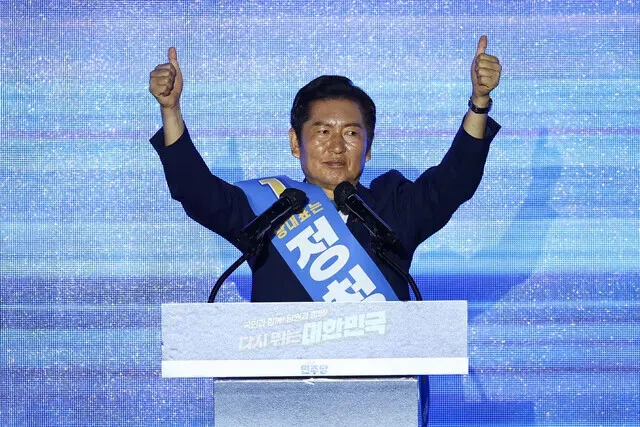
Korea’s ruling party has elected Democratic Party lawmaker Jung Chung-rae to be its first party leader since Lee Jae-myung’s inauguration as president. Jung pledges to lead the party in a powerful reform drive.
Jung clinched his victory with a vote share of 61.74%. He prided himself on winning the hearts of party members in the convention and only trailed opponent Park Chan-dae in the delegate vote, which is dominated by current National Assembly lawmakers.
The new leader received the overwhelming support of party rank and file, who have their hearts set on passing judgment on insurrectionists. He appointed lawmakers Jo Seoung-lae and Han Jeoung-ae to key positions in the party on Sunday as secretary general and policy committee chair, respectively.
Many are curious to see how the Democratic Party, under Jung’s leadership, will navigate its relationships with the presidential office and the opposing People Power Party (PPP). The reforms Jung has pledged to swiftly implement — in the prosecution, media and judiciary — require close coordination with the presidential office and negotiations with the opposition party during the legislation process.
Jung’s biggest mission is striking a balance between the conflicting wishes of party members, who want speedy and thorough reforms, and the presidential office and administration, who must cater to the demands of public opinion as a whole, including moderates.
After Jung’s election as party leader, the president offered a multifaceted response. Presidential spokesperson Kang Yu-jung said Saturday evening that “The president hopes [Jung] remembers how we all move as a team. He also hopes we can work together to demonstrate our competence on behalf of the people.”
On the surface, this message seems to wish Jung all the best as he “caters to those within the party with differing opinions.” But when we delve deeper, a different message emerges. The emphasis on “one team” and “togetherness” can be read in the context of the party and the presidential office.
Lee seems to be addressing Jung’s insistence on the separation of roles. During his political speech at the party’s convention on Saturday, Jung declared, “I will be the one to fight every battle so the president can focus on ploughing through paperwork. The fruits of success — cooperation, harmony and stability — will all be remembered in the president’s name.”
In short, Jung said, the party should shepherd bills and motions through parliament while the administration focuses on the bigger picture of running the country. The question is whether such a division of labor is actually feasible, and what obstacles it may face. Experience suggests that party oversight of legislation and governance of the nation are like two interlocking cogs that need each other to turn.
Jung will face his first parliamentary challenge in August and September. As he stated in his acceptance speech, “I will make sure to carry out prosecution, media and judiciary reforms before Chuseok [Oct. 6 this year]. Task forces for the various reforms will be launched as soon as possible.” During a Q&A session, he declared, “Reforms are always met with resistance. I will do my utmost to surmount such opposition.”
His remarks also elicited concerns from within his party. A five-term lawmaker from the Seoul metropolitan area said, “There’s a huge difference between advocating for bold reforms as the opposition party and designing and implementing policies that can function effectively in real life as the ruling party. The ruling party’s hardline stance could hinder the government’s ability to smoothly carry out many urgent affairs of state.”
Jung and his allies dismissed such concerns as being ungrounded. “When the ruling party takes a clear and principled stance in the face of the opposition party’s obstruction, the president is given greater political leeway,” commented a first-term lawmaker close to Jung. A second-term lawmaker who supports Jung added that the new leader “will act as the accelerator, the government as the brakes, and the president as the gear shifter.”
The relationship between the ruling and opposition parties also bears serious consideration. Jung has long declared his intention to dissolve the PPP, as the party of the insurrection, in response to party members’ demands to pass full judgment on former president Yoon Suk-yeol’s botched martial law declaration on Dec. 3, 2024.
Jung stated during a Q&A session after winning the election that “if the special counsel probe into the insurrection turns up various insurrection sympathizers, abettors and collaborators within the PPP, I believe many in the public will want the party dissolved for violating the Constitution. If we come to such a juncture, I will make a prudent decision as the party leader.” His remarks imply that while the Democratic Party will not spearhead legal efforts to dissolve the PPP, he will gladly take responsibility for carrying out such measures if justified by the evidence and demanded by the public.
Jung also made clear he does not recognize the PPP as a legitimate negotiating partner. When asked how he would approach the Democratic Party’s relationship with the PPP after his victory, he curtly said, “We’re currently waging a war against insurrectionist forces. This isn’t a matter of which is the ruling party and which is the opposition.”
What this suggests is that following the Dec. 3 insurrection attempt, the South Korean political landscape does not represent the typical division between ruling and opposition parties, but rather a confrontation between forces who seek to destroy democracy and the Constitution (that is, the PPP) and those who wish to protect those very values (the Democratic Party and other smaller parties).
Problematically, this dynamic is likely to escalate the standoff between the Democratic Party and the PPP, which could declare a full-blown boycott of political proceedings and resort to street protests. A prolonged standoff could enable conservative forces to frame Jung and his Democratic Party as being peremptory, uncommunicative and out of control and to place the same frame on the Lee administration.
Korea’s local elections, which are 10 months away, will serve as an end-of-the-year report card for Jung, who will remain interim party leader for one year. A landslide victory for the Democratic Party in those elections will help Lee’s government build momentum and position Jung to seek a full term as party leader.
“The outcome of the local elections will depend on whether Lee can sustain his high approval ratings through next year. Jung faces the daunting challenge of maintaining close coordination with the government while at times opposing the presidential office’s decisions,” one senior lawmaker remarked.
By Choi Ha-yan, staff reporter
Please direct questions or comments to [english@hani.co.kr]

Editorial・opinion
![[Editorial] Convict Yoon Suk-yeol must use prison term to reflect on his crimes](https://flexible.img.hani.co.kr/flexible/normal/500/300/imgdb/original/2026/0710/5417836717649921.jpg "[Editorial] Convict Yoon Suk-yeol must use prison term to reflect on his crimes") [Editorial] Convict Yoon Suk-yeol must use prison term to reflect on his crimes
[Editorial] Convict Yoon Suk-yeol must use prison term to reflect on his crimes![[Column] The twin adversaries of North and South Korea](https://flexible.img.hani.co.kr/flexible/normal/228/137/imgdb/original/2026/0709/5517835850370662.jpg "[Column] The twin adversaries of North and South Korea") [Column] The twin adversaries of North and South Korea
[Column] The twin adversaries of North and South Korea- [Editorial] Seoul must respond firmly to US’ biased claims about Coupang
- [Column] The Tumen is the new Yalu, the Yalu is the new Pearl River
- [Column] Who is the antichrist today?
- [Editorial] Mockery of Gwangju at high school ball game shouldn’t be treated lightly
- [Column] Does profit-driven investment by chaebol make them ‘national heroes’?
- [Column] Korea at a crossroads: ‘Yoon Again’ or real change?
- [Column] Stuck in Strait of Hormuz, US can no longer pivot to Asia
- [Column] The harder US pushes N.Korea to denuclearize, the greater the risk to S. Korea
Most viewed articles
- 1[Q&A] Is democratic socialism about to go mainstream in America?
- 2Blue House pushes back against US claims about Coupang after White House says it’s ‘deeply concerned’
- 3Real-life heroes of “A Taxi Driver” pass away without having reunited
- 4[Column] The twin adversaries of North and South Korea
- 5Hong Myung-bo to attend parliamentary hearing on issues in Korean soccer
- 6[Editorial] Convict Yoon Suk-yeol must use prison term to reflect on his crimes
- 7[Editorial] Defense cooperation with NATO could cost Korea
- 8AI could replace humans in 90% of tasks at 90% of jobs by 2030, predicts KDI
- 9Poet Kim Hye-soon and the true story of Eun-sook the editor in Han Kang’s ‘Human Acts’
- 10Korea to invest more than $1 trillion into AI, chips in regions outside Seoul