hankyoreh
Links to other country sites 다른 나라 사이트 링크
Those with ties to China decry racist intimidation by far right in their community
“What can we do? We have no power. I can only think about how helpless we are in this situation.”
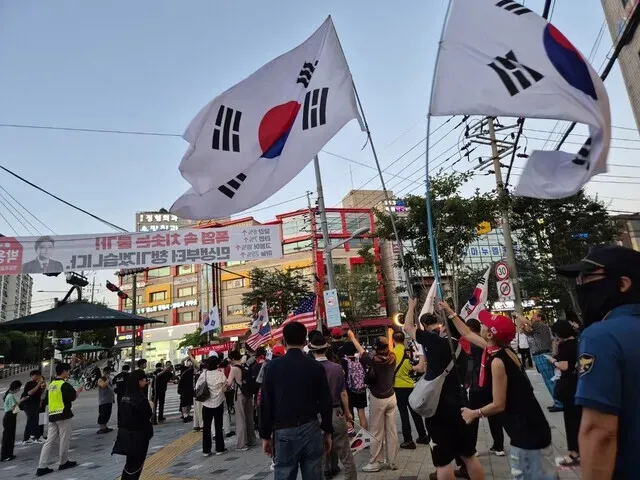
A 62-year-old individual surnamed Lee who resides in the Daerim area of Seoul’s Yeongdeungpo District, which has one of the highest concentration of Chinese residents the city, sighed as he described the feeling of hopelessness he felt after seeing far-right crowds swarm the streets of his neighborhood while chanting slogans such as “Deport the Chinese,” “Chase away the ethnic Korean-Chinese.”
“It’s already been 20 years since I came to South Korea from China to work in the construction field,” Lee said. “Many South Koreans respect people who come from countries like the US, but refer to us disparagingly as people who come from a ‘poor’ country.”
On Friday, when the Hankyoreh spoke to Lee, members of far-right groups, including conservative YouTubers such as LiberTub, rallied in Daerim to demand the deportation of migrants from China and the reinstatement of former President Yoon Suk-yeol.
The 30-odd people at the rally gathered near Exit 11 of Daerim subway station at 7:30 pm. Donning red headbands and hats adorned with phrases such as “Only Yoon” and “Yoon Again,” they stood together and waved large South Korean and American flags. They marched to the Boramae station on the same line while chanting “Yoon again!” “Out with Xi Jinping,” and “Stop election fraud.” Some members of the rally shouted blatantly racist slogans during the procession.
LiberTube, the YouTuber who organized the rally, had announced the event on his social media account on Tuesday.
“The overseas Chinese community is the most privileged group in our society,” he wrote. “If we are bold enough to chant ‘Yoon again’ in the heart of their community, we will be able to deter them from attempting to engage in any anti-state activities in the future.”
Another far-right group that calls itself “Free University” held a rally and march in the Jayang neighborhood in Seoul’s Gwangjin District, known for its high concentration of Chinese migrants, in April. Back then, the streets also rang with voices calling for “Yoon again.”
However, slogans espousing hate toward Chinese compatriots and migrants were not the only sounds echoing through the streets of Daerim that day, as many people also came out to voice their belief in coexistence and solidarity.
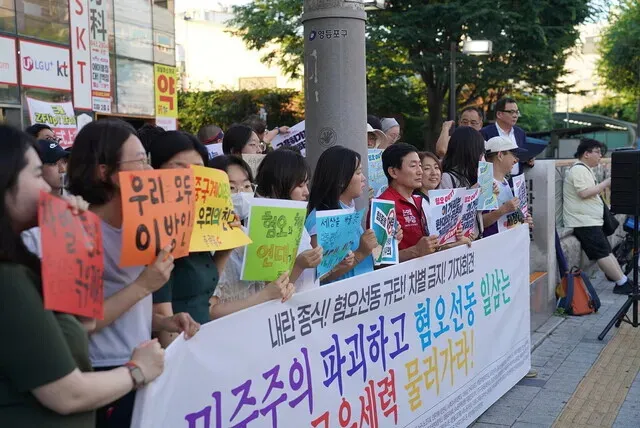
Once notified that far-right forces were descending into the neighborhood, more than 200 people gathered with signs reading “Chinese migrants are our friends,” “No place for hate and discrimination here” at an emergency press conference held by more than 70 human rights, civil society organizations and political parties including the South Korean Coalition Anti-discrimination Legislation, 3rd Voice Laboratory, Platform C, the Democratic Labor Party, and an association of Chinese compatriots living in Korea.
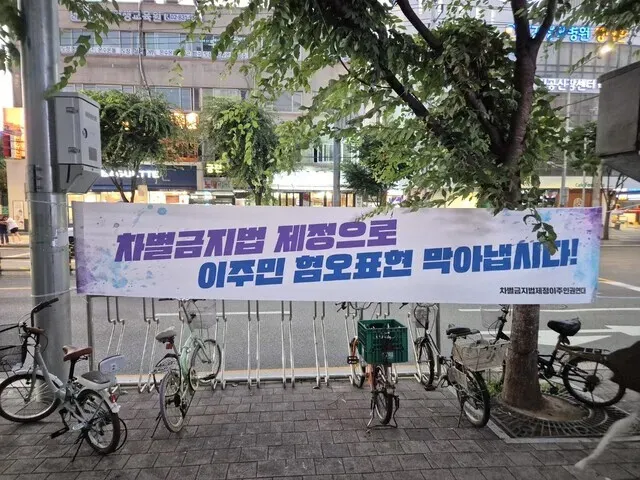
Some participants held signs with the phrases, “We oppose discrimination. Daerim is a neighborhood that welcomes coexistence” in Chinese. Many banners around Daerim station read, “We need to enact anti-discrimination laws to stop hate speech against migrants.”
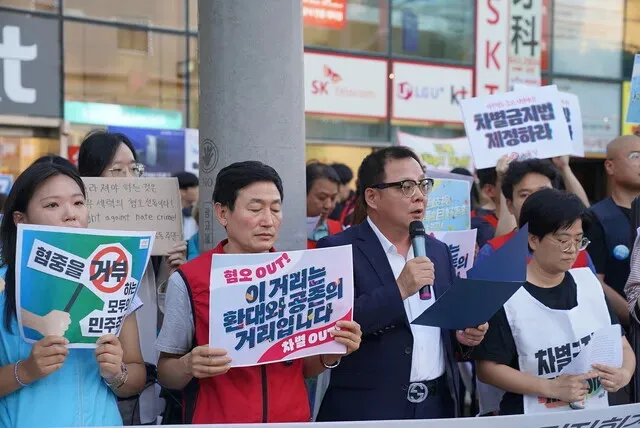
Many of the Chinese compatriots and migrants who spoke at the press conference expressed concerns that the levels of discrimination they have experienced have risen rapidly since the martial law crisis in December.
“Many within the Chinese diaspora were worried after far-right groups shouted unrepeatable vitriol while marching down the Gwangjin District in April, as they were worried that such rallies would be repeated if we did not stop this vicious cycle of hate,” said Park Dong-chan, the director of the 3rd Voice Laboratory. “Alas, we have arrived at a situation where such worries have become a reality.”
“There is no reason for us to be the recipient of such ungrounded hate. We are no different from other people living in South Korea, we work, pay taxes and raise our children here,” said Kim Se-gwang, the president of the association of Chinese compatriots in Korea.
Udaya Rai, the president of the Migrants’ Trade Union, also spoke at the rally.
“To migrant compatriots, South Korea is their homeland. Migrant workers are, however, being attacked for ‘taking jobs’ and labeled as ‘potential criminals.’ The fact that far-right forces are invading spaces with a high concentration of migrants and fueling hate by demanding that they leave the country is a pure act of racism. It does nothing to benefit our society,” he said.
Many ordinary Koreans also spoke up against hate.
Han Chae-min, an individual who introduced themselves as a “teacher who has met a variety of students in this neighborhood after being assigned to a school in Guro and Yeongdeungpo,” said, “A student who recently came from China asked me if they would face any discrimination for their poor Korean. I found myself at a loss for words. When I asked my other students for advice, one of them said, ‘Don’t worry. Lots of people will want to be your friend, and I’m one of them.’”
“I learned the power of solidarity from my students, who answered my worries over discrimination with promises of friendship. I want to tell the far-right protesters this: you will go home knowing that solidarity and friendship are far stronger and everlasting than hate,” they added.
Many also called for urgent institutional solutions to prevent hateful incitement by the far right.
“Residents of areas with dense migrant populations, who are exposed to hatred and discrimination by these instigators of hate, are facing challenges to their livelihoods as they become afraid to open their shops every morning,” said Gio, a joint-chairperson of the executive committee of the South Korean Coalition for Anti-discrimination Legislation.
“If President Lee Jae-myung is serious about making sure that every person is able to live a life free from want, he needs to enact a comprehensive anti-discrimination law,” they said.
By Chung In-seon, staff reporter
Please direct questions or comments to [english@hani.co.kr]

Editorial・opinion
![[Column] Negotiating with bombs](https://flexible.img.hani.co.kr/flexible/normal/500/300/imgdb/original/2026/0406/7717754651470434.jpg "[Column] Negotiating with bombs") [Column] Negotiating with bombs
[Column] Negotiating with bombs![[Column] What the debate over Atlas and robots in factories missed](https://flexible.img.hani.co.kr/flexible/normal/500/300/imgdb/original/2026/0405/4917753549834215.jpg "[Column] What the debate over Atlas and robots in factories missed") [Column] What the debate over Atlas and robots in factories missed
[Column] What the debate over Atlas and robots in factories missed- [Editorial] There’s no more relying on US after Iran war
- [Column] A year on from ‘Liberation Day,’ is America any greater?
- [Editorial] US threat to ‘reexamine’ NATO shows Korea can’t delay defense self-reliance
- [Column] Was Seoul’s choice to pursue dialogue, not war, in 1994 a ‘strategic error’?
- [Column] Is the PPP’s far-right shift a path to self-destruction
- [Column] Putin, Trump and Netanyahu: All tactics, no strategy
- [Column] Iran war heralds a new age of every country for itself
- [Editorial] Another avoidable factory fire kills 14 in Daejeon
Most viewed articles
- 1Trump extends deadline for Iran to open Strait of Hormuz by one day
- 2[Exclusive] Korea’s Lee orders review of humanitarian aid for Iran to extricate stranded ships
- 3‘Somebody stop this madman’: Strikes on nuclear plants raise risk of disaster in Iran
- 4Approval of China’s leadership outstrips that of US by largest margin seen yet
- 5[Column] Is “Afghan Girl” doing well?
- 6Lee says Korea will reduce burden on US by boosting defense spending, regaining OPCON
- 7South Korean military chopper accidentally entered DMZ while fighting fire in March
- 8Team behind ‘KPop Demon Hunters’ say sequel will center ‘Koreanness’
- 9[Column] Negotiating with bombs
- 10[Korea travels] Spring is in the air in Donghae, where ocean vistas take your breath away