hankyoreh
Links to other country sites 다른 나라 사이트 링크
Lee Jae-myung’s path from outsider underdog to undisputed presidential favorite
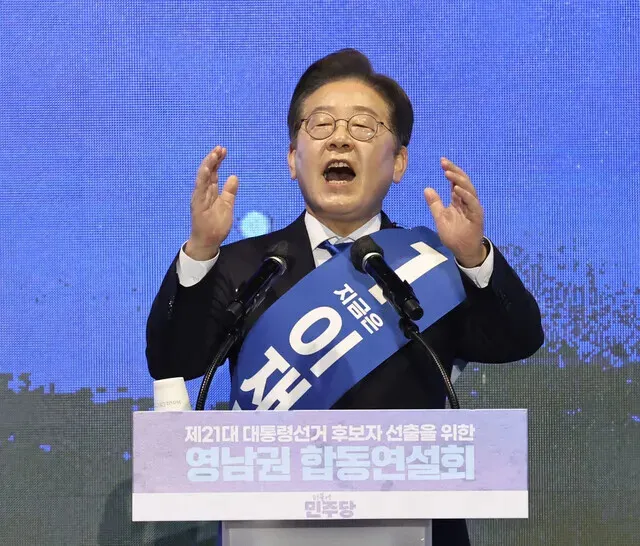
From the time he first threw his hat into the race for the presidency in 2017 up to earning the Democratic Party of Korea’s presidential nomination in a landslide primary victory on Sunday, Lee Jae-myung, 61, has run the gamut of ups and downs in his political career. Yet no matter the crisis at hand, he has always managed to bounce back stronger than before, demonstrating an uncanny aptitude for turning every situation around.
Lee hails from what he called an “impoverished” background, as he declared himself on Dec. 4, 2021. After passing the bar exam and becoming a lawyer, he dove head-first into politics and earned himself a reputation as an underdog, even within the Democratic Party. Fifteen years after he entered elected office as the mayor of Seongnam, a major satellite city of Seoul, Lee is now the uncontested standard-bearer of the 170-seat-strong Democratic Party.
“I am fearless. Not because I have always had nerves of steel, but because I have always had to pull myself up from the gutter,” Lee wrote in his 2022 memoir “No Loneliness on the Road We Share” (Wisdom House). The fourth child of seven siblings living in a small village in the mountains of Andong, North Gyeongsang Province, Lee said he was born “without a spoon in [his] mouth” and has lived life as a “perpetual outsider, on the margins.”
With no one to lean on, Lee began to work as a child laborer when he was 12 at an industrial complex in Seongnam. After passing equivalency exams for middle and high school, Lee matriculated at Chung-Ang University, where he studied law before going on to become a human rights lawyer.
Lee’s career has been a series of clashes with the mainstream. After his experience in local organizing led him into mainstream politics and eventually to become Seongnam mayor, his policies of providing services at no cost to beneficiaries — including free postnatal care services and free school uniforms — made him a nuisance for the conservative administration, which wanted to rein him in.
Even within his party, he belonged to the fringe. Following his eight-year stint as the mayor of Seongnam, he bested former lawmaker Jeon Hae-cheol, a key figure in the Moon Jae-in administration, in a party primary to become the governor of Gyeonggi Province. His road to becoming the bona fide kingpin of the Democratic Party after he helped lead the party to victory in the 2024 legislative elections was one of constant struggles for recognition against the mainstream of the party, represented by the Roh Moo-hyun and Moon Jae-in factions.
After losing the presidency to Yoon Suk-yeol by a razor-thin margin of 0.73 percentage points in the election three years ago, Lee continued to battle the mainstream forces within his party while also confronting Yoon and those loyal to him in the prosecution service. In the less than three years of Yoon’s presidency, Lee and those in his orbit were subject to relentless investigative shakedowns that pushed them to the brink. When convening with key members of his presidential campaign on April 11, Lee warned his colleagues that they were all “targets in the line of fire.”
Despite everything, Lee has continued to turn things around whenever his back has been against the wall. The first such resurgence came in 2020 when the Supreme Court reversed and remanded a case in which he had been convicted of spreading falsehoods in regard to his older brother’s forceful admittance into a psychiatric hospital. Lee’s political career was once again brought back from the brink last month, when the Seoul High Court acquitted him of all charges of violating election law after he had received a one-year prison sentence from a lower court that would have stripped him of his elected office.
These results cannot be wholly attributed to luck, despite what those within political circles may say. In the words of Democratic lawmaker Park Jie-won, we could say that Lee was both lucky and tactical. When some of his fellow lawmakers joined forces with prosecutors to pass a motion consenting to his arrest, Lee fought back by holding a hunger strike. In the end, the warrant was dismissed. In the 2024 legislative election, Lee led the Democratic Party to a decisive victory, winning 171 seats in the National Assembly.
“My comrades, please save your tears. We may part on sad terms, but as we return to our families, our workplaces and our villages, let us resolve to meet again. On our reunion, our dreams of a new world will be bigger than ever,” Lee said in his concession speech to supporters after coming in third in the Democratic Party primary on April 3, 2017.
Very few people could have believed at the time that Lee would make a thunderous comeback eight years later, emerging triumphant with the most support a Democratic Party nominee has ever received in a primary. Now Lee returns to the ring, with dreams greater than ever.
By Um Ji-won, staff reporter
Please direct questions or comments to [english@hani.co.kr]

Editorial・opinion
![[Column] The megalomanic dictator with tariffs in one hand, missiles in the other](https://flexible.img.hani.co.kr/flexible/normal/500/300/imgdb/original/2026/0313/86177339097223.jpg "[Column] The megalomanic dictator with tariffs in one hand, missiles in the other") [Column] The megalomanic dictator with tariffs in one hand, missiles in the other
[Column] The megalomanic dictator with tariffs in one hand, missiles in the other![[Editorial] Korea can’t let US trade probes strong-arm it into concessions](https://flexible.img.hani.co.kr/flexible/normal/500/300/imgdb/original/2026/0313/3517733915192038.jpg "[Editorial] Korea can’t let US trade probes strong-arm it into concessions") [Editorial] Korea can’t let US trade probes strong-arm it into concessions
[Editorial] Korea can’t let US trade probes strong-arm it into concessions- [Editorial] Trump’s baseless claim that Iran bombed girls’ school crosses line
- [Correspondent’s column] JD Vance’s 67-hour disappearance
- [Column] Withstanding Trump’s predatory hegemony
- [Editorial] US dragging Kurds into its war with Iran would be a disaster
- [Column] US allies in the Gulf are in flames. Can Korea avoid a similar fate?
- [Editorial] North Korea’s tough talk mustn’t deter Seoul’s efforts to rebuild trust
- [Editorial] Attack on Iranian girls’ school is an indefensible crime against humanity
- [Editorial] Trump’s unjustified war with Iran threatens chaos for us all
Most viewed articles
- 1US may seek exit from Iran war by moving the goalposts of victory
- 2Iran sets terms for ending war, but US unlikely to acquiesce
- 3Korean legislature passes US investment bill, but loophole for waiving safeguards sparks backlash
- 4Iran’s new supreme leader vows to keep Strait of Hormuz closed in first public address
- 5[Column] The megalomanic dictator with tariffs in one hand, missiles in the other
- 6Lee Se-dol’s advice for young job seekers worried about AI
- 7[Olympics] Korea clinches gold in women’s 3000-meter short track relay
- 8[Editorial] Korea can’t let US trade probes strong-arm it into concessions
- 9Korea named as target of new Section 301 probe by US
- 1065% of Korean men say gender equality has gone ‘far enough’; only 42% of women agree