hankyoreh
Links to other country sites 다른 나라 사이트 링크
Four dead and thousands under evacuation as wildfires engulf southeastern Korea
 Add as preferred source on Google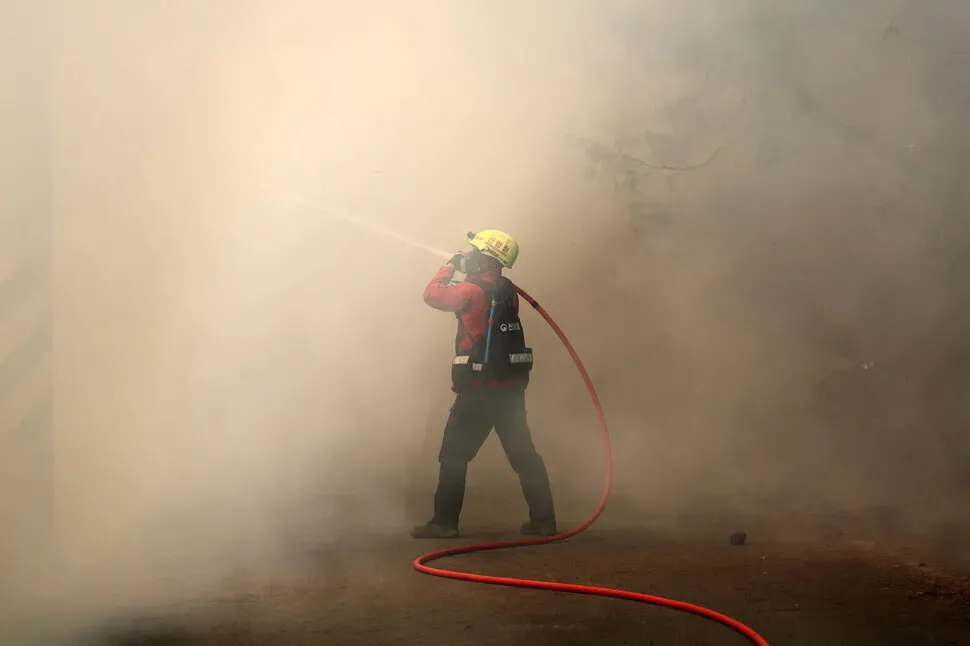
Forestry officials are struggling to put out large-scale wildfires that erupted throughout southeastern Korea over the weekend amid dry weather.
The South Korean government declared states of disaster in South Gyeongsang and North Gyeongsang provinces and Ulsan in response.
As of 8 pm on Sunday, the casualties from the wildfires stood at four deaths and six injuries. Over 2,000 residents were evacuated from the region, with damage to 39 residences.
A Level 3 wildfire response was in effect for the three regions of Sancheong County in South Gyeongsang, Uiseong County in North Gyeongsang, and Ulju County in Ulsan. According to a situation report issued by the Central Disaster and Safety Countermeasure Headquarters, a total of 6,328 hectares of land had been burnt by the wildfires as of 4 pm on Sunday — the equivalent of 8,864 soccer pitches.
A fire that erupted at Mount Gugok — a mountain on the fringes of Mount Jiri in the Sincheon village of Sancheong’s Sicheon township, with an elevation of 961 meters — had been 70% extinguished as of 6 pm on Sunday. Since breaking out at around 3:26 pm on Friday, the fire has raged for three days and spread to neighboring Hadong County.
Three firefighters in their 60s were trapped and lost their lives while attempting to extinguish the Sancheong fire, along with one guidance official in their 30s. Another six were reportedly undergoing treatment for burns.
Meanwhile, 589 residents fled to areas such as the Donguibogam Village in Sancheong’s Geumseo township. As of Monday, the cause of the Sancheong fire had not been determined.
Another fire that broke out on a mountainside (San 61) near the rural village of Goesan in the Anpyeong township in Uiseong had been 60% extinguished as of 6 pm on Sunday. The region impacted by the fire extends over 6,028 hectares, with a total length of 98 km. The fires had been extinguished over an area extending 59 km.
Forestry officials have deployed 48 helicopters and 3,777 firefighting personnel to extinguish the blaze. While no casualties were reported, 1,504 residents were evacuated to locations including an indoor gymnasium in the town of Uiseong.
The fire in question was accidentally started by a visitor to an ancestral grave in the region at around 11:24 am on Saturday. The visitor reported the fire to the 119 emergency service number, explaining that they had started it while tending to the gravesite.
A third fire, which started near a highway (San 108-1) in the rural village of the Unhwa in Ulju County’s Onyang at around 12:12 pm on Saturday, had been 70% extinguished as of 6 pm on Sunday. Difficulties were reported in putting out the fire due to the presence of nearby transmission lines that complicated the process of spraying water from helicopters.
Other wildfires of various scales were also reported on Sunday alone in areas including Gyeongju and Gyeongsan in North Gyeongsang Province and Okcheon in North Chungcheong Province.
At 6 pm on Saturday, the South Korean government declared states of disaster in the Ulsan, North Gyeongsang, and South Gyeongsang areas and assigned the matter to the central disaster headquarters. It also declared a special disaster area in Sancheong at 10:30 the same evening.
This marks the fifth time in history that the South Korean government has declared a state of disaster, after a wildfire in Yangyang, Gangwon Province, in April 2005; an oil spill of the coast of Taean in South Chungcheong Province in December 2007; an East Sea coast wildfire in Gangwon Province in April 2019; and another East Sea coast wildfire in North Gyeongsang and Gangwon Provinces in March 2022.
By Kim Gyu-hyun, staff reporter
Please direct questions or comments to [english@hani.co.kr]

Editorial・opinion
![[Column] BTS is right to boycott the Grammys](https://flexible.img.hani.co.kr/flexible/normal/500/300/imgdb/original/2026/0828/5217879047477209.jpg "[Column] BTS is right to boycott the Grammys") [Column] BTS is right to boycott the Grammys
[Column] BTS is right to boycott the Grammys![[Column] A woman went missing in Jeju. Why did police keep evidence from her family?](https://flexible.img.hani.co.kr/flexible/normal/500/300/imgdb/original/2026/0827/6817878195709257.jpg "[Column] A woman went missing in Jeju. Why did police keep evidence from her family?") [Column] A woman went missing in Jeju. Why did police keep evidence from her family?
[Column] A woman went missing in Jeju. Why did police keep evidence from her family?- [Column] Trump’s desperation after Iran doesn’t bode well for Korea
- [Editorial] The goal of a nuclear-free Korean Peninsula must not be abandoned
- [Column] Is Donald Trump good for the Korean Peninsula?
- [Column] The unspoken deal that made China a nation led by engineers
- [Column] Does the US deserve allies’ trust?
- [Column] No, tactical nukes aren’t practical for real-world use
- [Column] ‘The Odyssey’: Finally, a good chamber drama
- [Column] How will the US uphold deterrence when it runs out of weapons?
Most viewed articles
- 1Births in South Korea surge 15% in first half of 2026
- 2Korea’s seas are warming more than twice as fast as the global ocean
- 3What China really means when it says it wants ‘independence and autonomy’ for Korea
- 4[Breaking] Dam bursts in Tibet, prompting new flood warnings in Nepal
- 5[Column] BTS is right to boycott the Grammys
- 6Constitutional Court affirms birth registration rights for foreign children born in Korea
- 7Real-life heroes of “A Taxi Driver” pass away without having reunited
- 8[Column] Trump’s desperation after Iran doesn’t bode well for Korea
- 99 Koreans missing after catastrophic flooding in Nepal
- 10[Interview] Amid war at home, musician brings Ukrainian culture to the world