hankyoreh
Links to other country sites 다른 나라 사이트 링크
Was Yoon behind instruction to cut power, water to Hankyoreh and other critical press?
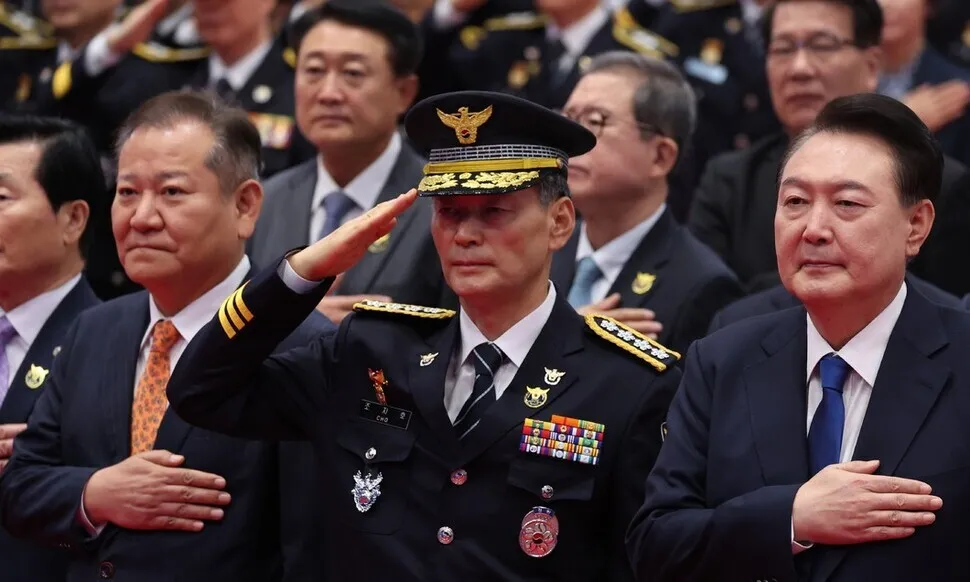
New testimony has come out that Korea’s former interior minister, a close ally of President Yoon Suk-yeol, told the commissioner of the National Fire Agency to cut off water and electricity to key media outlets including the Hankyoreh following the declaration of martial law on Dec. 3.
There was no mention of cutting off electricity and water to media outlets in the unconstitutional and illegal martial law proclamation, suggesting that the measures had been drawn up in advance. There is a high chance that such instructions came directly from Yoon right before he declared martial law.
According to the Martial Law Act, the only two members of the Cabinet who could propose martial law to the president were former Defense Minister Yong-hyun (currently indicted and in custody) and Lee.
During a general meeting of the National Assembly’s Public Administration and Security Committee on Monday, Democratic Party lawmaker Youn Kun-young asked if, following the martial law declaration, National Fire Agency (NFA) Commissioner Heo Seok-gon received instructions from then-Interior Minister Lee Sang-min to cut off power and water to the Hankyoreh, the Kyunghyang Shinmun and MBC.
Although Youn continued to repeat the question, Heo kept saying, “I don’t recall.” When Youn reminded him that he could be investigated for perjury in connection to insurrection, Heo finally admitted, “I received a phone call telling me to cooperate with the National Police Agency if they contacted me about cutting off water and power to a few media outlets.”
Heo said that he discussed the matter with his second-in-charge, since cutting off water and power is not within the purview of the NFA, and ultimately decided not to act on the orders. However, considering that Heo did not report Lee’s illegal command to the National Assembly for over a month, authorities will need to conduct additional investigations of the NFA, the Korea Electric Power Corporation (KEPCO), and Seoul Water to see how far down the line such orders went.
Lee was present at the emergency Cabinet meeting on Dec. 3 that took place right before Yoon declared martial law. The proclamation that accompanied the declaration did not contain any measures regarding cutting off power and water to the Hankyoreh or other media outlets. Considering that Lee told Heo to cut off power and water directly after the martial law declaration, it’s possible that Yoon issued such instructions directly to Lee before the Cabinet meeting.
Yoon could not include such extralegal directives in his martial law edict, so he appears to have summoned the head of a state institution to relay the orders separately. Police units that had been issued related instructions by Lee had already received a list of targeted media organizations before Yoon issued his martial law declaration.
On Dec. 3, the day of the martial law declaration, Yoon summoned former national police commissioner Cho Ji-ho (currently indicted and in custody), and Seoul police chief Kim Bong-sik (currently indicted and in custody), to his safe house in Seoul’s Samcheong neighborhood and gave them a list of over 10 “targeted institutions.” Cho’s attorney has stated, “There were other [targeted] media outlets than MBC. The list contained sensitive content that is difficult to reveal at present.”
It appears that both the Hankyoreh and the Kyunghyang Shinmun were on that list.
These revelations support suspicions that Lee was deeply involved in the insurrection plot both before and after the martial law declaration.
On the day of the martial law declaration, Lee attended a joint central and local government policy conference in Ulsan. After the conference, he canceled his remaining appointments for the day and boarded a train bound for Seoul at around 5:40 pm to go see Yoon. Around 20 minutes later, Lee talked with former Defense Minister Kim Yong-hyun (arrested and detained), who is accused of playing a major role in the insurrection plot, on the phone. Both Lee and Kim are fellow alumni of Choongam High School, Yoon’s alma mater.
Lee had previously testified that on Dec. 3, “I learned around lunchtime that there might be a meeting scheduled with the president, so I canceled my flight, which was scheduled to take off at 9 pm that day, and boarded a train bound for Seoul.” Lee did not mention that he spoke with Kim on the phone.
Even Lee’s movements after martial law was rescinded aroused suspicions of his deep involvement in the insurrection. Lee stated before the National Assembly on Dec. 5 that “martial law was an act of high-level political governance” and that “the president was merely exercising the authority granted by the Constitution.”
“If we had properly sealed off the National Assembly, would they have passed the resolution [to rescind martial law]?” he asked at the time.
“If we were truly intent on blocking the authority of the National Assembly, we could have done so,” he continued, proactively defending Yoon’s unconstitutional and illegal martial law declaration.
Yet Lee did not say anything about directives to cut off water and power to key media outlets, which would be illegal.
In the early hours of Dec. 4, when martial law was rescinded, Lee met with Justice Minister Park Sung-jae as well as Kim Joo-hyun, presidential office’s chief secretary for civil affairs, and Lee Wan-kyu, minister of government legislation, at the president’s safe house. There are suspicions that they met to discuss legal countermeasures regarding the snowballing insurrection allegations in the wake of the martial law debacle.
Lee did not publicly state his intention to resign until Dec. 8, the day after the National Assembly introduced a motion to impeach Yoon. The president then immediately approved Lee’s dismissal. On Dec. 16, Lee was questioned by a special police investigative team as a suspect. The ongoing investigation into Lee has been delegated to the Corruption Investigation Office for High-ranking Officials. On Dec. 18, prosecutors turned over their investigation of both Lee and Yoon to the CIO.
By Kim Nam-il, staff reporter
Please direct questions or comments to [english@hani.co.kr]

Editorial・opinion
![[Editorial] Korea awaits verdict that will bring Yoon to justice](https://flexible.img.hani.co.kr/flexible/normal/387/232/imgdb/original/2026/0114/2717683786156022.jpg "[Editorial] Korea awaits verdict that will bring Yoon to justice") [Editorial] Korea awaits verdict that will bring Yoon to justice
[Editorial] Korea awaits verdict that will bring Yoon to justice![[Editorial] Starting small will be key for Lee’s big vision for cooperation with North Korea](https://flexible.img.hani.co.kr/flexible/normal/500/300/imgdb/original/2026/0114/1717683780759382.jpg "[Editorial] Starting small will be key for Lee’s big vision for cooperation with North Korea") [Editorial] Starting small will be key for Lee’s big vision for cooperation with North Korea
[Editorial] Starting small will be key for Lee’s big vision for cooperation with North Korea- [Column] Surviving our era beyond the looking glass
- [Column] Welcome to the age of corridors
- [Correspondent’s column] Risks and opportunities in Xi’s gesture to Korea
- [Column] The pretexts of the powerful
- [Column] Why do working-class young people fall for the far right?
- [Editorial] A step in the right direction for South Korea and China
- [Column] Lee’s efforts to write a hopeful new chapter for inter-Korean relations
- [Column] What ‘innovation’ by Coupang’s Kim Bom-suk missed
Most viewed articles
- 1[Interview] Judith Butler: Repressive acts by anti-democratic regimes are ‘confessions’ of fear
- 2‘KPop Demon Hunters’ takes home Golden Globes for animated film, best original song
- 3Korea, China and Japan must find ‘common ground’ and communicate, says Lee
- 4Yoon offers more rationalization, not remorse, in final statement of insurrection trial
- 5Korea, Japan agree to identify remains of those killed in Chosei mine disaster
- 6Special counsel demands death penalty for Yoon in insurrection trial
- 7Why prosecutors are seeking the death penalty for Korea’s former president
- 8[Editorial] Korea awaits verdict that will bring Yoon to justice
- 9Naver unveils HyperCLOVA X in bid to become early leader in Korea’s AI ecosystem
- 10Lee proposes 4 major projects to China, including Seoul-Pyongyang-Beijing high-speed rail