hankyoreh
Links to other country sites 다른 나라 사이트 링크
Yoon to face ‘inevitable’ probe over alleged meddling in nominations for public office
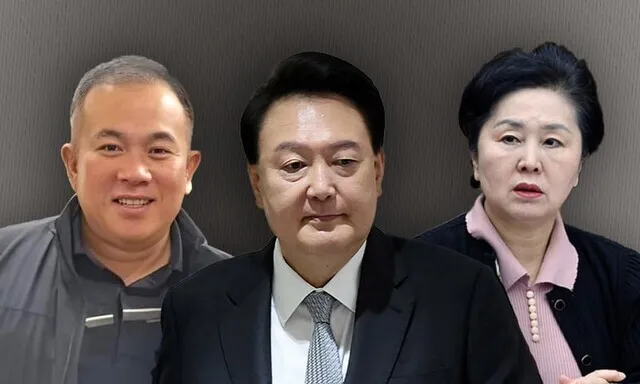
An investigation appears inevitable into South Korean President Yoon Suk-yeol’s alleged violation of the Public Official Election Act after audio recordings revealed Yoon saying he had a hand in the nomination of former lawmaker Kim Young-sun a month before the by-elections on June 1, 2022.
Whether Yoon, who was president-elect when he made the comments in question during a phone call with Myung Tae-kyun, further meddled in the by-election after the official start of his presidential term will likely be the focus of the investigation.
Article 86 of the Public Official Election Act stipulates that public officials are prohibited from using their status to influence any election. Violations of the act result in up to three years in prison or a fine of up to 6 million won (approximately US$4,330).
Yoon’s voice in the audio file declaring, “The [PPP] nomination committee showed me the [by-election nomination] plan, so I said, ‘Since Kim Young-sun campaigned hard [for me], why don’t you do that for [nominate] her?’” virtually serves as testimony from the president that he exerted his influence to help Kim win the nomination.
However, the Democratic Party shared that the conversation between Yoon and political broker Myung Tae-kyun took place on May 9, 2022, when Yoon was still the president-elect. The president-elect is, according to the Presidential Transition Act, given the power to nominate candidates for government personnel and establish a presidential transition committee.
While the act stipulates that no public official can become the chairperson, the vice chairperson, a committee member or a staff member of the transition committee, it does not specify whether the president-elect is considered a public official. Since the law does not set forth such restrictions, prosecutors and others say one cannot consider the president-elect a public official.
However, it would be hasty to assume that Yoon’s influence over the election came to a halt after his phone call with Myung. The day after the phone call, on May 10, 2022, the PPP’s internal nomination committee selected Kim Young-sun as the party’s nominee for the National Assembly seat in Changwon’s Uichang District. This coincides with the first day of Yoon’s official presidential term.
Democratic Party lawmaker Seo Young-kyo, the head of the party’s task force for investigating allegations related to what they’re calling “Myung Tae-kyun-gate,” said, “The announcement of a nomination influenced [by Yoon’s order] occurred during the president’s term.”
While Yoon may have been the president-elect when he spoke over the phone with Myung, there is the possibility that he influenced the nomination process after the beginning of his term as president at the stroke of 12:00 am on May 10, 2022, which necessitates further investigations.
A legal authority with much experience with election-related investigations told the Hankyoreh that it would be “difficult” to suggest that the president-elect is a government official.
“However, judging by the content of the call, there is enough evidence to deem that Yoon did meddle in the by-elections after May 10, so an investigation seems necessary,” they said.
Presidents have, in the past, faced punishment for interfering in the nomination of candidates for public office. Former President Park Geun-hye was sentenced to two years in prison for deliberately manipulating the makeup of the Saenuri Party’s internal nomination committee ahead of the 20th general election in 2016 so as to favor the nomination of pro-Park candidates.
Although Park’s intervention was less direct than Yoon, who appears to have singled out Kim Young-sun and directly asked for her nomination, Park was found guilty. The prosecutor who indicted her was none other than Yoon himself.
While in office, the president enjoys immunity from prosecution, with exceptions for insurrection and treason. But since the statute of limitations for other crimes is paused during a presidential term, a president is subject to prosecution after they leave office.
The Changwon District Public Prosecutors’ Office is due to summon Myung and Kim Young-sun, but the case is quickly snowballing from alleged violations of the Political Funds Act in the form of 81 public opinion polls to now the president’s alleged breach of the Public Official Election Act.
This is the reason people are calling for a special independent counsel probe, instead of letting the case be handled by the prosecution service, which is completely under Yoon’s thrall.
“Since recordings of the president have come to light, it is not realistic for the Changwon District Public Prosecutors’ Office to continue investigations. In order to go after the president, they’ll need at least 50 people involved in the investigation,” a former prosecutor turned lawyer commented.
“A special counsel probe is inevitable,” they said.
By Bae Ji-hyun, staff reporter; Kim Nam-il, staff reporter
Please direct questions or comments to [english@hani.co.kr]

Editorial・opinion
![[Column] Coupang’s play in Washington](https://flexible.img.hani.co.kr/flexible/normal/500/300/imgdb/original/2026/0227/7817721808892682.jpg "[Column] Coupang’s play in Washington") [Column] Coupang’s play in Washington
[Column] Coupang’s play in Washington![[Editorial] Clarification and accountability needed on USFK standoff with Chinese jets](https://flexible.img.hani.co.kr/flexible/normal/500/300/imgdb/original/2026/0226/4817720940359806.jpg "[Editorial] Clarification and accountability needed on USFK standoff with Chinese jets") [Editorial] Clarification and accountability needed on USFK standoff with Chinese jets
[Editorial] Clarification and accountability needed on USFK standoff with Chinese jets- [Editorial] USFK’s provocation of China demands more than perfunctory protest by Seoul
- [Editorial] PPP’s refusal to cut ties with Yoon will be its undoing
- [Editorial] Korea is no staging ground for US operations against China
- [Editorial] Court convicts Yoon, but fails to fully reckon with his attempted coup
- [Editorial] Just because Japan is rushing US investments doesn’t mean Korea should
- [Column] Moment of truth: What the Epstein files really show us
- [Editorial] Coupang’s lobbying in US won’t win back Korean customer base
- [Column] Today’s diverging paths of human virtue, hegemony and tyranny
Most viewed articles
- 1Real-life heroes of “A Taxi Driver” pass away without having reunited
- 2Threatening North Korea has not made peninsula any safer, says South Korea’s Lee
- 3Russian Embassy in Seoul ignores host nation’s request to remove pro-war banner
- 4[News analysis] Behind split strategies, Kim Jong-un stays focused on regime security, advancement
- 5Former bodyguard’s dark tale of marriage to Samsung royalty
- 6Trump open to talking with Kim Jong-un ‘without any preconditions,’ says White House
- 7[NBS] Korea’s Lee logs 67% approval rating, his highest since taking office
- 8Hard labor an increasing punishment for poor people unable to pay fines
- 9Rosé’s ‘APT.’ was best-selling single of 2025, a first for singer not from North America or Europe
- 10[Editorial] USFK’s provocation of China demands more than perfunctory protest by Seoul