hankyoreh
Links to other country sites 다른 나라 사이트 링크
Undercutting competition on pricing could cost Korea in Czech nuclear plant bid
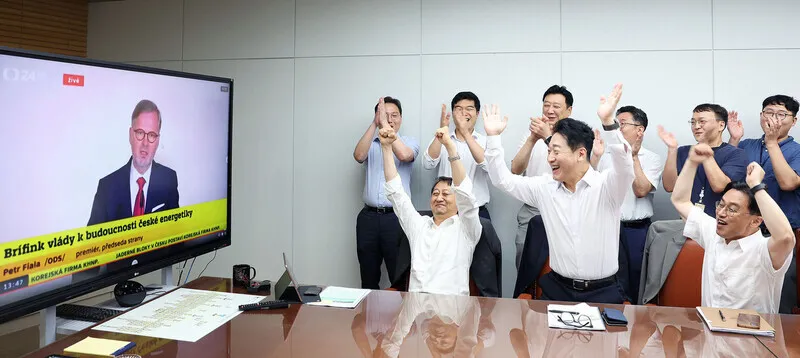
During a roundtable on livelihood issues in North Jeolla Province on Thursday, President Yoon Suk-yeol lauded the selection of Korea Hydro & Nuclear Power (KHNP) as the Czech government’s preferred bidder to build two nuclear reactors on Wednesday as a success.
“The entire South Korean industry will benefit greatly from overcoming the troubles caused by nuclear phase-out policies and restoring our nuclear power industry, which was almost driven to extinction,” he said.
The president noted that the Czech project was Korea’s first successful bid in 15 years following the tender to build reactors for the Barakah nuclear power plant in the United Arab Emirates. Yoon emphasized that Korea’s participation in the project will pave the way for Korea’s nuclear power corporation to target other European countries that are expected to commission the construction of more nuclear plants, such as Poland, Romania and Sweden.
The Yoon administration sees this as a win in its push to repeal nuclear phase-out policies put in place by its predecessor. However, experts the Hankyoreh spoke to agreed that it was unwise of the administration to use the export of nuclear reactors for political ends, considering that they have long-term consequences for the national interest.
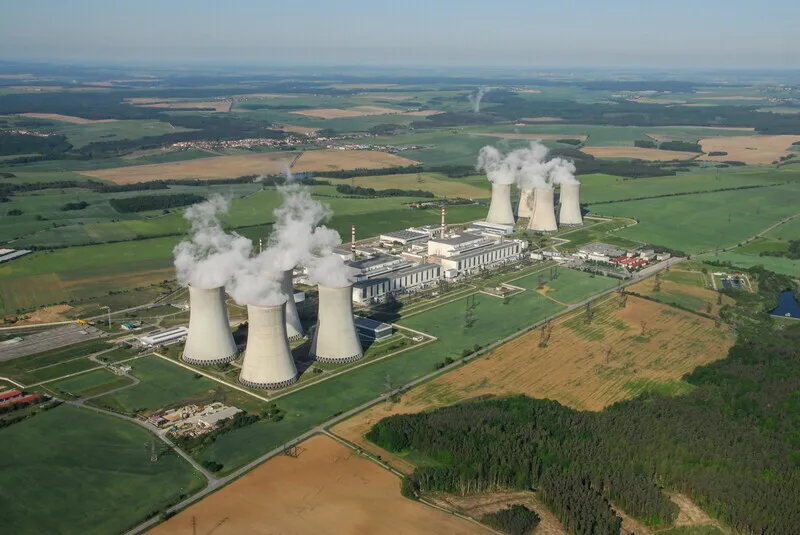
The Ministry of Trade, Industry and Energy has underscored that, once finalized, the deal to build two new large-scale 1,000-megawatt nuclear units at the Czech Republic’s Dukovany power station will be worth 24 trillion won (US$17.24 billion).
However, experts opined that if South Korea adheres to its promises of using more than 60% local companies in the project and prioritizing employment of local workers, such promises, along with additional financing conditions, could make the economic benefits minimal, since buyers have the upper hand in the nuclear plant trade market.
“Our cost per unit for construction is less than half of that of France, which is more experienced in nuclear plant exportations, and even lower than that of China. This means that less profit is to be made by having construction costs so much cheaper than our competitors,” explained Park Jong-woon, a professor at Dongguk University’s department of energy and electrical engineering.
“All that is decided currently is the Czech government’s project budget of 6 billion euros, which roughly amounts to 9 trillion won [US$6.5 billion], and the financing plan for the remaining costs is uncertain. There’s still a very high possibility that subsequent price negotiations will diminish the scale of the contract, despite KHNP’s estimations,” he added.
In regard to South Korea’s promises to keep costs within budget, which is thought to have been the crucial factor that won Korea the tender, Lee Heon-seok, the policy manager for the civic group Energy Justice Actions, predicted, “There may be difficulties to keep that promise due to Europe’s strong restrictions on nuclear plants and strict labor standards.”
Czech workers, who have been promised priority hiring, are legally required to work no more than 40 hours a week, which is shorter than the work week in South Korea, meaning that it is highly likely that construction will be delayed.
“A construction period of 15 years is quite long, meaning that there are many variables that may cause construction delays, as well as the fluctuations in construction and labor costs,” Lee explained.
Some predict that the Czech Republic’s medium- and long-term nuclear plant construction plan may be subject to changes due to the European Union’s push for more renewable energy. The EU plans to increase the percentage of renewable energy in its mix to 40% by 2030 to address the climate crisis and the Czech government is planning to increase renewable energy from 13% to 20% within the same time frame.
“Currently, the Czech Republic’s annual electricity consumption is 81 terawatt-hours (TWh), which is far less than the consumption of Gyeonggi Province (about 140 TWh). Six nuclear reactors already account for 41% of electricity usage in the country, so there doesn’t seem to be the need to build four more reactors,” said Seok Kwang-hoon, an energy policy consultant for the Energy Transition Forum.
“The price of electricity drops to zero for more than 440 hours in a year in the Czech Republic, so the country has a system that makes it difficult to expand both renewable energy, which has intermittency problems, and nuclear power plants, which have flexibility problems,” Seok explained. He added that this is why there are repeated instances of European countries, such as Poland and the UK, making plans to build nuclear plants only to scrap them.
KHNP’s conflict with Westinghouse Electric Company over intellectual property is another matter to be resolved. Regarding Westinghouse’s claims that the reactor technology to be used by KHNP in the Czech nuclear project is based on its technology and its threats to go forward with legal action, Park stated, “There will be more legal conflicts surrounding the 1,000-megawatt plant to be built in the Czech Republic compared to the 1,400-megawatt plant updated with KHNP technology.”
To such issues, KHNP has said that Westinghouse is “currently coordinating” the details of the matter.
By Ock Kee-won, staff reporter
Please direct questions or comments to [english@hani.co.kr]

Editorial・opinion
![[Column] The megalomanic dictator with tariffs in one hand, missiles in the other](https://flexible.img.hani.co.kr/flexible/normal/500/300/imgdb/original/2026/0313/86177339097223.jpg "[Column] The megalomanic dictator with tariffs in one hand, missiles in the other") [Column] The megalomanic dictator with tariffs in one hand, missiles in the other
[Column] The megalomanic dictator with tariffs in one hand, missiles in the other![[Editorial] Korea can’t let US trade probes strong-arm it into concessions](https://flexible.img.hani.co.kr/flexible/normal/500/300/imgdb/original/2026/0313/3517733915192038.jpg "[Editorial] Korea can’t let US trade probes strong-arm it into concessions") [Editorial] Korea can’t let US trade probes strong-arm it into concessions
[Editorial] Korea can’t let US trade probes strong-arm it into concessions- [Editorial] Trump’s baseless claim that Iran bombed girls’ school crosses line
- [Correspondent’s column] JD Vance’s 67-hour disappearance
- [Column] Withstanding Trump’s predatory hegemony
- [Editorial] US dragging Kurds into its war with Iran would be a disaster
- [Column] US allies in the Gulf are in flames. Can Korea avoid a similar fate?
- [Editorial] North Korea’s tough talk mustn’t deter Seoul’s efforts to rebuild trust
- [Editorial] Attack on Iranian girls’ school is an indefensible crime against humanity
- [Editorial] Trump’s unjustified war with Iran threatens chaos for us all
Most viewed articles
- 1US may seek exit from Iran war by moving the goalposts of victory
- 2Iran sets terms for ending war, but US unlikely to acquiesce
- 3Korean legislature passes US investment bill, but loophole for waiving safeguards sparks backlash
- 4[Column] The megalomanic dictator with tariffs in one hand, missiles in the other
- 5Iran’s new supreme leader vows to keep Strait of Hormuz closed in first public address
- 6Lee Se-dol’s advice for young job seekers worried about AI
- 7[Olympics] Korea clinches gold in women’s 3000-meter short track relay
- 8[Editorial] Korea can’t let US trade probes strong-arm it into concessions
- 9[News analysis] Air defense pullout signals new era of US strategic flexibility in Korea
- 10Korea named as target of new Section 301 probe by US