hankyoreh
Links to other country sites 다른 나라 사이트 링크
A vision of peace for Korea: From an end-of-war declaration to normalized NK-US ties
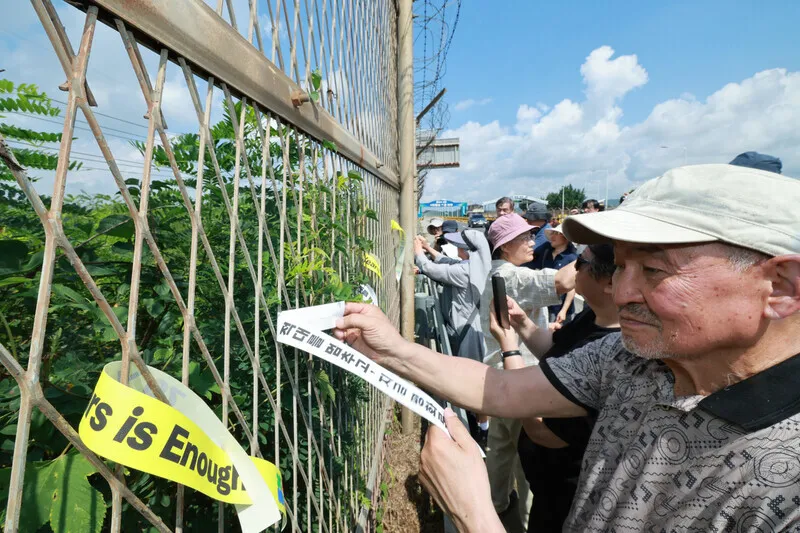
July 27 this year marked the 70th anniversary of the Armistice Agreement. The centennial will be in 2053.
Will the Korean War end up going down in history as another “hundred years’ war”? Will South Korea still be commemorating a “100-year ceasefire” that July, and will North Korea be staging a “Day of Victory” military review in the scorching summer heat?
I hope not. I hope there will come some clear day in Panmunjom when South and North gather together to noisily celebrate the day of peace when the war finally ended. I can also imagine them looking back from that vantage point on the major turn that things took in the preceding three decades.
As the mounting threat of nuclear war began impacting the everyday lives of ordinary people living on the Korean Peninsula, they will have come to the collective realization that the essence of the issue was not a matter of nuclear armament per se.
They will have grasped that nuclear weapons are a product of the armistice regime, great power politics, and inter-Korean confrontation — not a reason to sustain and reinforce those things. A third “miracle” will have occurred in Korea’s modern history, following the previous ones achieved with economic development and democratization.
The political realization came gradually, but the policy change came swiftly. To borrow an old phrase, Koreans set out on the path toward a “complete, verifiable, and irreversible” peace.
The policy that predicated peace on denuclearization was replaced with a policy of letting peace guide us toward denuclearization. Of course, the goal of eventual denuclearization was maintained. But the push to denuclearize was simply an attempt to achieve a “fringe benefit” of peace ahead of schedule.
The end-of-war declaration that would be the first step toward establishing a peace regime was made official during a meeting between the leaders of South and North Korea. That put an end to the debate about who should declare the war over and about the validity of de facto end-of-war declarations in previous inter-Korean statements.
While North Korea and the US technically remained at war, South and North Koreans had finally brought their internecine conflict to an end.
As for the peace treaty that would come next, everyone expected it would be an extremely complicated and challenging process that would require tampering with the South Korean Constitution. But that too was resolved through a simple and practical method.
Given the relationships among the four belligerents in the Korean War, the only remaining challenge was to end hostility between North Korea and the US. Establishing diplomatic relations between the two countries was able to stand in for an official peace treaty, since diplomatic relations were obviously predicated on ending hostilities and agreeing to peaceful relations.
By then, negotiations toward establishing official diplomatic relations were nearing completion, and Pyongyang and Washington had already set up liaison offices that functioned as de facto embassies. In fact, those liaison offices had been promised in the Agreed Framework that the US and North Korea signed in Geneva in October 1994. The two sides had also agreed to work together to improve bilateral relations and build a peace regime on the Korean Peninsula in their summit statement in June 2018.
An important role in the “great reversal” was played by the US, which became more flexible in its strategy on China and its policy toward North Korea. In its policy of decoupling, which had seemed to split the world into two halves, the US had sought not only to isolate China from the global economy but also to set up a hostile front against it.
But from an early stage, that policy had failed to win the eager support of big business except for the defense industry, and splitting the world into hostile camps only served to empower China. The eventual pivot to “de-risking” was an eminently practical and rational decision that essentially reinstated the strategy of blended competition and cooperation that had worked so well in the past.
Through frank discussions with the US, Korean diplomats secured its support and cooperation in regard to peace on the Korean Peninsula. Those changes were backed by the argument that an active push by the US for diplomatic relations with North Korea while South and North Korea were both committed to a policy of peace would have major diplomatic and economic dividends down the road for both the Korean Peninsula and Northeast Asia.
While the South Korea-US alliance remained in place and would continue to evolve going forward, South Korea’s growing confidence and the maturing of a peaceful cooperative relationship between South and North Korea brought qualitative changes.
For one, South Korea recovered wartime operational control (OPCON) of its military. As a matter of sovereignty, rather than a subject for agreement, that was a step South Korea should have simply informed the US it was taking. After OPCON was returned to Seoul, the ROK-US Combined Forces Command was replaced with a Joint Command under the South Korean military. The US troops that had been assigned to Combined Forces Command were returned to US Forces Korea with the exception of a small liaison group.
The UN Command also temporarily moved to Japan before being folded into US Forces Korea. That was a natural development for a command that had already been part of the US military with no formal relationship to the UN. Jurisdiction for the Demilitarized Zone was assumed by South and North Korea in their respective halves of the zone, based on the principle that state sovereignty had absolute supremacy over military authority under the Korean Armistice Agreement.
The resulting military command structure on the southern half of the Korean Peninsula consisted of two theater-wide commands — the Korean military’s Joint Command and US Forces Korea — which cooperated on their missions of peacekeeping and crisis management.
South Korea and the US ended their large-scale joint military maneuvers, and the US stopped deploying strategic assets to the Korean Peninsula. The South Korean and US militaries were holding the minimum required exercises separately and transparently, only joining together to assess each other’s performance.
To sum up, the focus of the South Korea-US alliance shifted from war to peace, from military matters to the economy, and from the Korean Peninsula to cooperation on global issues.
Historians would long praise the efforts by the South Korean government, military and diplomatic corps to advance that agenda swiftly yet smoothly, without undermining military preparedness or causing the US to lose face.
The last and most important reversal came in the form of the South and North Korean militaries’ development of a cooperative relationship. Nobody had dared dream the two sides would achieve not only military contact and exchange but also cooperation.
The two militaries had come to trust each through the operation of the Inter-Korean Joint Committee for Military Affairs, which had come into being even before the South and North Korean leaders made their end-of-war declaration. The terms of the 1992 Inter-Korean Basic Agreement and the Pyongyang Joint Declaration of September 2018 were implemented as well.
While South and North Korea continued military consultations with their respective allies, the Inter-Korean Joint Committee for Military Affairs was elevated to the preeminent deliberative body, at least in terms of peace and security on the Korean Peninsula.
In addition, Seoul and Pyongyang exchanged military attachés to enable ongoing military exchange and cooperation. The military attachés were busy arranging student exchanges between South Korea’s National Defense University and North Korea’s Kim Il-sung Military University, observing military exercises on both sides of the border, and supporting joint reconnaissance missions by the two sides’ armies, navies and air forces.
Operational cooperation was institutionalized in the form of the Inter-Korean Military Cooperation Headquarters, which coordinated joint military missions in limited areas including search and rescue missions, disaster aid, and troop deployments to provide humanitarian and peaceful aid overseas.
Once South and North Korea reach the federation stage of unification, they could even create a separate Inter-Korean Joint Operational Command while maintaining their separate command structures.
It’s time to return to the present day and the 70th anniversary of the armistice.
Some may see this hopeful vision as being a daydream or even a delusion. But in truth, this is the future for which we’ve long dreamed. It’s also the past I hope we’ll be able to look back on 30 years hence.
By Moon Jang-ryul, former professor at Korea National Defense University
Please direct questions or comments to [english@hani.co.kr]

Editorial・opinion
![[Editorial] Korea must rally nations to unite against Trump’s bullying](https://flexible.img.hani.co.kr/flexible/normal/500/300/imgdb/original/2026/0318/5317738209168584.jpg "[Editorial] Korea must rally nations to unite against Trump’s bullying") [Editorial] Korea must rally nations to unite against Trump’s bullying
[Editorial] Korea must rally nations to unite against Trump’s bullying![[Editorial] Korea must say no to sending soldiers into Trump’s war](https://flexible.img.hani.co.kr/flexible/normal/500/300/imgdb/original/2026/0317/9417737388477196.jpg "[Editorial] Korea must say no to sending soldiers into Trump’s war") [Editorial] Korea must say no to sending soldiers into Trump’s war
[Editorial] Korea must say no to sending soldiers into Trump’s war- [Column] What do norms mean in times of war?
- [Column] The megalomanic dictator with tariffs in one hand, missiles in the other
- [Editorial] Korea can’t let US trade probes strong-arm it into concessions
- [Editorial] Trump’s baseless claim that Iran bombed girls’ school crosses line
- [Correspondent’s column] JD Vance’s 67-hour disappearance
- [Column] Withstanding Trump’s predatory hegemony
- [Editorial] US dragging Kurds into its war with Iran would be a disaster
- [Column] US allies in the Gulf are in flames. Can Korea avoid a similar fate?
Most viewed articles
- 1Former bodyguard’s dark tale of marriage to Samsung royalty
- 2‘Golden’ acceptance speech interruption draws criticism over ‘disrespect’ at Oscars
- 3Trump inflates USFK numbers, pressures Seoul to ‘defend’ US in Strait of Hormuz
- 4Trump’s miscalculation in Iran derails plan for highly anticipated summit with Xi
- 5[Editorial] Korea must rally nations to unite against Trump’s bullying
- 6Trump adviser causes stir by suggesting Israel might nuke Iran
- 7Will US shifting THAAD to Mideast really leave a hole in South Korea’s air defenses?
- 8Return of the kings: BTS comeback turns Seoul thoroughfare into a stage
- 9BTS taps into history of ‘Arirang’ in teaser for new album
- 10Ejae’s Oscar dress inspired by Korean Empire’s ceremonial court attire