hankyoreh
Links to other country sites 다른 나라 사이트 링크
Why nasal swab – not saliva – COVID-19 tests are here to stay in S. Korea
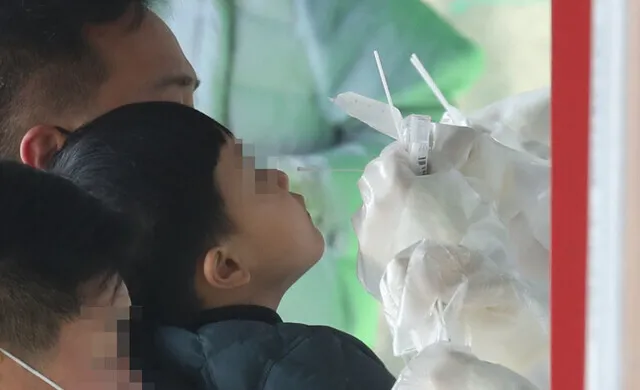
With the Omicron wave driving South Korea’s COVID-19 caseload to record highs, there are growing calls to test saliva samples instead of nasopharyngeal samples, which are collected with swabs inserted through the nose. In particular, some want the disease control authorities to allow the use of oral samples when testing children. But the authorities say it’s better to maintain PCR testing of nasopharyngeal swabs because saliva testing is less accurate and efficient.
Posts asking for saliva oropharyngeal swabs when administering PCR tests to children are easy to come across on online information-sharing communities for mothers. There are also frequent posts asking for information about testing centers that use oral samples, taken from inside the mouth.
Parents grew more anxious after someone posted on Feb. 2 that their child had a nosebleed that soaked their mask following a COVID-19 test in which the swab was inserted through the nose. At the end of last year, a petition was posted on the website of the Blue House asking for the government to accept saliva samples when testing infants for COVID-19.
At present, the disease control authorities regard nasopharyngeal swabs as the primary sample for PCR testing. Oral samples are only used in exceptional cases when there are medical reasons why a sample can’t be collected from the nose.
The government did accept saliva samples at temporary testing centers during the third wave of COVID-19, at the end of 2020. The problem, however, was that saliva samples are less accurate than the standard nasopharyngeal samples even when tested using the same PCR method. In terms of sensitivity — that is, the likelihood that an infected person will be diagnosed as positive by a test — nasopharyngeal samples are above 98%, but saliva samples are just 92%.
“Saliva testing can be regarded as being about 80% as accurate as standard PCR testing because saliva contains various kinds of foreign matter,” said Jung Ki-suck, professor of respiratory health at Hallym University Medical Center, on Feb. 4.
While PCR tests using saliva samples are more accurate than the rapid antigen tests that the Korean authorities have adopted in their response to the Omicron wave, another issue is that saliva testing is less efficient.
“After collecting the saliva sample, it takes a long time to process the sample for the test. It’s easy for the person providing the saliva sample, but the problem is that it creates more work [for medical staff],” said Eom Joong-sik, a professor of infectious disease at Gachon University Gil Medical Center.
“In our evaluation of saliva testing in the field, we found that it’s difficult to apply at scale. More staff and time are needed for pre-test processing, so we concluded that it’s not feasible to apply across the board,” said Koh Jae-yeong, head of the crisis communication team at Korea’s Central Disease Control Headquarters, on Feb. 4.
In the end, saliva testing is less efficient than rapid antigen testing and less accurate and efficient than nasopharyngeal PCR testing.
By Seo Hye-mi and Kim Yoon-ju, staff reporters
Please direct questions or comments to [english@hani.co.kr]

Editorial・opinion
![[Column] Takaichi is putting Japan’s constitution in crisis](https://flexible.img.hani.co.kr/flexible/normal/500/300/imgdb/original/2026/0607/1217807963082103.jpg "[Column] Takaichi is putting Japan’s constitution in crisis") [Column] Takaichi is putting Japan’s constitution in crisis
[Column] Takaichi is putting Japan’s constitution in crisis![[Editorial] Losing Seoul mayor’s race should be a wakeup call for Democrats](https://flexible.img.hani.co.kr/flexible/normal/500/300/imgdb/original/2026/0605/7417806468829773.jpg "[Editorial] Losing Seoul mayor’s race should be a wakeup call for Democrats") [Editorial] Losing Seoul mayor’s race should be a wakeup call for Democrats
[Editorial] Losing Seoul mayor’s race should be a wakeup call for Democrats- [Column] Naming the enemy: The unsettling return of ideological litmus tests in Korea
- [Editorial] No excusing ballot shortage fiasco
- [Column] Want to know where US decline is headed? Look at Russia
- [Column] Korea: A nation divided into blue and red
- [Column] Balancing strength and institutions to build Korean peace
- [Column] When obeying law and order is a true subversion
- [Editorial] PPP’s shameless parade of disgraced presidents
- [Column] From complete denuclearization of North Korea to managing nuclear risk
Most viewed articles
- 1Korean election body’s efforts to curb conspiracy theories backfire amid ballot shortages
- 2[Column] From complete denuclearization of North Korea to managing nuclear risk
- 3[Editorial] Korean democracy 20 years after the death of Park Jong-cheol
- 4[Editorial] Losing Seoul mayor’s race should be a wakeup call for Democrats
- 5[Column] When obeying law and order is a true subversion
- 6[News analysis] Korean voters rebuked the PPP, but withheld mandate for Democrats
- 7[Reportage] Next-gen SMRs poised to power America’s AI future
- 8[Column] Takaichi is putting Japan’s constitution in crisis
- 9Former bodyguard’s dark tale of marriage to Samsung royalty
- 10[Column] Korea: A nation divided into blue and red