hankyoreh
Links to other country sites 다른 나라 사이트 링크
S. Korea pauses further easing of COVID-19 curbs, makes at-home treatment standard
 Add as preferred source on Google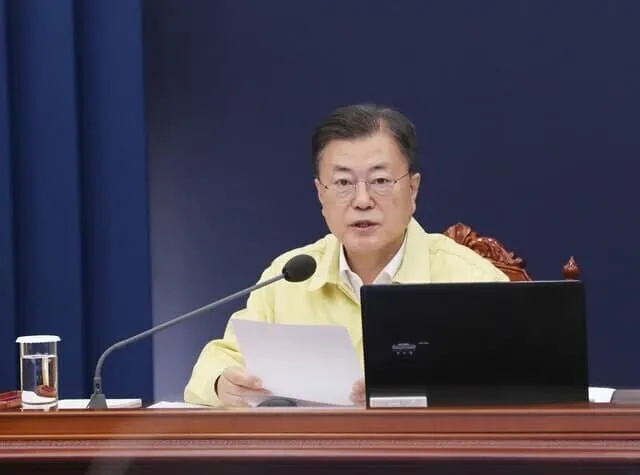
The South Korean government has decided to postpone the further easing of COVID-19 prevention measures that had been planned for mid-December as the second stage of its gradual return to everyday life.
Instead, it is implementing special disease control measures for a four-week period lasting until Dec. 26.
Booster shots of COVID-19 vaccines are to be provided for people aged 18 to 48, and expiration dates are to be imposed on vaccine passports, which certify that an individual has been fully vaccinated or produced a negative COVID-19 test result.
Speaking at a special disease control review meeting conducted via videoconference at the Blue House on Monday afternoon, President Moon Jae-in said, “After all the difficulties in starting, we cannot simply turn back the gradual return to everyday life and retreat into the past.”
“The government will be conducting a close assessment of the first stage of the return to everyday life over the past four weeks, while postponing the transition to the second stage as it implements special disease control measures over the next four weeks,” he said.
“We need to start viewing the third dose not as a ‘booster’ but as a basic part of the vaccination course, understanding that our vaccination is only complete when we have received that third shot,” he added.
Moon called on authorities to move quickly in examining whether COVID-19 vaccines should be made available to children aged 5 to 11, and in ensuring that orally administered COVID-19 treatments can be introduced within the year rather than by next February as scheduled.
The same day, the government announced special measures focused on adjusting the tempo of the “living with COVID-19” approach through stronger disease control rather than returning to the way things were before restrictions were eased.
Korea Disease Control and Prevention Agency Commissioner Jeong Eun-kyeong said in a briefing, “We need to implement special disease control measures in consideration of the current situation, where critical care beds and healthcare response capabilities are reaching their limits and all of the leading indicators are on the rise.”
“With the continued increase in the number of confirmed [COVID-19] cases and the positive testing rate, we have determined that measures are needed to suppress the occurrence of cases,” she noted.
Based on the nationwide booster administration policy, adults aged 18 and over would need to receive a third vaccine dose five months, or 150 days, after their second dose.
Those eligible for booster shots will be able to reserve an appointment online starting on Thursday, Dec. 2. Same-day administration of leftover vaccines will also be made available on Thursday.
Those receiving leftover vaccines will be able to move their third dose up by at least one month from the regular schedule: at least three months after the second dose in the case of people aged 60 and older, and at least four months after for those aged 18 to 59.
The current vaccine passports will expire six months out from vaccination — five months for the interval between second and third doses, with a one-month grace period.
“In light of the decline in the vaccines’ effectiveness in preventing infection as time passes after administration, we plan to apply an expiration date to vaccine passes and encourage booster vaccinations for those hoping to use multipurpose and infection-vulnerable facilities [subject to vaccine pass restrictions],” the government explained.
Home treatment is also being expanded. To address the shortage of hospital beds, the government plans to adopt a new system where home treatment is considered the standard, rather than the optional status it currently holds.
Under this system, all confirmed COVID-19 patients are to remain at home as a rule, with hospitalization only in cases that are deemed to warrant it, including the presence of hospitalization risk factors or a home environment that is deemed vulnerable in terms of additional transmission.
In response to the recent sharp rise in confirmed cases — in the greater Seoul area in particular — disease control authorities plan to open additional residential treatment centers in the capital region and elsewhere, with another 2,000 or so sickbeds to be made available.
The measure is meant to reduce the burden on the healthcare system as total and severe/critical cases have risen steeply in the greater Seoul region and elsewhere since the transition toward “living with COVID-19.”
As of 5 pm on Sunday, the dedicated COVID-19 critical care hospital bed occupancy rate had passed 76.9% — and was at 86.6% for the greater Seoul area — exceeding the 75% threshold given by the government for consideration of an emergency plan.
The measures did not include any plans for enforced social distancing, such as a reduction in the number of allowable participants in private gatherings. But a pilot program to allow the consumption of food in movie theaters is to be halted in light of recent cluster infections occurring at cinemas.
A total of 3,309 new confirmed COVID-19 cases were counted by the end of the day Sunday, with 629 patients in severe or critical condition.
By Lee Jae-ho, Kwon Ji-dam and Lee Wan; staff reporters
Please direct questions or comments to [english@hani.co.kr]

Editorial・opinion
![[Editorial] Seoul mayor risks losing office, but he’s already lost voters’ trust](https://flexible.img.hani.co.kr/flexible/normal/500/300/imgdb/original/2026/0723/2217847949281733.jpg "[Editorial] Seoul mayor risks losing office, but he’s already lost voters’ trust") [Editorial] Seoul mayor risks losing office, but he’s already lost voters’ trust
[Editorial] Seoul mayor risks losing office, but he’s already lost voters’ trust![[Column] Korea’s brave new world: Tanking employment and soaring home prices](https://flexible.img.hani.co.kr/flexible/normal/500/300/imgdb/original/2026/0723/1917847946266774.jpg "[Column] Korea’s brave new world: Tanking employment and soaring home prices") [Column] Korea’s brave new world: Tanking employment and soaring home prices
[Column] Korea’s brave new world: Tanking employment and soaring home prices- [Editorial] Korean Peninsula once again becomes the front line of a geopolitical rivalry
- [Editorial] Regulatory action needed after another preventable warehouse fire
- [Column] Seeking the Korean soldiers who showed mercy during Vietnam massacres
- [Reporter’s notebook] Trump’s White House windfall
- [Column] Will Lee’s NATO partnership end differently than Yoon’s support for Ukraine?
- [Editorial] For Korea’s disputes with the US, the only way out is through
- [Column] Trump’s war at home
- [Column] Another sign of an empire in decline
Most viewed articles
- 1[News analysis] Trump’s nuclear carrot for Saudis could further destabilize Mideast
- 2Peace, not denuclearization, now South Korea’s priority in policy toward North
- 3[Column] Trump’s war at home
- 4[Column] Korea’s brave new world: Tanking employment and soaring home prices
- 5SK Chairman and Roh tae-woo’s daughter expected to divorce
- 6Real-life heroes of “A Taxi Driver” pass away without having reunited
- 7A whole new China-North Korea alliance is taking shape, report argues
- 8Test-obsessed Korea reckons with smart glasses-powered cheating
- 9New MASGA hub marks next phase of Korea-US shipbuilding partnership
- 10After Iran war, North Korea’s nukes are an asset, not a burden, for China, says expert