hankyoreh
Links to other country sites 다른 나라 사이트 링크
Not even a war can stop Ukrainian kids from dreaming big with robotics
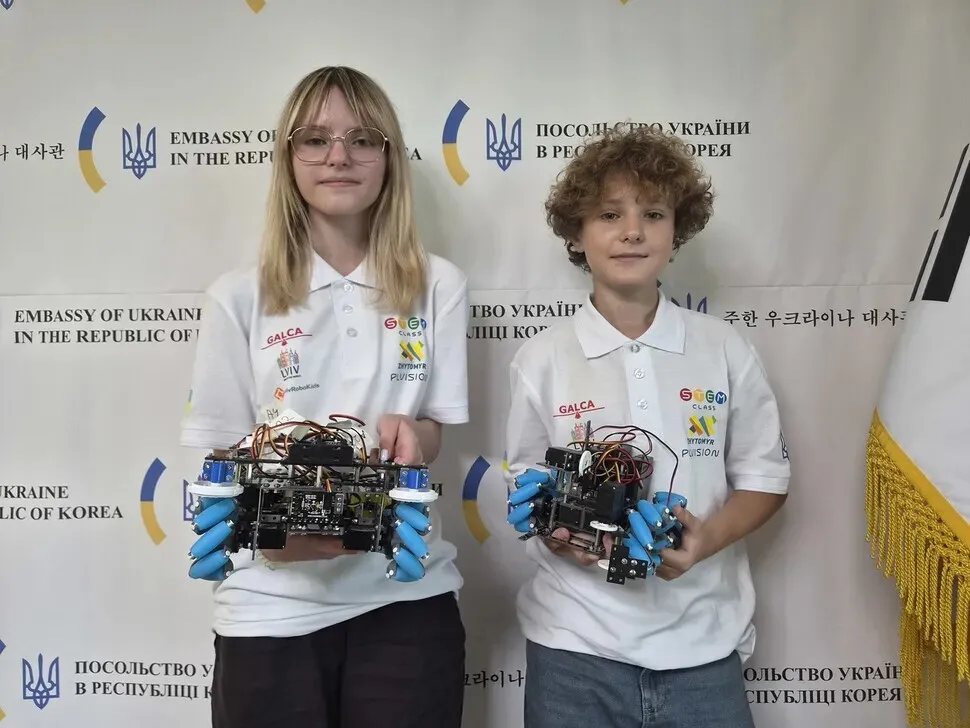
With the flip of a switch, a robot began to whir before setting off on its four wheels to find its target. After locating a box with the five sensors on all its sides and the bottom of its frame, the robot grabbed the box with its arms and put it down exactly where it was programmed to.
The robot was created by Anna Tieliehina, a 14-year-old from Ukraine, who was responsible for everything from its design to its construction.
“I made sure that the wheels were fastened tight so that the robot wouldn’t wobble when it picked up boxes,” Anna said when explaining how the robot was able to move with ease.
Though war has raged on in Ukraine for over four years, the country’s children continue to dream big.
Anna and Oles Letyta, 12, recently won a national robotics competition for children and teenagers in Ukraine, and were in Seoul to participate in the International Programming Robot Challenge, which took place on Sunday.
The Hankyoreh met with Anna and Oles at the Ukrainian Embassy in Yongsan, Seoul, on Thursday to hear how robots helped them find their dreams.
Anna’s robot specializes in pathfinding and carrying objects. It had the highest accuracy during the preliminary round, which involved finding a box in a maze and moving it to a specific destination.
“We had to program the robot’s path at the competition venue. I quickly corrected the errors I found during the first round, so the robot did a better job navigating in the second round,” Anna said.
Oles’ robot is a shooting robot controlled remotely via a joystick. The robot picked up a die and fired it forward, knocking the target away in a blink of an eye.
Oles began making robots after his older brother went to Korea after winning the Ukrainian qualifiers last year.
“To prepare for the competition, I would focus on designing my robot as soon as I was done with school and before dinner. I revised my first idea many times, so the whole process took about four months,” he said.
Anna got her start in robotics after she began learning computer programming at school last year, when she was in seventh grade. Her teachers noticed her knack for the subject and introduced her to an outside professional instructor. From there, her coding skills improved by leaps and bounds.
Her dedication was so strong that she spent hours after school practicing programming.
Anna became the first female student to date to have won in the Ukrainian national qualifiers. Last year, not a single female student participated in the qualifiers, yet Anna went on to win first place in her very first robotics competition.
“My mom was over the moon when she heard that I’d won. She’s cheering me on, saying that I’ll get even better results in the Korean competition,” Anna said with a smile.
“My family said that representing your country isn’t an opportunity available to everyone, so they encouraged me to go to Korea and show off my skills,” Oles said.
However, the ongoing war made concentrating on their robots far from easy for the young Ukrainians. Air raid sirens wail almost daily, warning of incoming missile and suicide-drone attacks and forcing the children to wake in the middle of the night and seek safety in underground shelters.
“If the Shahed icon pops up on the air raid alert app, we run to the hallway. But if a missile icon pops up, our entire family has to run to the shelter,” said Oles.
Since drones have only enough explosive power to destroy walls, people need only to seek shelter in hallways and away from windows. But ballistic missiles, which are powerful enough to topple entire buildings, force residents to flee underground for safety.
Even in broad daylight, the children recounted seeing Russian drones flying through the streets.
“I had missed the strike alert and was playing with my friends when a Shahed drone came flying by. It swerved at the last minute, flying above our heads before crashing into a nearby building,” Oles said, shaking his head as he recalled that close call.
Even making the journey to Korea came with various complications, as Ukraine has closed its entire airspace to all commercial flights due to Russian strikes. The children had to travel by land to the neighboring country of Poland to board a plane to Beijing before finally arriving in Seoul.
“The person screening luggage at the airport looked at our robots, which were from Ukraine, and asked if they were drones. We had to convince them that the robots didn’t fly or shoot bullets,” said Anna.
Despite all the challenges they face, the children want to continue to make robots.
“I want to become an engineer or a programmer to make programs for robots and applications that’ll help people in their daily lives,” Anna said.
“First, I want to do well in this competition. Then, I’ll develop a new robot and enter a new contest. I’ll make a robot that’ll clean the streets of my home city, Lviv,” Oles said.
The 12-year-old shared one last dream when we spoke with him.
“I hope that the war doesn’t spread any further, so I can continue to study in Lviv,” he said.
By Cheon Ho-sung, staff reporter
Please direct questions or comments to [english@hani.co.kr]

Editorial・opinion
![[Column] Harari’s 2030s: A new age of repressive desublimation](https://flexible.img.hani.co.kr/flexible/normal/500/300/imgdb/original/2026/0927/7317904739856884.jpg "[Column] Harari’s 2030s: A new age of repressive desublimation") [Column] Harari’s 2030s: A new age of repressive desublimation
[Column] Harari’s 2030s: A new age of repressive desublimation![[Guest essay] This Chuseok, think of the seasonal workers who plant and pick your food](https://flexible.img.hani.co.kr/flexible/normal/500/300/imgdb/original/2026/0927/771790472388276.jpg "[Guest essay] This Chuseok, think of the seasonal workers who plant and pick your food") [Guest essay] This Chuseok, think of the seasonal workers who plant and pick your food
[Guest essay] This Chuseok, think of the seasonal workers who plant and pick your food- [Editorial] To build back public confidence, Lee must address issues affecting everyday Koreans
- [Column] Korea-Japan cooperation still has a long way to go
- Trump has taken a wrecking ball to America’s democratic institutions
- [Column] Sending troops to Hormuz would be a fatal miscalculation by Seoul
- [Guest essay] A tribute to Gloria Steinem and her legacy in Korea
- [Correspondent’s column] Korea has its own ‘red lines,’ too
- [Column] An open letter to Kim Jong-un and Donald Trump
- [Editorial] It’s time to pump the brakes on AI’s development
Most viewed articles
- 1[Column] Harari’s 2030s: A new age of repressive desublimation
- 2Not just Korea: Google leaked identifying info for sex crime victims across the world
- 3[Paris Olympics] An Se-young wins Korea’s first women’s badminton singles gold in 28 years
- 4Swedish IOC member’s adoptee wife seeking her birth parents
- 5June Huh becomes first mathematician of Korean descent to win prestigious Fields Medal
- 6Korea’s atrocities in Vietnam, in the words of those who saw and survived them
- 7Do Korea’s conservative frontrunners have what it takes to become president in 2030?
- 8South Korea’s president forgoes ‘denuclearization’ for ‘peninsula free from nuclear weapons’ in UN speech
- 9Korea a half century ago
- 10[Photo] Dismissed MBC journalists return to work