hankyoreh
Links to other country sites 다른 나라 사이트 링크
Korea to participate in multinational mission to secure Strait of Hormuz after war’s end
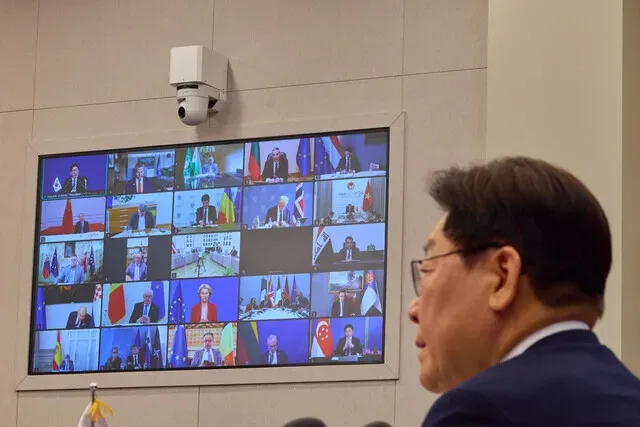
While participating in an international summit on securing the freedom of navigation through the Strait of Hormuz, South Korean President Lee Jae Myung announced plans to make “substantive contributions” to guaranteeing free passage through the strait.
The statement officially declared his intent for South Korea to join a multinational mission in the strait once the US-Israel war with Iran is over.
On Friday, Lee participated via videoconference in a summit on the France- and UK-led initiative for maritime navigation in the Strait of Hormuz. Representatives of two international organizations and 49 countries including South Korea, Germany and Italy took part in the summit.
Emphasizing that South Korea’s reliance on imports through the Strait of Hormuz for around 70% of its crude oil makes it a key stakeholder in the situation, Lee proposed an approach of “quickly resolving the deadlock and working with the international community to explore management mechanisms for the sake of the strait’s stability.”
The “substantive contributions” that Lee referred to mean that the South Korean military would be participating in a multinational mission to begin activity after the US-Iran war has ended.
A senior Blue House official explained that this represented a “commitment to participating in and contributing to” such a mission.
“The idea is that we would be taking part in the international mobilization of forces to ensure free navigation in the Strait of Hormuz after the war is over,” the official added. The situation reflects an awareness of the direct connection between the strait’s stability and South Korea’s national interests in terms of energy supplies.
After the summit, the UK and France issued a joint statement on the outcome, explaining that at least 12 countries were prepared to take part in the multinational mission that would be established to conduct mine clearance operations and other activities in the strait after a ceasefire agreement has been reached.
On Tuesday, South Korean Minister of National Defense Ahn Gyu-back announced before the National Assembly that preparations were underway for South Korea’s participation in such a multinational mission after the war.
But it remains to be seen what international discussions and preparations will need to happen if the South Korean military is to take part after the war, as well as what form the participation will take.
A key variable has to do with what kind of agreement about the strait emerges in the negotiations by Washington and Tehran to end the war. Participation in the multinational mission does not necessarily mean sending warships or combat troops. Other possible approaches include deploying liaison officers or staff officers to its headquarters or providing logistical support to areas other than the Strait of Hormuz.
Military officials said that even if South Korea does decide to send destroyers or minesweepers, the procedures would take upwards of three months, including two months for unit organization and training at home and another month for travel to the strait.
The procedures for establishing the mission are also complicated. For naval forces from different countries to take part jointly, communication rules will need to be aligned, and tactics and situational perceptions will need to be shared. Questions of which ports to use as key stopover points or who will be responsible for clearing mines from port access routes and when will also require planning and a division of labor.
A South Korean government official said, “It does appear that European countries will be central to the multinational mission’s forces, and there will need to be follow-up discussions in terms of what contributions are made by what countries.”
Still another key variable is the question of US participation. German Chancellor Friedrich Merz said after the summit that he hoped the US would participate if possible, while French President Emmanuel Macron envisions an approach that centers on countries that were not belligerents.
Meanwhile, Iranian Ministry of Foreign Affairs spokesperson Esmaeil Baqaei commented on the meeting on the initiative for free navigation in the Strait of Hormuz in a message on Saturday on X.
“Europe’s chronic failure to practice what it preaches has turned its ‘international law’ talk into peak hypocrisy,” he argued.
By Park Min-hee, senior staff writer; Kwon Hyuk-chul, staff reporter; Seo Young-ji, staff reporter
Please direct questions or comments to [english@hani.co.kr]

Editorial・opinion
![[Editorial] Sinking Korean youth employment in AI era requires action, and fast](https://flexible.img.hani.co.kr/flexible/normal/500/300/imgdb/original/2026/0612/6917812528673508.jpg "[Editorial] Sinking Korean youth employment in AI era requires action, and fast") [Editorial] Sinking Korean youth employment in AI era requires action, and fast
[Editorial] Sinking Korean youth employment in AI era requires action, and fast![[Editorial] Korean students show how to protest ballot fiasco without resorting to conspiracies](https://flexible.img.hani.co.kr/flexible/normal/500/300/imgdb/original/2026/0611/3417811664396971.jpg "[Editorial] Korean students show how to protest ballot fiasco without resorting to conspiracies") [Editorial] Korean students show how to protest ballot fiasco without resorting to conspiracies
[Editorial] Korean students show how to protest ballot fiasco without resorting to conspiracies- [Column] What do people crying election fraud in Korea even want?
- [Column] Once security assets, US bases are now liabilities to host countries
- [Column] Takaichi is putting Japan’s constitution in crisis
- [Editorial] Losing Seoul mayor’s race should be a wakeup call for Democrats
- [Column] Naming the enemy: The unsettling return of ideological litmus tests in Korea
- [Editorial] No excusing ballot shortage fiasco
- [Column] Want to know where US decline is headed? Look at Russia
- [Column] Korea: A nation divided into blue and red
Most viewed articles
- 1Yoon gets 30 years for drone plot aimed at riling North Korea so he could declare martial law
- 2Korean court rules same-sex union entitled to legal protection in homewrecker suit
- 3Korea’s reliance on US for security, China for economy has ‘lost validity,’ says Lee
- 4Record fine for Coupang is only the beginning of its troubles
- 5[World Cup] Hwang inspires comeback as Oh completes turnaround to beat Czech Republic 2-1
- 6[Editorial] Sinking Korean youth employment in AI era requires action, and fast
- 7Blue House policy chief outlines vision to make Korea a hub for AI supply chain
- 8US draft defense bill may ease ban on foreign construction of auxiliary naval vessels
- 9Coupang hit with record 624.7 billion won fine by Korean regulator over privacy violations
- 10Rapid oil stockpile depletion raises alarm over potential crisis later this year