hankyoreh
Links to other country sites 다른 나라 사이트 링크
Khamenei the martyr, Trump the fool? Why a wider, longer war may be in store
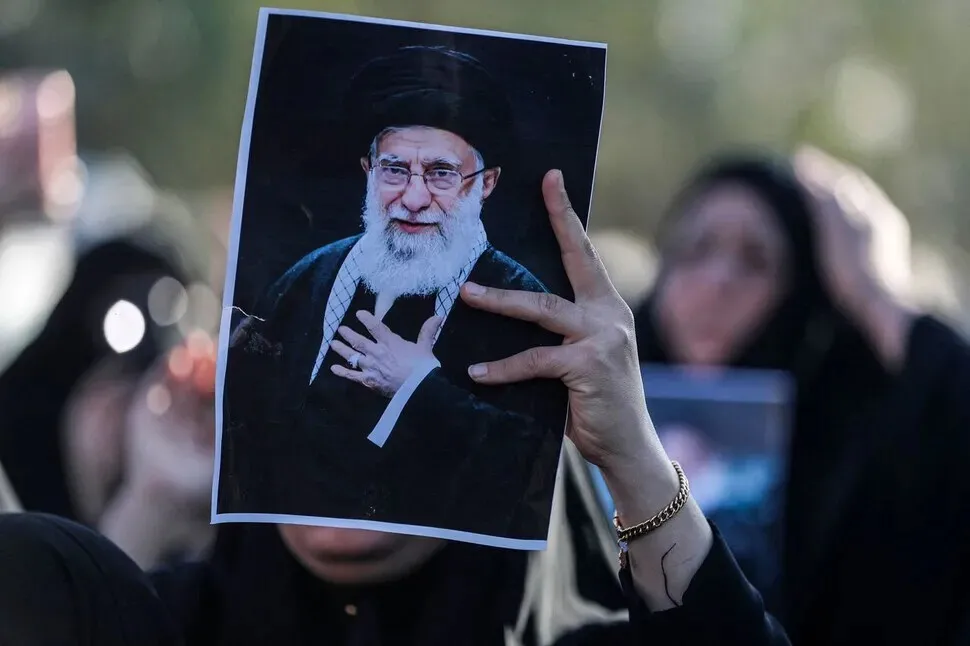
Expand the war. Increase the costs. Outlast the enemy.
That strategy, established by Iran’s late supreme leader, has caught US President Donald Trump on the back foot, analysts say, as Iran uses low-cost drones to drag the wider Middle East into war, driving up global energy prices and inflation, in a bid to put pressure on Trump ahead of November’s midterm elections.
According to reports published Tuesday by the Financial Times and others, Iran’s Ayatollah Ali Khamenei and military leaders began working on a detailed plan to attack energy facilities and strikes that would disrupt air travel in the region following Israel’s 12-day war against the Islamic Republic in June 2025.
By plunging the entire Middle East into chaos and wreaking havoc on global markets with an oil shock, Iran intended to pressure the US and Israel into stopping their attacks.
This strategy immediately kicked in when Iran’s supreme leader and others were assassinated in US-Israel strikes on Saturday. Iran fired back by targeting US military bases, energy facilities, international airports, ports and hotels in the Middle East.
“We had no choice but to escalate and start a big fire so everyone would see. What did they expect? If the head of the Islamic Republic is targeted, do they think nothing will happen?” an Iranian regime insider told the Financial Times.
Iran was able to conduct an aggressive and swift counterattack as the government and military leadership had prepared for emergencies by decentralizing decision-making authority, addressing the vacuum that occurred in June 2025, when it lacked commanders following sudden strikes that summer.
Some believe that Khamenei, who had taken refuge in an underground bunker during those attacks, deliberately chose to remain at his residence in Tehran, the capital, opting to become a martyr. That calculation would have been based on confidence that preparations would ensure the stability of the Iranian regime and its capacity for retaliation, even if he were killed.
The wave of mourning that has swept across Iran following Khamenei’s death has also been instrumental in dousing the momentum of anti-government protests.
Tactically, Iran is employing a strategy of driving up the cost of war for the US by using cheap unmanned drones to exhaust pricey air defense missiles. The Guardian reported Monday that Iran has sent over 1,000 unmanned drones, including Shahed 136s, since the outbreak of the war on Saturday.
Two or three air defense missiles, which cost US$4 million a pop, are usually launched to strike down one Shahed 136, which is priced at around US$50,000. Concerns are growing that, once US and Israeli air defense missiles are exhausted, Iran will attempt to turn the tables by launching the supersonic missiles it had set aside to target the official residences of Israeli leadership or desalination facilities in the Middle East. The Turkish Anadolu Agency reported that the US spent around US$779 million on the first 24 hours of the war alone.
The New York Times analyzed that Iran’s more fundamental strategy is to drag out the war so as to increase the political costs for the US and thereby ratchet up pressure on Washington. The longer the war goes on, the higher international energy costs will be driven up, as will global inflation.
Also, Trump’s core base — those with the MAGA movement and young Americans — don’t want a protracted war or a rising toll of US combat deaths. By pursuing this strategy, Iran is attempting to drag down support for Trump, which will then impact the results of the midterm elections in November.
The New York Times predicted that Europe, which has become dependent on energy from the Persian Gulf to wean itself off Russian gas, will add pressure on the US to bring the war to a halt. However, it also posited that the US would be wary to retreat without achieving its key goals of dismantling Iran’s nuclear and missile programs or bringing an end to the theocratic regime.
Ali Larijani, the secretary of Iran’s Supreme National Security Council and the country’s de facto leader, uploaded a post on the social media site X on Monday to say, “Iran, unlike the United States, has prepared itself for a long war.”
“We will fiercely defend ourselves and our six thousand years old civilization regardless of the costs and will make the enemies sorry for their miscalculation,” his message went on.
By Kim Ji-hoon, staff reporter
Please direct questions or comments to [english@hani.co.kr]

Editorial・opinion
![[Editorial] Trump’s baseless claim that Iran bombed girls’ school crosses line](https://flexible.img.hani.co.kr/flexible/normal/500/300/imgdb/original/2026/0309/4217730446901883.jpg "[Editorial] Trump’s baseless claim that Iran bombed girls’ school crosses line") [Editorial] Trump’s baseless claim that Iran bombed girls’ school crosses line
[Editorial] Trump’s baseless claim that Iran bombed girls’ school crosses line![[Correspondent’s column] JD Vance’s 67-hour disappearance](https://flexible.img.hani.co.kr/flexible/normal/500/300/imgdb/original/2026/0306/2517727866984907.jpg "[Correspondent’s column] JD Vance’s 67-hour disappearance") [Correspondent’s column] JD Vance’s 67-hour disappearance
[Correspondent’s column] JD Vance’s 67-hour disappearance- [Column] Withstanding Trump’s predatory hegemony
- [Editorial] US dragging Kurds into its war with Iran would be a disaster
- [Column] US allies in the Gulf are in flames. Can Korea avoid a similar fate?
- [Editorial] North Korea’s tough talk mustn’t deter Seoul’s efforts to rebuild trust
- [Editorial] Attack on Iranian girls’ school is an indefensible crime against humanity
- [Editorial] Trump’s unjustified war with Iran threatens chaos for us all
- [Column] What a Korean man’s foiled plan to seek assisted death in Switzerland reveals
- [Column] This is what accountability looks like
Most viewed articles
- 1Korea named as target of new Section 301 probe by US
- 2‘Made in USA’: Scraps of missile that killed Iranian children point to US responsibility
- 3[Editorial] No greater sign that South Korea must prioritize building its own defense abilities
- 4US may seek exit from Iran war by moving the goalposts of victory
- 5US Democrats say Trump’s investment pressure has ‘deeply unsettled’ alliance with Seoul
- 6[Column] Misconceptions about America’s war with Iran
- 765% of Korean men say gender equality has gone ‘far enough’; only 42% of women agree
- 8How much is the US willing to risk for the Strait of Hormuz?
- 9Coupang investors insinuate that US is planning Section 301 probe into Korea
- 10[News analysis] Air defense pullout signals new era of US strategic flexibility in Korea