hankyoreh
Links to other country sites 다른 나라 사이트 링크
[Reportage] As drones range deeper, distinctions of war’s front and rear blur in Ukraine

At dawn on Feb. 5, the deafening sound of explosions shook Kyiv. Combat drones sent by Russia had struck an apartment building near a central train station. Two women, aged 79 and 89, were injured by shrapnel. Amid the roar of the explosions and the blare of emergency sirens, people out in the streets greeted the day with tense looks on their faces.
Speaking to Hankyoreh reporters, a Ukrainian soldier said a “mother ship,” a larger drone, had “dispatched smaller ones from a high elevation.”
“This is to avoid anti-drone counterstrikes,” the soldier explained, shaking his head.
Since Russia’s invasion of Ukraine on Feb. 24, 2022, drones have become the weapon of choice in the ongoing war.
Outnumbered, Ukrainians have devoted themselves to developing drones and drone warfare tactics since the beginning of the war — efforts that have helped them resist the Russians for the past four years.
However, Russia has since built up its own drone forces, both in number and in sophistication. Moscow has extended its strike range to thousands of kilometers. Every night, drone strikes reach even the Ukrainian rear. Once the exclusive domain of science fiction, warfare in which robots controlled by joysticks kill people is already the norm in Ukraine.
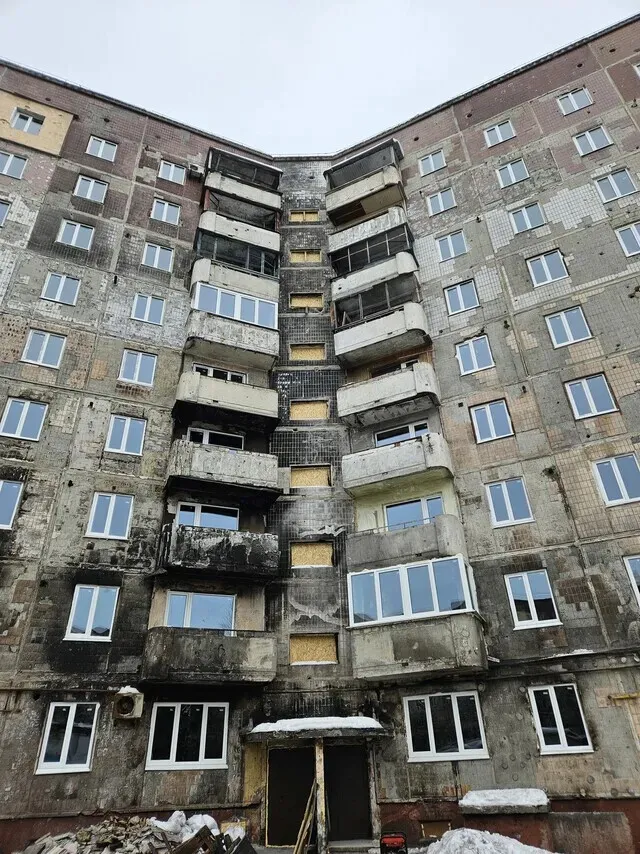
When I met her on Feb. 3, Nelia sighed as she surveyed the damage to her home, charred black by a Russian airstrike. The apartment in Ternopil, a city in western Ukraine, where she had lived since 1989, was struck at around 7 am on Nov. 19 by a Russian missile and was engulfed in flames. Nelia and her husband evacuated from their unit on the building’s second floor to a nearby church, where a priest had put out a ladder that led to the church’s balcony. They climbed the ladder to avoid the inferno. Six people who lived above them, including family members, died in the blaze.
“Our neighborhood is the most densely populated in Ternopil — it’s all residential. There are no industrial or military facilities, so I never thought that they would launch missiles at our neighborhood,” Nelia said.
Five blocks away, another apartment was struck on the same day. The wall collapsed, and the building collapsed. Shrapnel from the explosion went as far as the home of Halyna, an 83-year-old living in a building some 50 meters away. Suffering from high blood pressure, the very thought of that day makes her heart race and her body shudder.
“I have bad knees, so even when I saw the window shatter, I couldn’t move. A neighbor pulled me out by my arms, and only then was I able to escape the building,” she said.
According to the Ternopil city government, Russia had used four drones and four missiles for that day’s attack. The strike killed a total of 38 people, including eight children, in the two apartment buildings targeted, making it one of the deadliest attacks on Ukrainian noncombatants in the war.
The drones struck civilian residences in a city that was over 1,000 kilometers from the front. The attack shocked the international community.
“The Russians are sending a message: Even the rear is not safe. Nowhere in Ukraine is safe. They killed civilians to instill fear,” said Ternopil Mayor Serhiy Nadal, his voice quivering with grief and rage.
The disappearance of safe zones is mainly due to advancements in Russia’s drone program throughout the past four years, allowing it to infiltrate deeper and strike more accurately.
In the early stages of the war, armored Russian vehicles were easy targets for small FPV (first-person view) drones. The Ukrainians used DJI drones from China to determine the location of Russian tanks. They would then fire upon the location with antitank guns or strike directly with combat drones. YouTube videos showing quadcopter drones dropping mortar bombs on tank engines, turning them into balls of fire, were watched around the world.
Russia started mass-producing drones in 2023, however, and its drone capacity is now roughly on par with Ukraine’s. The skies above the front line are saturated with drones. Surveillance drones detect enemy movements in real time, making it effectively impossible for either side to mobilize a large amount of troops or artillery.
“Around six months ago, NATO forces requested that our drone commanders appraise the West’s latest tanks. The commander replied, ‘Tanks like this will become an entirely new existence [scrap metal] within 30 minutes on the front,’” commented a Ukrainian officer who asked to remain anonymous.
With the front locked in a stalemate, preventing either side from making significant advances, both sides have now shifted to long-distance strikes that penetrate deep into the enemy’s interior. The bulk of Russian strikes are done by Iranian-designed Shahed drones, shaped like stingrays. The latest line of Shaheds has a range of up to 2,500 km, and can fly as high as 4,000 meters. They can dive bomb from near their targets, drastic movements that render air defense systems ineffective, according to Ukrainian authorities.
The Ukrainian military authorities that I spoke to were especially concerned about the discovery of Starlink, a satellite internet service developed by SpaceX, terminals on Shahed drones.
Before Starlink, beyond about 100 km inside Ukrainian territory, Russian communications links would no longer reach, so operators had to pre-program the target coordinates and send the drones off on their own. With the satellite internet, they can assess targets in real time through video shot by smaller long-range FPV drones, allowing them to adjust for strike accuracy.
“The Shahed now has eyes. It’s become that much more difficult to bring them down through electromagnetic scrambling,” a Ukrainian military official said.
In early February, SpaceX adopted a system that allowed only approved transmitters to connect to Starlink satellites, thereby limiting transmissions to regions within Ukraine, but there are still concerns about the Russians evading such controls.
Ukraine is deploying strike drones with ranges up to 1,500 km to attack oil refineries within Russia. Fearing an expansion of the war, the US has not provided Ukraine with Tomahawks — long-range, all-weather, subsonic cruise missiles. So Ukraine has turned to drones, which are much easier to develop.
The scope of drone operations has since expanded to above the seas and into high elevations. Equipped with tracks, unmanned ground vehicles (UGVs) are often tasked with transporting rations, ammunition, and wounded soldiers because of their ability to evade drone detection. Drones now install mines near the front in areas that are dangerous for humans to approach. The Ukrainian Navy operates maritime drones that strike enemy ships and coastal bases.

Both enlisted soldiers and officers alike are saying that drone capabilities will decide who wins or loses future military conflicts. The paradigm of war is shifting to emphasize the capacity to produce as many drones as cheaply as possible to destroy as many enemy forces as possible.
“This war has become a fight of who is more efficient. Instead of larger, heavier, and more expensive weapons, cheaper and more mobile weapons are ‘hunting’ humans from a distance,” commented an officer who requested anonymity.
Olha Melyoshina, a drone commander, said, “There will be no more wars without drones. Military doctrines that emphasize conventional weapons need to evolve to include drone combat.”
By Cheon Ho-sung, staff reporter
Please direct questions or comments to [english@hani.co.kr]

Editorial・opinion
![[Editorial] Trump’s baseless claim that Iran bombed girls’ school crosses line](https://flexible.img.hani.co.kr/flexible/normal/500/300/imgdb/original/2026/0309/4217730446901883.jpg "[Editorial] Trump’s baseless claim that Iran bombed girls’ school crosses line") [Editorial] Trump’s baseless claim that Iran bombed girls’ school crosses line
[Editorial] Trump’s baseless claim that Iran bombed girls’ school crosses line![[Correspondent’s column] JD Vance’s 67-hour disappearance](https://flexible.img.hani.co.kr/flexible/normal/500/300/imgdb/original/2026/0306/2517727866984907.jpg "[Correspondent’s column] JD Vance’s 67-hour disappearance") [Correspondent’s column] JD Vance’s 67-hour disappearance
[Correspondent’s column] JD Vance’s 67-hour disappearance- [Column] Withstanding Trump’s predatory hegemony
- [Editorial] US dragging Kurds into its war with Iran would be a disaster
- [Column] US allies in the Gulf are in flames. Can Korea avoid a similar fate?
- [Editorial] North Korea’s tough talk mustn’t deter Seoul’s efforts to rebuild trust
- [Editorial] Attack on Iranian girls’ school is an indefensible crime against humanity
- [Editorial] Trump’s unjustified war with Iran threatens chaos for us all
- [Column] What a Korean man’s foiled plan to seek assisted death in Switzerland reveals
- [Column] This is what accountability looks like
Most viewed articles
- 1Korea named as target of new Section 301 probe by US
- 2‘Made in USA’: Scraps of missile that killed Iranian children point to US responsibility
- 3[Editorial] No greater sign that South Korea must prioritize building its own defense abilities
- 4US may seek exit from Iran war by moving the goalposts of victory
- 5US Democrats say Trump’s investment pressure has ‘deeply unsettled’ alliance with Seoul
- 6[Column] Misconceptions about America’s war with Iran
- 765% of Korean men say gender equality has gone ‘far enough’; only 42% of women agree
- 8How much is the US willing to risk for the Strait of Hormuz?
- 9Coupang investors insinuate that US is planning Section 301 probe into Korea
- 10[News analysis] Air defense pullout signals new era of US strategic flexibility in Korea