hankyoreh
Links to other country sites 다른 나라 사이트 링크
Trump threatens 25% tariff on Korea amid delays to bill on US investment package
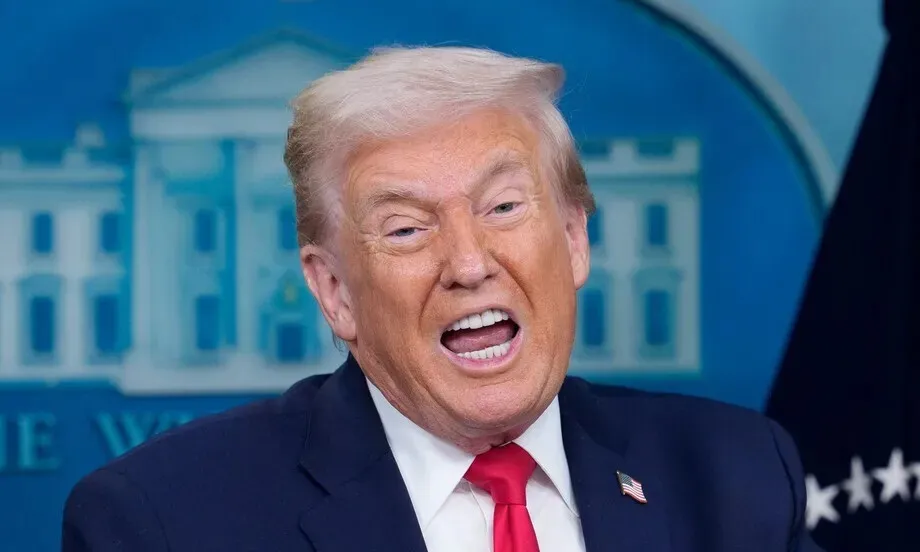
Claiming that South Korea’s National Assembly was not holding up its end of the trade bargain, US President Donald Trump said he would be raising the tariffs on various Korean goods entering the US to 25%.
Some suggest that Trump’s reversal on tariff rates that were already lowered for Korean companies is an expression of frustration regarding the delays in legislative approval of Korea’s investments in the US in return for lowered tariff rates.
In a post to his Truth Social on Monday (US time), Trump declared, "Our Trade Deals are very important to America. In each of these Deals, we have acted swiftly to reduce our TARIFFS in line with the Transaction agreed to. We, of course, expect our Trading Partners to do the same."
"South Korea's Legislature is not living up to its Deal with the United States," he continued.
"President Lee and I reached a Great Deal for both Countries on July 30, 2025, and we reaffirmed these terms while I was in Korea on October 29, 2025. Why hasn't the Korean Legislature approved it?"
"Because the Korean Legislature hasn't enacted our Historic Trade Agreement, which is their prerogative, I am hereby increasing South Korean TARIFFS on Autos, Lumber, Pharma, and all other Reciprocal TARIFFS, from 15% to 25%. Thank you for your attention to this matter!" he wrote, ending the post.
The post seems to be a reference to delays the passage of a bill related to Korea’s pledged investment in the US.
The US had previously announced that it would lower its reciprocal tariff on Korean goods from 25% to 15% starting Aug. 7 of last year, with the sector-specific rates for autos and auto parts to be lowered from 25% to 15% starting Nov. 1.
Trump’s perception seems to be that Korea is dragging its feet on passing a bill regarding the US investment package, despite the US already lowering tariffs. There has reportedly been growing discontent within the Trump administration regarding delays in South Korea holding up its end of the trade deal.
The bill that would provide the legal basis for carrying out the agreed-upon investments is currently stalled in the National Assembly's Finance, Economy, Planning and Budget Committee. Because the ruling and opposition parties differ in their interpretations of the legal nature of the Korea-US trade agreement, the bill is not expected to move forward quickly.
The ruling Democratic Party is arguing that because the trade agreement took the form of a memorandum of understanding, it is not legally binding and therefore does not require National Assembly approval. The Democratic Party introduced the bill on Nov. 26 of last year, and supports following through on the trade agreements with the US by passing the bill.
The opposition People Power Party, conversely, has argued that any pact that places significant fiscal burdens on the public requires the National Assembly's approval, citing Article 60, Paragraph 1 of Korea’s Constitution.
The opposition party’s position is that a pledge to invest an amount as massive as US$350 billion essentially constitutes a treaty, which would require ratification before the bill could be passed.
The chairperson of the National Assembly’s Finance, Economy, Planning and Budget Committee, where the bill is currently stalled, is Rep. Lim Lee-ja of the PPP. Without the opposition party’s cooperation, the bill is unlikely to be put up for a vote any time soon.
By Kim Won-chul, Washington correspondent
Please direct questions or comments to [english@hani.co.kr]
Editorial・opinion
![[Column] US shows China its limits in Iran war](https://flexible.img.hani.co.kr/flexible/normal/500/300/imgdb/original/2026/0428/7417773664810225.jpg "[Column] US shows China its limits in Iran war") [Column] US shows China its limits in Iran war
[Column] US shows China its limits in Iran war![[Editorial] South Korea must turn to multifaceted diplomacy as North Korea-Russia military ties deepen](https://flexible.img.hani.co.kr/flexible/normal/500/300/imgdb/original/2026/0428/5817773685699443.jpg "[Editorial] South Korea must turn to multifaceted diplomacy as North Korea-Russia military ties deepen") [Editorial] South Korea must turn to multifaceted diplomacy as North Korea-Russia military ties deepen
[Editorial] South Korea must turn to multifaceted diplomacy as North Korea-Russia military ties deepen- [Column] Don’t shoot the messenger
- [Column] People do not live on bread alone
- [Editorial] Another act of political violence, another red flag for America’s democracy
- [Column] Trump has no idea how to fight a war
- [Editorial] Seoul must make an effort to move up OPCON transfer
- [Editorial] US has no business telling Korea whether it can arrest Coupang founder
- [Editorial] Korea must protect its interests while sorting out US intel leak dispute
- [Column] America is a wounded giant running amok
Most viewed articles
- 1Succession spotlight on Kim Ju-ae may cause rifts in North Korean regime, says analyst
- 2Big lessons from how we treat the littlest of creatures
- 3[Column] US shows China its limits in Iran war
- 4[Editorial] South Korea must turn to multifaceted diplomacy as North Korea-Russia military ties deepen
- 580+ Korean lawmakers cosign letter protesting US pressure on Coupang investigation
- 6US lawmaker behind Coupang letter met PPP leader, voiced ‘concerns’ over company’s treatment
- 7Appeals court sentences Kim Keon-hee to 4 years on corruption conviction
- 8North Korea and Russia hail ties ‘written in blood,’ discuss continued military cooperation
- 9[Column] Don’t shoot the messenger
- 10[Photo] “We condemn Japan’s militaristic rearmament!”