hankyoreh
Links to other country sites 다른 나라 사이트 링크
New US defense strategy signals Seoul will bear ‘primary responsibility’ for deterring North Korea
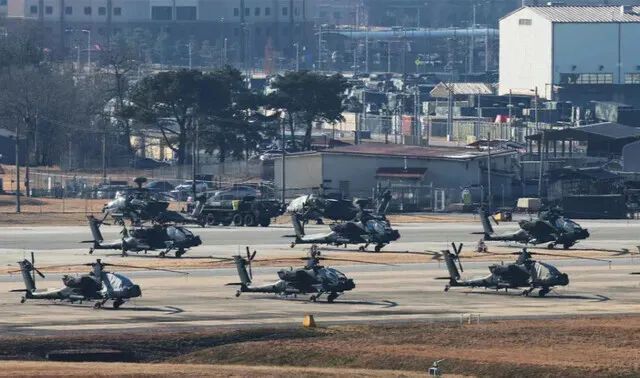
The 2026 National Defense Strategy released by the US on Friday states that South Korea will need to take charge of defending against the North Korean threat with “critical but more limited US support.”
The Trump administration’s adoption of the principle of US allies taking on a bigger role in their defense in this key document outlining threats and setting defense priorities points to fundamental changes in Washington’s approach to defense of the Korean Peninsula.
“South Korea is capable of taking primary responsibility for deterring North Korea with critical but more limited US support,” the Pentagon said in the document.
The 2026 National Defense Strategy — which is subordinate to the National Security Strategy, released last December — confirms that the US intends to maintain extended deterrence, also known as the nuclear umbrella, through its strategic assets. But it also clarifies that the US will focus its strategic capabilities on defending the American homeland and countering China and that South Korea needs to become less dependent on the alliance and take the lead on the battlefield through the operation of conventional forces.
The US’ official declaration of a strategic realignment of the ROK-US alliance with Seoul assuming primary responsibility suggests the US will accelerate the timeframe for reconfiguring US troop presence in Korea and handing over wartime operational control (OPCON) of South Korean forces.
“Defense autonomy is the sine qua non amid geopolitical uncertainty. It’s inconceivable that South Korea, which has the world’s fifth strongest military, would be unable to defend itself,” South Korean President Lee Jae Myung wrote on the social media platform X on Saturday.
Lee’s remarks suggest he means to push forward resolutely with his policy of defense autonomy, including his campaign pledge to complete the OPCON handover before leaving office.
Notably, the new US defense document states that “this shift in the balance of responsibility is consistent with America’s interest in updating US force posture on the Korean Peninsula.” The implication is that these changes could enable an adjustment of the size and scope of US Forces Korea, or USFK.
Some suspect this means that USFK’s mission will be refocused from defending against North Korea to countering China.
And while the document describes North Korea’s nuclear arsenal as presenting “a clear and present danger of nuclear attack on the American Homeland,” there is significantly no mention of the goal of denuclearization. The Trump administration is presumably toning down its demands to make room for future dialogue with North Korea, based on the assumption that denuclearization is no longer a feasible goal.
Immediately after the strategy document was released, Elbridge Colby, the US undersecretary of defense for policy, embarked on a trip to Korea and Japan. Colby reportedly played an instrumental role in devising the new strategy.
Following a meeting with South Korean Defense Minister Ahn Gyu-back on Monday, Colby will remain in Korea until Tuesday for meetings with high-ranking officials in foreign policy and national security. The agenda of those meetings is expected to include adjusting USFK’s role, transferring OPCON and increasing defense spending.
During his time in Korea, Colby will also reportedly visit the US military base at Camp Humphreys, in Pyeongtaek, Gyeonggi Province.

By Park Min-hee, senior staff writer; Kim Won-chul, Washington correspondent
Please direct questions or comments to [english@hani.co.kr]

Editorial・opinion
![[Editorial] Trump’s baseless claim that Iran bombed girls’ school crosses line](https://flexible.img.hani.co.kr/flexible/normal/500/300/imgdb/original/2026/0309/4217730446901883.jpg "[Editorial] Trump’s baseless claim that Iran bombed girls’ school crosses line") [Editorial] Trump’s baseless claim that Iran bombed girls’ school crosses line
[Editorial] Trump’s baseless claim that Iran bombed girls’ school crosses line![[Correspondent’s column] JD Vance’s 67-hour disappearance](https://flexible.img.hani.co.kr/flexible/normal/500/300/imgdb/original/2026/0306/2517727866984907.jpg "[Correspondent’s column] JD Vance’s 67-hour disappearance") [Correspondent’s column] JD Vance’s 67-hour disappearance
[Correspondent’s column] JD Vance’s 67-hour disappearance- [Column] Withstanding Trump’s predatory hegemony
- [Editorial] US dragging Kurds into its war with Iran would be a disaster
- [Column] US allies in the Gulf are in flames. Can Korea avoid a similar fate?
- [Editorial] North Korea’s tough talk mustn’t deter Seoul’s efforts to rebuild trust
- [Editorial] Attack on Iranian girls’ school is an indefensible crime against humanity
- [Editorial] Trump’s unjustified war with Iran threatens chaos for us all
- [Column] What a Korean man’s foiled plan to seek assisted death in Switzerland reveals
- [Column] This is what accountability looks like
Most viewed articles
- 1Korea named as target of new Section 301 probe by US
- 2‘Made in USA’: Scraps of missile that killed Iranian children point to US responsibility
- 3[Editorial] No greater sign that South Korea must prioritize building its own defense abilities
- 4US may seek exit from Iran war by moving the goalposts of victory
- 5US Democrats say Trump’s investment pressure has ‘deeply unsettled’ alliance with Seoul
- 6[Column] Misconceptions about America’s war with Iran
- 765% of Korean men say gender equality has gone ‘far enough’; only 42% of women agree
- 8How much is the US willing to risk for the Strait of Hormuz?
- 9Coupang investors insinuate that US is planning Section 301 probe into Korea
- 10[News analysis] Air defense pullout signals new era of US strategic flexibility in Korea