hankyoreh
Links to other country sites 다른 나라 사이트 링크
South Korea’s Lee affirms respect for ‘one-China’ principle ahead of summit with Xi
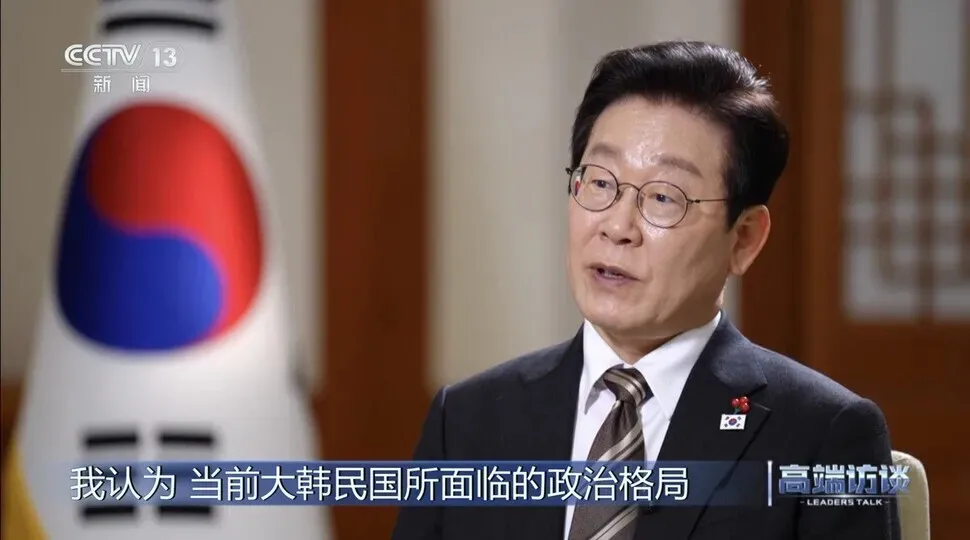
President Lee Jae Myung confidently stated that his state visit to China, which began on Sunday, will help relations between South Korea and China to “enter a new stage of development,” during an interview with a Chinese state-run media outlet.
“[South Korea and China] are closely intertwined across history, the economy, geography, politics, and security,” Lee said during a Friday interview with China’s CCTV, adding that his upcoming visit to China was “aimed at minimizing or eliminating past misunderstandings of differences, promoting an upgrade of South Korea-China relations to a new stage, and firmly establishing the two countries as partners that support each other’s development,” according to a translation provided by the Global Times.
As Lee is to lead an economic and trade delegation of around 200 members during this four-day state visit, the interviewer asked what the president expected for the development of economic and trade relations between South Korea and China. Lee answered the question by expressing his willingness to “reshape bilateral economic cooperation toward a more horizontal structure.”
“In the past, China-South Korea economic cooperation was largely based on a vertical structure, combining South Korea’s advanced technology and capital with China’s labor force. Today, however, under the outstanding leadership of President Xi Jinping, China has achieved substantial economic growth and development, and in many areas of technology and capital has caught up with or even surpassed South Korea,” he noted.
Lee stressed the importance of building new cooperative relationships in technology-intensive fields such as artificial intelligence and high-tech industries, to “create a cooperation-oriented economic partnership that benefits both sides.”
When asked to comment on the focus of China’s latest five-year development plan being on high-quality development and AI, Lee pointed out the “significant similarities” in the economic growth strategies of China and South Korea.
“This naturally creates competition, but it also leaves ample room for cooperation. I believe that if we can identify areas for cooperation within a competitive environment, and use cooperation to enhance our respective strengths, we can build a complementary relationship that both supports China’s sustainable development strategy and advances South Korea’s growth strategy,” the South Korean president added.
Lee reiterated South Korea’s basic position on the Taiwan question: “South Korea has always respected the one-China stance.”
“The consensus reached by the governments of South Korea and China at the time of establishing diplomatic relations remains the core principle governing bilateral ties, and its validity has never changed,” mentioning that “in Northeast Asia — and on surrounding issues, including cross-straits relations — maintaining peace and stability is of vital importance to us.”
When the interviewer touched upon the fact that China and South Korea share historical memories in that 2025 marked the 80th anniversary of China’s victory over Japan in WWII and the 80th anniversary of South Korea’s liberation from Japan, Lee commented, “The shared historical experience of China and South Korea in resisting aggression and struggling together is especially valuable.”
“Acts of invading other countries and massacring their people in the name of national interest must never be allowed to happen again. Humanity often repeats its mistakes, which makes it essential to draw lessons from history,” he opined. “Of course, while historical experience is important, we cannot remain confined to the past. For a better future for the peoples of both countries, we must continue to explore ways to move forward together.”
Lee underscored the importance of South Korea’s strategic autonomy as the backbone of pragmatic diplomacy. While every country strives to maximize its own national interests when it comes to international relations, he explained that “coexistence among countries becomes possible” when all sides “coordinate within reasonable bounds to manage conflicts of interest, and at the same time gain greater benefits through cooperation.”
Lee suggested that the leaders of South Korea and China ought to convene at least once every year, stating that “dialogue is essential, along with continuous efforts to identify new forms of cooperation.”
“As the international environment becomes increasingly complex and challenging, the more necessary it is for us to engage in more frequent dialogue to jointly explore new paths and pursue better avenues for development. This is my position,” the president said.
Lee, who met Xi for the first time at the end of October, described the Chinese leader as a “truly reliable neighbor and partner with whom we can move forward together and support each other.” He noted Xi’s “sense of humor,” demonstrated in the way that Xi responded “very readily” when Lee “half-jokingly talked about a mobile phone gift.” Lee commented that such interactions “left the South Korean public with a very positive impression of President Xi’s personal charisma.”
“In my view, this is exactly how China-South Korea relations should be. On the surface, there are indeed many difficulties at present, but these challenges can be resolved through sustained communication. At the same time, both sides should make every effort to identify areas of cooperation that benefit each other, and build a relationship based on mutual trust, mutual cooperation, and mutual support. This serves the interests of both China and South Korea. I perceive that President Xi has a deep understanding of this,” Lee shared.
By Lee Jeong-yeon, Beijing correspondent
Please direct questions or comments to [english@hani.co.kr]

Editorial・opinion
![[Column] Japan and South Korea: An alliance of middle powers?](https://flexible.img.hani.co.kr/flexible/normal/500/300/imgdb/original/2026/0615/4017815116945786.jpg "[Column] Japan and South Korea: An alliance of middle powers?") [Column] Japan and South Korea: An alliance of middle powers?
[Column] Japan and South Korea: An alliance of middle powers?![[Editorial] Korea must use G7 summit to band together with fellow middle powers](https://flexible.img.hani.co.kr/flexible/normal/500/300/imgdb/original/2026/0615/5817815111712322.jpg "[Editorial] Korea must use G7 summit to band together with fellow middle powers") [Editorial] Korea must use G7 summit to band together with fellow middle powers
[Editorial] Korea must use G7 summit to band together with fellow middle powers- [Editorial] Sinking Korean youth employment in AI era requires action, and fast
- [Editorial] Korean students show how to protest ballot fiasco without resorting to conspiracies
- [Column] What do people crying election fraud in Korea even want?
- [Column] Once security assets, US bases are now liabilities to host countries
- [Column] Takaichi is putting Japan’s constitution in crisis
- [Editorial] Losing Seoul mayor’s race should be a wakeup call for Democrats
- [Column] Naming the enemy: The unsettling return of ideological litmus tests in Korea
- [Editorial] No excusing ballot shortage fiasco
Most viewed articles
- 1[Editorial] Korean democracy 20 years after the death of Park Jong-cheol
- 2‘Trump surrendered’: US conservatives fume over Iran deal
- 3Goliath’s defeat: What Iran reveals about America’s future
- 4Korea’s conservative opposition leader drags party into battle for election do-over
- 5Seoul’s PPP mayor blasts party leader for exploiting ballot fiasco to cling to power
- 6Korean firms reportedly among backers of $300B Iran postwar investment fund
- 7Samsung to measure how many of its employees’ jobs AI can replace
- 8Korean sports groups denied access to offices for nearly 2 weeks due to ballot protests
- 9With 400,000 undocumented workers in Korea, Lee administration weighs paths to legal status
- 10[Q&A] Why Japan is angling for a military logistics pact with South Korea