hankyoreh
Links to other country sites 다른 나라 사이트 링크
Korea, US to release fact sheet on tariffs and security after next week’s summit
South Korea and the US are coordinating on the wording of a fact sheet to be announced at an upcoming Oct. 29 summit in Gyeongju, with content concerning their agreements on tariffs and investment.
The two sides’ leaders previously had a summit at the White House in late August but failed to reach a written agreement due to differences over key issues, including the method to be used for South Korea’s investments in the US.
The fact sheet also appears likely to include content on security-related matters, including a future vision for the bilateral alliance, an increase in South Korea’s share of defense costs, and reduced restrictions on uranium enrichment.
According to accounts Tuesday from multiple sources with knowledge of foreign affairs, the US recently made new proposals to South Korea concerning tariffs and investment. The current plan is for the two sides to use this as a basis for bridging their differences before reaching a final determination between their leaders at the Oct. 29 summit, with the agreement to be published in fact sheet form.
As a diplomatic document, a fact sheet is less binding than a joint statement or memorandum of understanding, as it includes only a list of terms agreed upon by the parties. The Donald Trump administration previously published White House fact sheets to announce the terms when it reached tariff agreements with Japan and the European Union in late July.
The possibility remains that South Korea and the US could also draft and sign an additional MOU for certain terms of their tariff agreement, as the US previously did with Japan.
The fact sheet also appears likely to stipulate terms relating to national security — an area where the two sides reached an agreement at their August summit but where no announcement was made due to the failure to reach an agreement on tariffs.
At the time, they reportedly agreed on a framework where South Korea would raise its national defense spending to 3.5% of GDP and increase its purchasing of US weapons, while the US would maintain the character of the South Korea-US alliance and the “strategic flexibility” of US Forces Korea at their current levels.
The fact sheet is also expected to include terms concerning the need for South Korea to pursue some level of uranium enrichment and nuclear fuel reprocessing, paving the way for follow-up discussions toward amending the two sides’ nuclear cooperation agreement.
The progress made between them appeared to have been influenced decisively by their mutual perception of the Gyeongju summit as an unmissable opportunity, along with the recent narrowing of their differences on key issues.
Returning on Monday from a visit to the US, South Korean Minister of Industry, Trade and Energy Kim Jung-kwan stressed that the situation was “not one where the US is demanding cash investment for all of the [pledged] US$350 billion.”
“There is an aspect of them accepting our position on a considerable portion [of the terms],” he said at the time.
But the presidential office has remained cautious, with policy chief Kim Yong-beom noting that there were “a few remaining issues in need of coordination.” This suggests that some of the terms — potentially including those relating to the proportion of the US$350 billion in US investment to be provided in cash, the period of investment, exchange rate stabilization measures, and decisions on investment recipients — are still unacceptable to Seoul.
One foreign affairs source suggested there may be “no other option but for President Lee Jae Myung to meet Trump and have a ‘top-down’ negotiation on the US’ new proposals.”
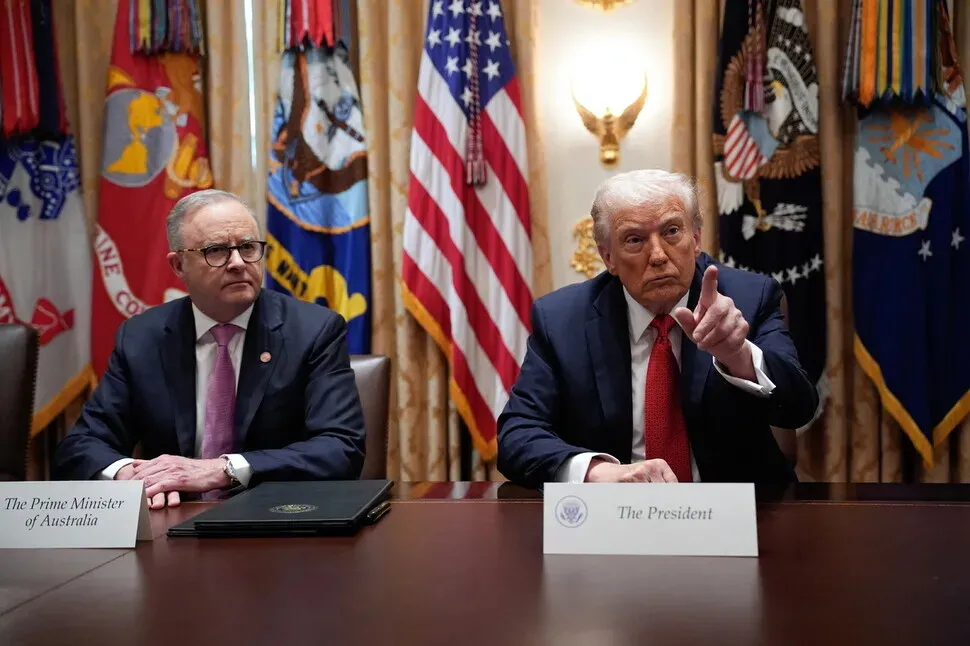
Speaking at the White House on Tuesday after a summit with Australian Prime Minister Anthony Albanese, Trump said, “I expect we’ll probably work out a very fair deal with President Xi of China [in South Korea].”
“[With] Japan, we worked out a very fair deal [in addition to the EU deal]. [With] South Korea, where I'll be meeting President Xi, we worked out a very fair deal,” Trump also said.
By Park Min-hee, senior staff writer; Kim Won-chul, Washington correspondent
Please direct questions or comments to [english@hani.co.kr]

Editorial・opinion
![[Column] Coupang’s play in Washington](https://flexible.img.hani.co.kr/flexible/normal/500/300/imgdb/original/2026/0227/7817721808892682.jpg "[Column] Coupang’s play in Washington") [Column] Coupang’s play in Washington
[Column] Coupang’s play in Washington![[Editorial] Clarification and accountability needed on USFK standoff with Chinese jets](https://flexible.img.hani.co.kr/flexible/normal/500/300/imgdb/original/2026/0226/4817720940359806.jpg "[Editorial] Clarification and accountability needed on USFK standoff with Chinese jets") [Editorial] Clarification and accountability needed on USFK standoff with Chinese jets
[Editorial] Clarification and accountability needed on USFK standoff with Chinese jets- [Editorial] USFK’s provocation of China demands more than perfunctory protest by Seoul
- [Editorial] PPP’s refusal to cut ties with Yoon will be its undoing
- [Editorial] Korea is no staging ground for US operations against China
- [Editorial] Court convicts Yoon, but fails to fully reckon with his attempted coup
- [Editorial] Just because Japan is rushing US investments doesn’t mean Korea should
- [Column] Moment of truth: What the Epstein files really show us
- [Editorial] Coupang’s lobbying in US won’t win back Korean customer base
- [Column] Today’s diverging paths of human virtue, hegemony and tyranny
Most viewed articles
- 1Real-life heroes of “A Taxi Driver” pass away without having reunited
- 2Threatening North Korea has not made peninsula any safer, says South Korea’s Lee
- 3Russian Embassy in Seoul ignores host nation’s request to remove pro-war banner
- 4[News analysis] Behind split strategies, Kim Jong-un stays focused on regime security, advancement
- 5Former bodyguard’s dark tale of marriage to Samsung royalty
- 6Trump open to talking with Kim Jong-un ‘without any preconditions,’ says White House
- 7[NBS] Korea’s Lee logs 67% approval rating, his highest since taking office
- 8Hard labor an increasing punishment for poor people unable to pay fines
- 9Rosé’s ‘APT.’ was best-selling single of 2025, a first for singer not from North America or Europe
- 10[Editorial] USFK’s provocation of China demands more than perfunctory protest by Seoul