hankyoreh
Links to other country sites 다른 나라 사이트 링크
[Reportage] Behind luxe façades of Phnom Penh, fraud factories fester

The 30-story hotel stuck out like a sore thumb, rising between low-slung buildings in the Sen Sok district of Phnom Penh, Cambodia. Aside from a swanky vibe that didn’t suit the location, the hotel was fairly nondescript. A large banner on the side said “for rent” in Chinese.
“Chinese voice phishing syndicates typically rent out one floor at a time. It’s a kind of symbiotic relationship: the hotel minimizes vacancies, and the syndicates secure space for their criminal activities on the cheap,” said a 54-year-old Korean resident of Cambodia surnamed Park as he stared up at the hotel.
In a tourism-dominated country that’s home to the famed Angkor Wat temple complex, a handful of Chinese individuals in casual wear milled around in the hotel lobby, seemingly uninterested in sightseeing.
When the Hankyoreh visited Phnom Penh on Tuesday, the rainy season was transitioning to the cooler dry season. The hustle and bustle of the streets, interspersed with unexpected moments of calm and warmth, were what one would expect of any city in Southeast Asia.
Cambodia may not be a gangster state, but it does foster criminal operations. It’s a stronghold of global voice phishing operations, honey traps and gambling scams, as well as operations in which Koreans are confined or blackmailed until they agree to take part in criminal activity.
The settings of the crimes have been difficult to pin down. During the 2010s, they mainly took place in vacant rooms at condos and luxury hotels built with Chinese capital. Today, even relatively clean-looking condominiums on the city’s periphery are transforming into dens of crime surrounded by walls and barbed wire.
“A lot of the Korean men live there, mostly ones in their 20s and 30s,” said a security worker in front of a mixed-use condominium building singled out as a criminal base in the heart of Phnom Penh.
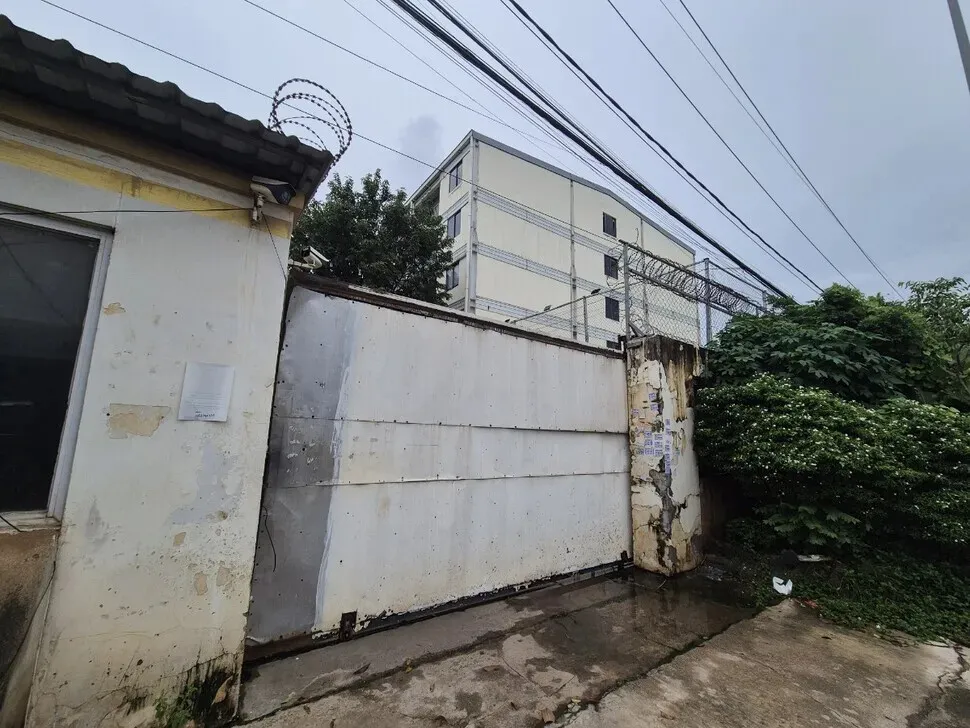
Two security workers in plain clothes stood watch over another complex known in Korean as “Wongu” — taken from the Chinese term for “park,” as the locations are known in the language — which is known to have been one of three such areas on the periphery of Phnom Penh with large numbers of phishing organizations where Koreans have been held captive. When I asked to look inside, the two workers said they would “need permission from the supervisor” and disappeared.
These may have been the same settings visited by young people who came in search of promised profits and regarded life overseas as a new challenge and chapter. Young people who had been victims of the scams and local Koreans agreed that the buildings’ ordinary exteriors conceal multinational criminal organizations and rife corruption.
The South Korean Ministry of Foreign Affairs reported that as of August this year, a total of 330 people had been reported missing or held captive in connection with Cambodia. The safety of around 80 of them had not been verified at the time.
A Korean national in his mid-20s who asked for anonymity told the Hankyoreh that he traveled to Cambodia in early August in the hopes of earning money to repay debts. On an online forum, he’d come across an advertisement claiming he could earn 3 million to 5 million won (US$2,110-US$3,522) a month for “chat-based promotion duties.”
During the seven days he was in Cambodia, he “fled places three times,” he said.
The first happened when he traveled to Sihanoukville and found that the organization was not a “chat-based promotion” business as it claimed, but a voice phishing organization. Worried about the prospects of returning to Korea without having earned any money, he next visited organizations in the Chrey Thum and Kampot areas. He fled again after realizing what they really were.
His experience with the criminal settings defied the imagination. They had systems in place already where crimes could be presented as “business” or “duties.”
Victims said they were forced to sign one-year labor contracts. In all cases, their duties were billed as lawful and ordinary.
The Kampot organization that the man had visited last enticed him by telling him it was a “Korean business” and warning that he would be “shot dead” if he continued working where he was, encouraging him to decamp to them instead. It was only when he got there that he learned it had been carrying out romance scams for years.
“They boasted of having 1,500 members in the organization alone,” he recalled. “They managed to grow to a business scale by eluding or colluding with the police.”
Though he got out quickly, he said there were many cases where victims themselves decide not to flee — having determined that they are already complicitous and past the point of turning back.

A police officer with experience working in Cambodia told the Hankyoreh, “The most frustrating cases are the ones where the victims have insisted they were ‘not being held captive’ and that they would ‘keep earning money.’”
“They keep getting gaslit by the organization telling them they will be punished for their role in the criminal activity, so they choose not to try to escape,” they explained.
When stopped by a coffee shop in the Boeng Keng Kang area — one of Phnom Penh’s most bustling neighborhoods — while speaking to Korean expats, an employee smiled cheerfully while showing a practice space filled with Korean writing. “I’m studying Korean,” they explained.
Local Koreans I spoke to stressed that Cambodia is a country full of ordinary, good-natured people like that employee, while voicing worries about Cambodia being represented solely in terms of crimes. At the same time, they expressed hopes that Korean and Cambodian authorities would take meaningful action against the criminal settings that have permeated the city’s reaches.
Ignoring the employee’s smile, Park lowered their voice and said, “Last month, a Korean was kidnapped by Chinese people while coming out of this café.”
By Chung In-seon, staff reporter; Park Chan-hee, staff reporter; Cho Hae-yeong, staff reporter
Please direct questions or comments to [english@hani.co.kr]

Editorial・opinion
![[Column] Japan and South Korea: An alliance of middle powers?](https://flexible.img.hani.co.kr/flexible/normal/500/300/imgdb/original/2026/0615/4017815116945786.jpg "[Column] Japan and South Korea: An alliance of middle powers?") [Column] Japan and South Korea: An alliance of middle powers?
[Column] Japan and South Korea: An alliance of middle powers?![[Editorial] Korea must use G7 summit to band together with fellow middle powers](https://flexible.img.hani.co.kr/flexible/normal/500/300/imgdb/original/2026/0615/5817815111712322.jpg "[Editorial] Korea must use G7 summit to band together with fellow middle powers") [Editorial] Korea must use G7 summit to band together with fellow middle powers
[Editorial] Korea must use G7 summit to band together with fellow middle powers- [Editorial] Sinking Korean youth employment in AI era requires action, and fast
- [Editorial] Korean students show how to protest ballot fiasco without resorting to conspiracies
- [Column] What do people crying election fraud in Korea even want?
- [Column] Once security assets, US bases are now liabilities to host countries
- [Column] Takaichi is putting Japan’s constitution in crisis
- [Editorial] Losing Seoul mayor’s race should be a wakeup call for Democrats
- [Column] Naming the enemy: The unsettling return of ideological litmus tests in Korea
- [Editorial] No excusing ballot shortage fiasco
Most viewed articles
- 1[Column] Japan and South Korea: An alliance of middle powers?
- 2Korean court rules same-sex union entitled to legal protection in homewrecker suit
- 3[Editorial] For a traitor like Yoon, even 30 years is too lenient
- 4[Editorial] Korea must use G7 summit to band together with fellow middle powers
- 5On anniversary of first inter-Korean joint declaration, Lee says peace is still within reach
- 6Yoon becomes first Korean president convicted of treason for sending drones to Pyongyang
- 7Lee rebukes election fraud claims as ‘absurd conspiracy theories’ and ‘anti-social behavior’
- 8Trump says US has reached deal with Iran, set to be signed on Friday
- 9Record fine for Coupang is only the beginning of its troubles
- 10[Editorial] Sinking Korean youth employment in AI era requires action, and fast