hankyoreh
Links to other country sites 다른 나라 사이트 링크
Xi and Putin hail ‘unprecedented’ development of bilateral ties at summit
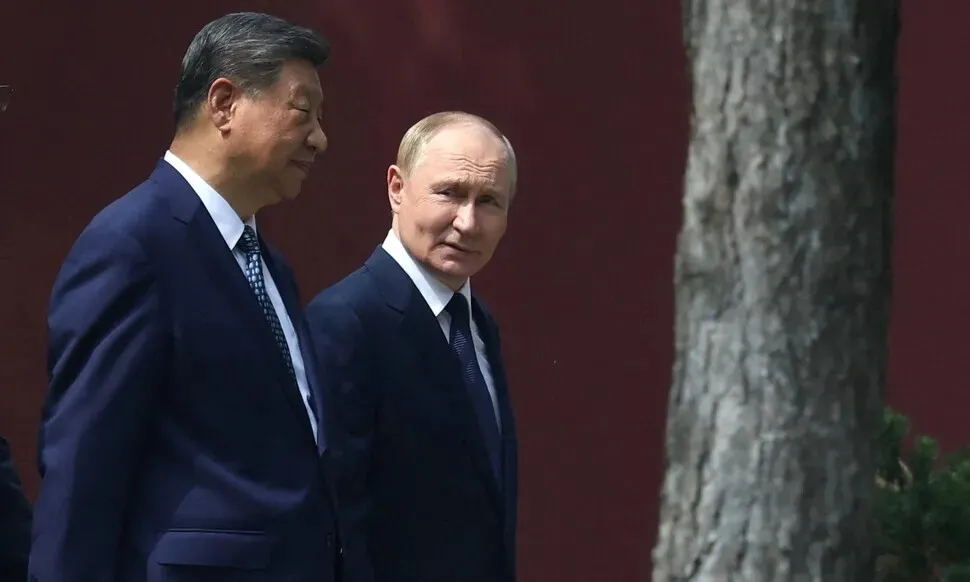
During their summit in Beijing on Tuesday, Chinese President Xi Jinping and Russian President Vladimir Putin emphasized that bilateral relations between their countries had developed to “an unprecedented level,” reaffirming their growing strategic cooperation against the US.
After attending the closing ceremony of the Shanghai Cooperation Organisation summit in Tianjin, Xi and Putin headed to Beijing, where they held a bilateral summit at the Great Hall of the People. Putin arrived in Beijing on Tuesday to attend a parade to celebrate China’s victory over Japan in WWII, known as “Victory Day.”
According to a readout of the meeting, Xi told Putin during their meeting that China-Russia relationship had become “an example of major-country ties, featuring permanent good-neighborly friendship, comprehensive strategic coordination and mutually beneficial cooperation.”
Highlighting that both states have the power to pursue their own development and revitalization, “the two sides should leverage major projects to steer their cooperation, develop exemplary cooperation projects, and promote deep-level integration of interests,” Xi was quoted as saying.
Xi stated that both China and Russia will prioritize sovereign equality and multilateralism, indirectly criticizing the “America First” agenda of US President Donald Trump.
At the beginning of their summit, Xi welcomed Putin as an “old friend.” Putin addressed Xi as a “dear friend,” and said that Moscow’s relations with Beijing have reached “an unprecedented level.”
“Our close communication reflects the strategic nature of Russian-Chinese ties, which have reached an unprecedented level,” Putin said.
“We stood together then, and we stand together now,” he said.
“We are ready to continue supporting each other in our national development and prosperity, to steadfastly uphold international justice and equality, and to advance the establishment of a more just and rational system of global governance,” Xi said.
Their formal summit was followed by a walk through Zhongnanhai, the walled complex that houses the residences and offices of China’s top power figures, boasting their chummy ties.
During their summit, Xi and Putin discussed cooperative measures regarding energy, AI, aerospace technology, agriculture, health, scientific research, and education, signing over 20 MOU agreements.
Notably, they signed a contract for building pipelines and supplying energy. The Russian oil company Gazprom and the China National Petroleum Corporation agreed to build the Power of Siberia 2 pipeline through Mongolia to supply China with Russian oil and gas.
In addition to the pipeline and gas and oil contracts, the two countries also agreed to a commitment of 30 years in their energy partnership. Russia also agreed to give China better prices than it offers to European countries. The pipeline will supply around 50 billion cubic meters of gas every year.
China is the largest buyer of Russian oil and gas, and the energy partnership between Moscow and Beijing has grown stronger since Russia’s invasion of Ukraine.
Last year, Russia supplied 31 billion cubic meters of gas to China. This figure is expected to increase to 38 billion this year.
Ahead of their bilateral summit, the two leaders held a trilateral summit with Mongolian President Ukhnaagiin Khurelsukh to discuss the construction of Siberian pipelines that go through Mongolia.
By Jung E-gil, staff reporter
Please direct questions or comments to [english@hani.co.kr]

Editorial・opinion
![[Editorial] Mockery of Gwangju at high school ball game shouldn’t be treated lightly](https://flexible.img.hani.co.kr/flexible/normal/500/300/imgdb/original/2026/0701/1817828951697517.jpg "[Editorial] Mockery of Gwangju at high school ball game shouldn’t be treated lightly") [Editorial] Mockery of Gwangju at high school ball game shouldn’t be treated lightly
[Editorial] Mockery of Gwangju at high school ball game shouldn’t be treated lightly![[Column] Does profit-driven investment by chaebol make them ‘national heroes’?](https://flexible.img.hani.co.kr/flexible/normal/500/300/imgdb/original/2026/0701/8317828953365056.jpg "[Column] Does profit-driven investment by chaebol make them ‘national heroes’?") [Column] Does profit-driven investment by chaebol make them ‘national heroes’?
[Column] Does profit-driven investment by chaebol make them ‘national heroes’?- [Column] Korea at a crossroads: ‘Yoon Again’ or real change?
- [Column] Stuck in Strait of Hormuz, US can no longer pivot to Asia
- [Column] The harder US pushes N.Korea to denuclearize, the greater the risk to S. Korea
- [Correspondent’s column] The new generation of ‘sewer socialists’ are in it to win it
- [Editorial] Who benefits from tug-of-war over jurisdiction in the DMZ?
- [Column] Inequality in Korea hits high not seen since colonial era
- [Editorial] Unity doesn’t mean embracing defenders of insurrection
- [Editorial] Stiff sentence for ex-justice minister shows abetting insurrection won’t go unpunished
Most viewed articles
- 1Korea on pace to record $1 trillion in exports in 2026, joining world’s top 4
- 2[Column] Korea at a crossroads: ‘Yoon Again’ or real change?
- 3Prosecution begins its investigation of bank sale to Lone Star
- 4Police refer Morse Tan to prosecutors on suspicion of defaming Korean president
- 5[Column] Does profit-driven investment by chaebol make them ‘national heroes’?
- 6After Starbucks, anti-Gwangju mockery rears its head at high school baseball game
- 7Student athletes suspended from competitive play after mocking Gwangju massacre
- 8‘All doors open if you knock long enough’: Lee vows to achieve peace with North Korea
- 9[News analysis] Can Lee and Moon’s push for unity get Democrats on the same page?
- 10US Republican lawmakers claim Korea’s NIS coerced Coupang