hankyoreh
Links to other country sites 다른 나라 사이트 링크
The real test of Lee’s foreign policy comes after Trump summit
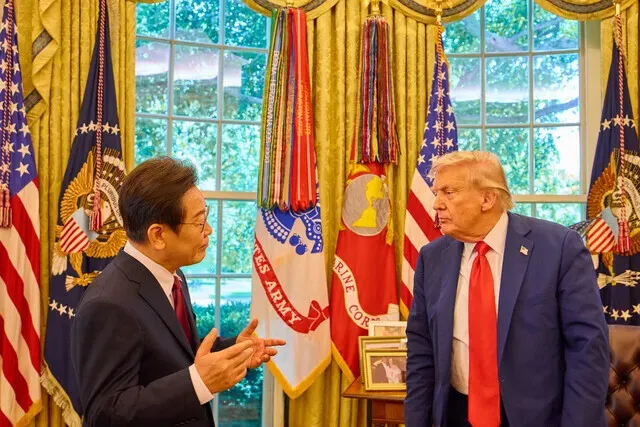
While the first summit between South Korean President Lee Jae Myung and US President Donald Trump wrapped up without incident, the biggest challenges may be yet to come, especially with respect to US demands of Korea on diplomacy and national security issues.
The tense atmosphere leading up to the summit underscores this. The US Department of Commerce, Department of State and Department of Defense gave Korea a list of hefty demands spanning from investments to national security and economic issues to the South Korean government, threatening to cancel the summit if those demands were not met.
The first issue that Seoul will have to prepare itself for is Washington’s demands regarding the modernization of the South Korea-US alliance. Lee promised an increase in South Korea’s defense spending during Monday’s summit, choosing to deflect the focus from the more sensitive issue of reorienting the role of US troops in Korea toward checking China.
Lee was reportedly the first to broach the topic of increasing South Korea’s defense spending, which is a major focus of attention for Trump. In terms of US advanced weapons, he opted for a strategy of purchases based on South Korea’s needs, with the clear aim of boosting its self-sufficiency.
But observers are predicting the demands for the alliance’s “modernization” — namely, the idea that US Forces Korea and the South Korean government should play a more active role in containing China — will intensify in the summit’s wake.
The US Defense Department is scheduled to complete its National Defense Strategy document in connection with this, and the matter is certain to come up for discussion at the annual Security Consultative Meeting involving the two sides’ defense ministers toward the end of the year. This means Seoul needs to establish clear strategies and principles to prepare itself for a difficult tightrope walk with Washington.
An even more careful and delicate strategy is necessary when it comes to setting Seoul’s diplomatic bearings with Beijing.
China is keenly observing Lee’s aims, with the South Korean president remarking at the Center for Strategic and International Studies after the summit that South Korea “is in a situation where it is no longer possible to maintain the logic of the past” in terms of relying on the US for security and China for economic matters.
In a regular briefing on Wednesday, Chinese Foreign Ministry spokesperson Guo Jiakun sounded a meaningful note by saying, “The two countries [South Korea and China] grow bilateral relations for our common interests, which does not target any third party and should not be affected by any third-party factors.”
As it weighs its relationship with South Korea amid its recent competition with the US, China has sent messages to Seoul emphasizing the avoidance of third-party interference and South Korea’s strategic autonomy. The idea is that Seoul should not allow itself to be swayed by US strategies for containing Beijing.
In response, Lee appears likely to continue voicing and practicing the position that South Korea is obliged to emphasize its alliance with the US amid its antagonisms with North Korea, but that it also does not intend to neglect economic and diplomatic cooperation with China. The same intent can be seen in his decision to send a special envoy delegation to China to coincide with his Aug. 24 departure to the US for the summit, with former National Assembly Speaker Park Byeong-seug acting as a representative.
Reestablishing relations with Japan represents another difficult task.
Lee has taken pains to improve ties with Tokyo — even breaking with precedent to visit Japan before traveling to the US. He has also repeatedly emphasized his intent to pursue future-oriented development of the South Korea-Japan relation as a driving force for trilateral cooperation with the US.
But he appears likely to continue facing criticism from the domestic press for the foreseeable future after remarks at the summit and a preceding interview with the Yomiuri Shimbun newspaper, where he acknowledged existing agreements with Japan on survivors of military sexual slavery and third-party compensation for victims of forced labor mobilization. In so doing, he partly recognized Tokyo’s claims that it had discharged its responsibility in terms of historical matters with the two sides’ 1965 agreement.
It also remains to be seen whether Tokyo shows a forward-thinking stance on matters such as a Sado gold mine memorial ceremony set to take place in Japan this autumn.
By Park Min-hee, senior staff writer
Please direct questions or comments to [english@hani.co.kr]

Editorial・opinion
![[Column] An incompetent ally is worse than no ally at all](https://flexible.img.hani.co.kr/flexible/normal/500/300/imgdb/original/2026/0522/3717794376301136.jpg "[Column] An incompetent ally is worse than no ally at all") [Column] An incompetent ally is worse than no ally at all
[Column] An incompetent ally is worse than no ally at all![[Editorial] Samsung’s tentative bonus deal highlights need for profit-sharing rules](https://flexible.img.hani.co.kr/flexible/normal/500/300/imgdb/original/2026/0522/3117794376376246.jpg "[Editorial] Samsung’s tentative bonus deal highlights need for profit-sharing rules") [Editorial] Samsung’s tentative bonus deal highlights need for profit-sharing rules
[Editorial] Samsung’s tentative bonus deal highlights need for profit-sharing rules- [Editorial] Crisis averted at Samsung, but society must continue chip profit-sharing debate
- [Editorial] Seoul and Tokyo should focus on pragmatic cooperation, not countering China
- [Column] The real lessons of Samsung Electronics’ labor dispute
- [Reporter’s notebook] The disastrous descent of Trump’s ‘America first’ to ‘America last’
- [Editorial] The bigger picture of immigration protocol for North Korean women’s soccer team
- [Column] What’s next for the Korean Peninsula after the Trump-Xi summit
- [Guest essay] Shame on Korea for revoking pro-Palestine activist’s passport
- [Column] Rethinking how we represent ‘comfort women’ victims
Most viewed articles
- 1Korean anti-war activist captured by Israel says she was beaten, causing partial hearing loss
- 2Xi positions himself as key arbiter on Korean Peninsula with series of summits
- 3Gwangju residents call for Shinsegae chairman’s resignation, launch Starbucks boycott
- 4[Editorial] Samsung’s tentative bonus deal highlights need for profit-sharing rules
- 5[Column] An incompetent ally is worse than no ally at all
- 6Starbucks Korea faces backlash for ‘Tank Day’ promotion on anniversary of Gwangju massacre
- 7Despite Lee’s jab at Netanyahu, Israel conveys hope of developing bilateral ties
- 8Starbucks global HQ issues apology for ‘Tank Day’ event in Korea
- 9[Editorial] Crisis averted at Samsung, but society must continue chip profit-sharing debate
- 10[Column] Iran, from Heidegger to Kant