hankyoreh
Links to other country sites 다른 나라 사이트 링크
What Lee and Xi’s phone call says about road ahead for South Korea-China relations
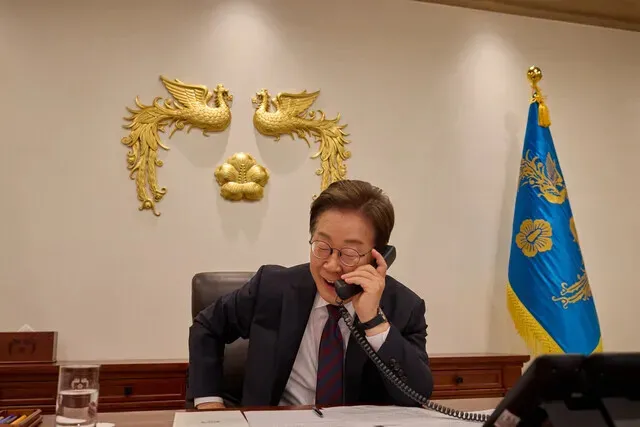
During their first phone call on Tuesday, South Korean President Lee Jae-myung and Chinese President Xi Jinping expressed intentions to turn around South Korea-China relations, which had deteriorated during the Yoon administration, and to work on improving bilateral ties in a pragmatic manner.
It appears likely that both leaders will focus on making Xi’s possible visit to Korea for the Asia-Pacific Economic Cooperation gathering in November — which would mark his first trip to the country in 11 years — a turning point in bilateral relations.
During the half-hour phone call, Lee invited Xi to the APEC summit in Gyeongju and emphasized “proactive exchange and cooperation efforts on all fronts” between the two countries.
The two leaders indicated that they were both aware of the challenging international environment that surrounds relations between Korea and China. The Donald Trump administration in the US wants South Korea and other American allies to actively help it hem in Beijing while also pressuring them to reduce their economic reliance on China. At home and abroad, the Yoon Suk-yeol administration fueled tensions with China, even spreading baseless, Sinophobic conspiracy theories claiming that China had interfered in Korea’s elections after he declared martial law in December.
Against this backdrop, the two leaders emphasized the need to “revive friendly emotions between our two peoples and to create ‘tangible results’ from practical economic cooperation.”
They also appear to have agreed to cooperate on stably managing the situation on the Korean Peninsula, which has deteriorated amid North Korea’s advancements on nuclear weapons and its increasingly close military cooperation with Russia. Lee called on China to play a constructive role in the denuclearization of the Korean Peninsula and inter-Korean peace and stability. Lee’s office reported that Xi called inter-Korean peace and stability “mutually beneficial” to China and South Korea, and pledged to work on solutions to that end.
According to China’s Foreign Ministry, Xi emphasized the current international disorder.
“The two sides should strengthen exchanges at all levels and in all fields and increase strategic mutual trust; enhance bilateral cooperation and multilateral coordination, jointly safeguard multilateralism and free trade, and ensure the stable and smooth functioning of global and regional industrial and supply chain,” Xi said.
The Chinese leader effectively underscored the importance of South Korea-China cooperation at a time when the Trump administration has touched off a tariff war and continues to act unilaterally.
Xi also said that the two countries need to “respect each other's core interests and major concerns,” essentially demanding that South Korea respect China’s position on Taiwan.
Lee and Xi’s phone call came much earlier than Xi’s call with Yoon, which took place 15 days after his inauguration. However, the call with China came after calls first with the US leader and the Japanese leader, a contrast from former President Moon Jae-in, who took calls with the US, China and Japan, in that order.
Lee has emphasized the South Korea-US alliance and trilateral cooperation with Japan, but his phone call with Xi also demonstrated his intentions to engage in “pragmatic” diplomacy by improving and managing relations with China.
By Park Min-hee, senior staff writer; Lee Jeong-yeon, Beijing correspondent
Please direct questions or comments to [english@hani.co.kr]

Editorial・opinion
![[Editorial] Working groups on Korea-US fact sheet must yield tangible results](https://flexible.img.hani.co.kr/flexible/normal/500/300/imgdb/original/2026/0529/5917800429126244.jpg "[Editorial] Working groups on Korea-US fact sheet must yield tangible results") [Editorial] Working groups on Korea-US fact sheet must yield tangible results
[Editorial] Working groups on Korea-US fact sheet must yield tangible results![[Editorial] Head of USFK continues to cross the line with inappropriate political remarks](https://flexible.img.hani.co.kr/flexible/normal/500/300/imgdb/original/2026/0528/4817799568931091.jpg "[Editorial] Head of USFK continues to cross the line with inappropriate political remarks") [Editorial] Head of USFK continues to cross the line with inappropriate political remarks
[Editorial] Head of USFK continues to cross the line with inappropriate political remarks- [Editorial] A disgraced former president like Park Geun-hye has no place on the campaign trail
- [Editorial] Korea’s online hate problem calls for platform regulation and anti-discrimination law
- [Reporter’s notebook] Trump’s primary purge of ‘traitors’ won’t win him anything
- [Guest essay] Moscow-Pyongyang ties are rewriting security in NE Asia
- [Reporter’s notebook] Trump’s primary purge of ‘traitors’ won’t win him anything
- [Column] An incompetent ally is worse than no ally at all
- [Editorial] Samsung’s tentative bonus deal highlights need for profit-sharing rules
- [Editorial] Crisis averted at Samsung, but society must continue chip profit-sharing debate
Most viewed articles
- 1Korean activists say Israeli captors physically and sexually assaulted flotilla activists
- 2[Editorial] Head of USFK continues to cross the line with inappropriate political remarks
- 3[Editorial] Samsung’s tentative bonus deal highlights need for profit-sharing rules
- 4[Reporter’s notebook] Trump’s primary purge of ‘traitors’ won’t win him anything
- 5[Guest essay] Moscow-Pyongyang ties are rewriting security in NE Asia
- 6[Editorial] Working groups on Korea-US fact sheet must yield tangible results
- 7Victory in June 3 elections may come down to Seoul and Busan mayoral races
- 8The US-China rare earth rivalry and the rise of a new geopolitics of resources
- 9Morse Tan, election conspiracy peddler, arrives in Korea ahead of June 3 elections
- 10[Editorial] Crisis averted at Samsung, but society must continue chip profit-sharing debate