hankyoreh
Links to other country sites 다른 나라 사이트 링크
Beijing criticizes Yoon’s speech stoking anti-China sentiment
In a speech Thursday rejecting calls for his resignation, President Yoon Suk-yeol stoked anti-China sentiment with references to alleged espionage by Chinese nationals, prompting protest from China and placing Seoul’s diplomatic relations with Beijing at risk.
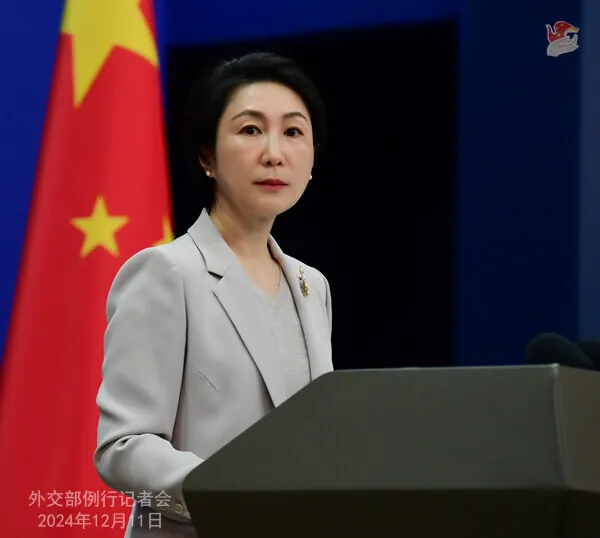
When asked about Yoon’s address during a regular press conference on the same day, Chinese Foreign Ministry spokesperson Mao Ning responded, “China noted the comments. We are surprised by those comments and find them deeply unsettling.”
“We absolutely oppose the ROK side associating its domestic affairs with Chinese elements, amplifying unfounded ‘Chinese spy’ accusations and throwing mud at normal economic and trade cooperation. None of these are conducive to a healthy and steady China-ROK relationship,” she commented.
ROK stands for Republic of Korea, the official name of South Korea.
China had thus far refrained from wading into the apparent attempt at insurrection in Korea on last week, characterizing the debacle as a South Korean “domestic affair,” but Mao’s response to the recent comments by the president shows that China isn’t happy with Yoon’s evocation of China in these current circumstances.
During an address televised live on Thursday morning, Yoon proclaimed that “the colossal group of opposition parties is now threatening even national security and social safety,” mentioning specific cases involving Chinese nationals when railing against the opposition’s refusal to amend the Criminal Act’s article on espionage.
“For example, three Chinese nationals were caught flying a drone and filming a US aircraft carrier docked in Busan in June. Found on their smartphones and laptops were photos of Korean military installations taken over the past two years or more,” Yoon said.
“Last month, a Chinese man in his 40s was caught filming the National Intelligence Service headquarters with a drone. It was revealed that he made a beeline for the National Intelligence Service to do this upon arriving from China,” the president said.
In response, Mao said, “The Chinese government always asks Chinese nationals overseas to observe local laws and regulations. We noted that the conclusion is yet to be made on the particular case mentioned by the ROK side.”
“China once again urges the ROK to handle justly cases concerning Chinese nationals, keep the Chinese side informed of the handling of the cases, and ensure the safety and lawful rights and interests of Chinese nationals concerned,” she said.
Both cases are still undergoing police investigation. In fact, the police released the suspect involved in filming the NIS headquarters, saying that there was no evidence of espionage.
Yoon fired up his base in the address on Thursday, asking, “What will happen if the country is governed by a destructive force that abuses the Constitution?” and making more explicit references to China, saying, “Nuclear power and semiconductor industries and other future growth engines will wither, and China-made solar power facilities will destroy forests across the country.”
Mao also responded to such statements, noting, “China’s booming green industry is a result of global market demand, technological innovation and adequate competition. It has also made important contributions to global climate response and environmental governance.”
South Korea-China relations, which were already on unsteady footing following the brief invocation of martial law last week are likely to be shaken again in the wake of Yoon’s speech.
With Yoon’s political future on the rocks, the appointment of Kim Dae-ki, former presidential chief of staff, as the new South Korean ambassador to China has now become uncertain.
The situation has also prompted Chinese politicians to cancel visits to South Korea.
The Chinese members of the National People’s Congress belonging to the South Korea-China Parliamentarians’ Union had been scheduled to visit Korea from Dec. 12 to Dec. 15 but canceled the trip in light of the events in Korea.
By Choi Hyun-june, Beijing correspondent
Please direct questions or comments to [english@hani.co.kr]

Editorial・opinion
![[Column] Korea: A nation divided into blue and red](https://flexible.img.hani.co.kr/flexible/normal/500/300/imgdb/original/2026/0603/1217804507549734.jpg "[Column] Korea: A nation divided into blue and red") [Column] Korea: A nation divided into blue and red
[Column] Korea: A nation divided into blue and red![[Column] Balancing strength and institutions to build Korean peace](https://flexible.img.hani.co.kr/flexible/normal/500/300/imgdb/original/2026/0603/861780450092097.jpg "[Column] Balancing strength and institutions to build Korean peace") [Column] Balancing strength and institutions to build Korean peace
[Column] Balancing strength and institutions to build Korean peace- [Column] When obeying law and order is a true subversion
- [Editorial] PPP’s shameless parade of disgraced presidents
- [Column] From complete denuclearization of North Korea to managing nuclear risk
- [Editorial] Korea is a model US ally on defense. It’s time it regains wartime OPCON.
- [Editorial] Election fraud conspiracy theorists are the real threats to Korea’s democracy
- [Column] Israel: The definition of a democratic fascist regime
- [Column] The tyranny of merit and the distribution of profit in the AI era
- [Editorial] Working groups on Korea-US fact sheet must yield tangible results
Most viewed articles
- 1[Column] Korea: A nation divided into blue and red
- 2Ripped from families for not being ‘Korean enough,’ mixed-race adoptees seek truth and justice
- 3[Column] When obeying law and order is a true subversion
- 4[Editorial] Election fraud conspiracy theorists are the real threats to Korea’s democracy
- 5[Column] Balancing strength and institutions to build Korean peace
- 6[Column] The tyranny of merit and the distribution of profit in the AI era
- 7[Column] From complete denuclearization of North Korea to managing nuclear risk
- 8[Editorial] PPP’s shameless parade of disgraced presidents
- 9[Column] Israel: The definition of a democratic fascist regime
- 10[Editorial] Korea is a model US ally on defense. It’s time it regains wartime OPCON.