hankyoreh
Links to other country sites 다른 나라 사이트 링크
Han’s Nobel hopefully ‘encouraging’ to Koreans in wake of martial law chaos, says Swedish Academy member
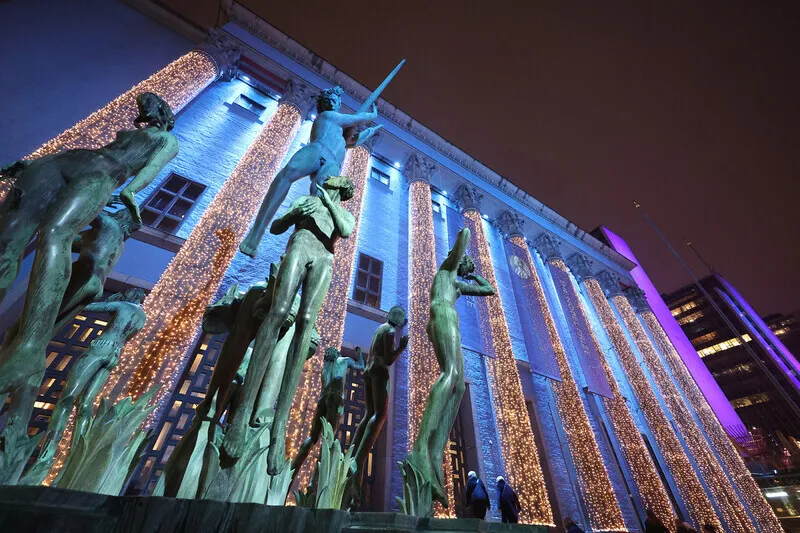
The award ceremony for the Nobel Prize in literature, where author Han Kang, 54, was awarded the prestigious prize, was held on Tuesday, Dec. 10. On that date, which marked the anniversary of Alfred Nobel’s death, the Nobel Prize laureates of 2024 received their medals and Nobel Prize certificates from Swedish King Carl XVI Gustaf at the Stockholm Concert Hall after addresses from members of the Swedish Academy.
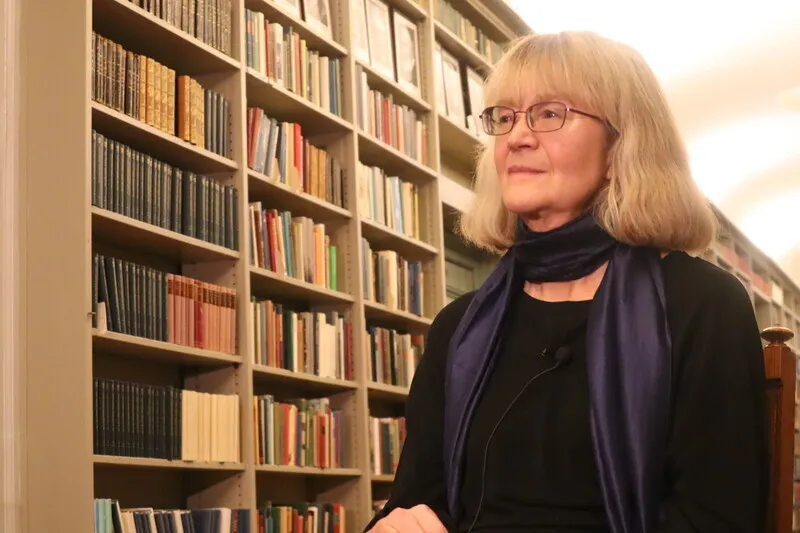
Swedish writer Ellen Mattson, one of the 18 members of the Swedish Academy, delivered the address for the literature prize.
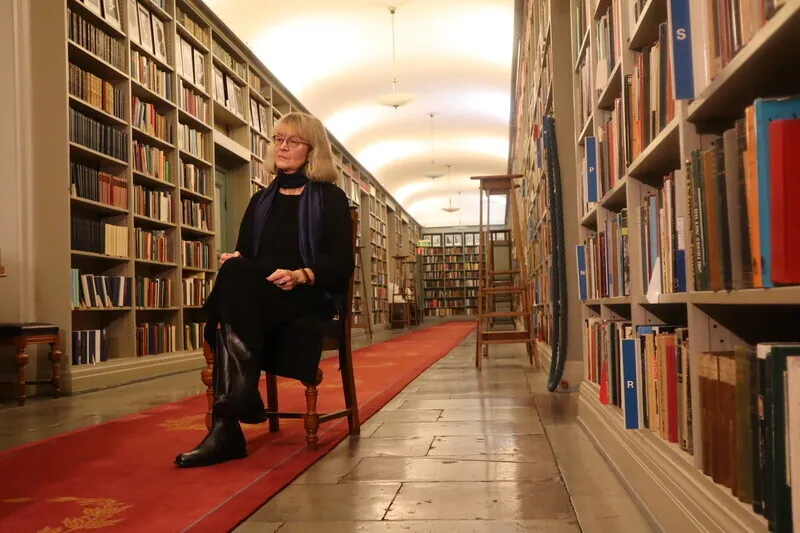
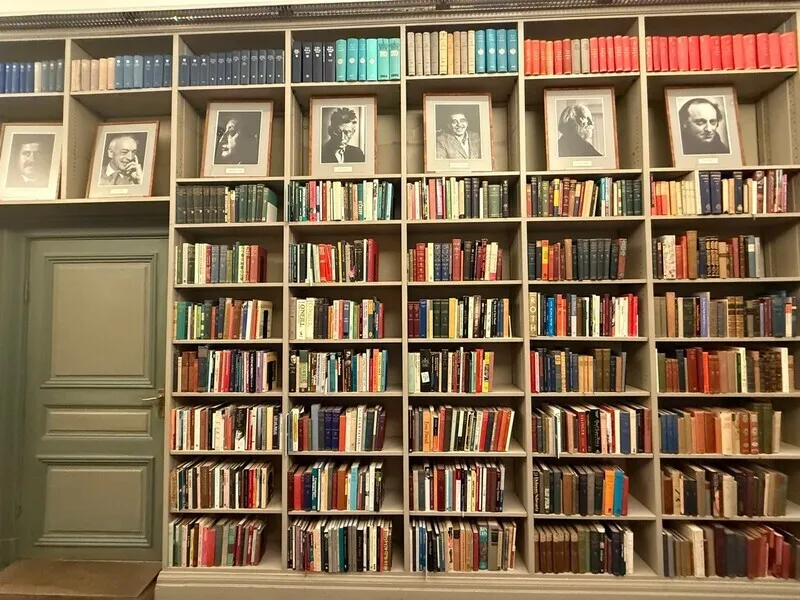
Before the awards ceremony, the Hankyoreh met Mattson at the Nobel Library of the Swedish Academy to gain insight into Mattson’s view of Han’s oeuvre and the implications of Han’s prize. This is Mattson’s first interview with Korean media.
Mattson said it was “uplifting” to see the South Korean parliament speedily pass the resolution lifting martial law after President Yoon Suk-yeol’s surprise declaration and crowds of Koreans who swarmed to the streets to protest, and expressed hope that Han’s winning of the Nobel would be “encouraging” to Koreans.
Emphasizing that Han Kang has a “soft, but very strong, voice that is her own,” Mattson lauded the Korean author’s ability to confront personal traumas and painful history in her writing. Regarding the controversy over Han’s book “The Vegetarian” being banned in some Korean libraries for supposedly “harmful themes,” Mattson said that acts of restricting books and removing them from libraries are “absolutely pointless” and “very unproductive,” saying that there is “absolutely no reason” for the book to be restricted, removed or banned.
Mattson was born in Uddevalla, Sweden, in 1962, and was elected to serve on the Swedish Academy in 2019, since which time she has had a hand in selecting and evaluating candidates for the Nobel Prize in literature. In 2021, she delivered the presentation speech for the Nobel Prize in literature, which was awarded to English novelist Abdulrazak Gurnah.
Both a writer and a critic herself, Mattson published her first novel, “Nattvandring” (“Night Wandering”), in 1992, after which she wrote “Snow” (2001) set in the 18th century under Charles XII, and her 2017 novel “Tornet och fåglarna” (“The Tower and the Birds”), another work of historical fiction.
The following interview has been edited for length and clarity.
Hankyoreh: The Nobel Prize award ceremony isn’t far away. What do you plan on saying about Han Kang’s works in your speech?
Ellen Mattson: Well the speech is only five minutes, so you have to concentrate on what’s important. For me, the central point I wanted to focus on was the contrasts in her writing. She has a very soft way, a very simple way [of writing], and sometimes very beautiful and quiet language. But she writes about cruelty and brutality. So there is a strong contrast. She has this sometimes very low, poetic, soft voice. But at the same time, she describes very difficult things and traumas. I think she does that in a very beautiful way. There are many aspects of the way she writes about experience, history. Of course, this is a personal experience, but also a universal experience. So it’s something that everyone can read and understand.
Hankyoreh: What kind of power do you find in Han’s books?
Mattson: When I look for candidates [for the Nobel Prize], I look for the voice. There’s something in the writing that is very personal. When you start reading a book, you know. It’s like a fingerprint. I think she has a very soft voice, but a very strong voice, that is her own. But of course, she also has the power to write about very painful things and describe them in a simple way that everyone can relate to. Every Nobel laureate is different from the others; there is no common thing. But there has to be a common quality of strength and excellence, and she has that. She’s a writer who is in the middle of her writing; she continues to move toward the future in her writing.
Hankyoreh: Currently, Korea is experiencing turmoil after its president briefly declared martial law. Do you think that Han’s Nobel Prize could offer consolation or give hope to Koreans?
Mattson: It was a very strange situation, to first read [Han’s] book and then see this happening [in Korea]. The book sort of becomes real, in a way in this political situation. But for me, personally, it was very uplifting to see the strong reaction; how democracy showed its strength in the counterreaction. This is not a political prize, but of course Han Kang’s writing is political; she writes from her political experience and history. So hopefully, this is encouraging for you [in Korea].
Hankyoreh: Recently in an interview with a Swedish media outlet, you recommended first-time readers of Han Kang to begin with “Human Acts,” before moving on to “We Do Not Part.” Is there a particular reason you chose these two for people first getting to know Han’s work?
Mattson: If you want to familiarize yourself with Han Kang, if you’re a new reader and you’re curious about her writing, I think “Human Acts” is a good place to start, because it’s like her writing starts there, in a way. Her life as a writer starts with those experiences, then it moves on to the effect of writing this book in “We Do Not Part.” So I think those two books belong together. In Sweden, there is a tradition around this time of year where you buy the Nobel Prize laureate’s books to give people, so I think that there are a lot of people who will discover her now.
Hankyoreh: When the Nobel Committee announced her prize, it mentioned the “intense poetic prose.” But as far as I am aware, her poetry collection remains untranslated into Swedish. Does that mean there could be works that are relatively not considered compared to others when selecting authors for the Nobel? How is such a possibility compensated for?
Mattson: Her poetic power is also in her prose. But it’s true, a few poems have been translated into Swedish, but not all of them, and not all of her books. But we also read her books in English, French and German. We have to try to do our best to evaluate her writing from different angles, using different languages, different translations. But the poetry is everywhere in her books. We rely on translators and translations in our work for the Nobel Prize because we cannot only give the prize to writers writing in languages that we know, or are translated into languages that we know. We have to move outside our most familiar languages to find new writers or new areas of literature and new experiences — literary experiences outside Europe and the Western world. And sometimes it’s difficult because of the lack of translations. But now, probably, there will be more translations of her books.
Hankyoreh: Out of all Han’s books, which has stayed with you the most?
Mattson: Her latest book, “We Do Not Part” in English. It was when I read that book that I started to get a greater understanding of her writing, which made me reread her earlier books and see them in a new light. There is something so extremely quiet and dreamlike in this novel; the way everything is sort of happening in the snow. The snow falls and creates a world of its own. And inside this white world of snow, everything is possible. There is no time, there is no death. Everything meets. But the first book I read by Han Kang was “The White Book.” When we were starting our work on the Nobel Committee, I also turned to her earlier works in German and English [translation], trying to widen my scope a bit.
Hankyoreh: Han Kang marked a lot of “firsts” for the Nobel Prize in literature. Why do you think it took so long for an Asian woman writer to win the prize?
Mattson: The Nobel Committee is not looking for a particular type of writer. The Nobel Committee has always just been looking for a good writer, not paying attention to nationality or gender. The Nobel Prize started in 1901, and in those times, it was very focused on Europe. There’s been a huge development, of course, during these last 120 years. It takes a long time to find a Nobel laureate. But the big problem here is, of course, language. It’s the problem of translations; it’s the problem of knowing where to look. It’s not just about finding a writer, it’s about knowing how to find writing — where to look and to ask people to help you, too. We have had a new system now, for the last four or five years, where we have specialists from all over the world who are helping us with this. We can’t do it on our own, we have to use specialists with knowledge of the culture and the language. And sometimes there is also a cultural barrier. A literature can be very different from the one that our brains are used to. And it’s a question of trying to break down that barrier and be open-minded. In a way, that makes you look for and be open to new things. But this is a long process. We elect one writer a year, and some of the writers that have been elected in the last five to ten years have been discussed for maybe 15 years before they are elected. So it’s a very slow process, but there is a little bit of a change now happening. But it’s important to understand that we are not trying to say, “It’s time to move in this direction.” That is not our job. Our job is to find really excellent writers. Literary quality is found everywhere, of course, but it takes a little longer to find our way into these new areas.
Hankyoreh: Recently there has been debate over “The Vegetarian” in Korea. Some schools have deemed it to have “harmful themes” and pulled it from their libraries, while some conservative groups argue that teenagers shouldn’t be allowed to read the book. What do you make of this?
Mattson: Books cannot be banned. I don’t think that books can ever harm you, actually. They can only open up your mind. It can, of course, be that you don’t understand parts of it. But this thing of removing books from libraries, restricting books, or saying, “This is forbidden” — I think that’s absolutely pointless. It’s very unproductive. It’s a very powerful novel. I read it a couple of times, actually. The more times you read it, the more you understand of it, and you see more layers. There’s absolutely no reason for this book to be restricted, removed or banned.
Hankyoreh: When was Han Kang’s name first discussed as a candidate for a Nobel? How many people nominated her?
Mattson: I cannot say.
Hankyoreh: Are there any other Asian writers that the Swedish Academy is paying attention to?
Mattson: We are paying attention to Asian writers, and we are paying attention to African writers. We are paying attention to writers from all continents at the moment. We have this nomination process where people from all over the world give us nominations, but we also nominate writers who we think belong on the list. So if there is a writer that no one from the world nominates, we can put in that name.
Hankyoreh: The world is currently witnessing war and strife, including the political turmoil in South Korea. What is the role of literature in times like these?
Mattson: Literature keeps asking the questions, and is one way of explaining things that cannot be explained otherwise. It’s a way to insist on what’s human. I think that literature is a way of describing things to people who are far away, outside of this political situation. Literature can actually make it understandable. And it’s in the same way that literature can describe a historical event in the past in a way that makes people understand. People in Sweden can read “Human Acts” and understand something. Literature has a great part to play. The writer as a person is very vulnerable, but literature itself is not so vulnerable because literature keeps on moving, it keeps on existing.
By Jang Ye-ji, Berlin correspondent
Please direct questions or comments to [english@hani.co.kr]

Editorial・opinion
![[Editorial] PPP’s shameless parade of disgraced presidents](https://flexible.img.hani.co.kr/flexible/normal/500/300/imgdb/original/2026/0602/1417803899056627.jpg "[Editorial] PPP’s shameless parade of disgraced presidents") [Editorial] PPP’s shameless parade of disgraced presidents
[Editorial] PPP’s shameless parade of disgraced presidents![[Column] From complete denuclearization of North Korea to managing nuclear risk](https://flexible.img.hani.co.kr/flexible/normal/500/300/imgdb/original/2026/0601/8617803026931084.jpg "[Column] From complete denuclearization of North Korea to managing nuclear risk") [Column] From complete denuclearization of North Korea to managing nuclear risk
[Column] From complete denuclearization of North Korea to managing nuclear risk- [Editorial] Korea is a model US ally on defense. It’s time it regains wartime OPCON.
- [Editorial] Election fraud conspiracy theorists are the real threats to Korea’s democracy
- [Column] Israel: The definition of a democratic fascist regime
- [Column] The tyranny of merit and the distribution of profit in the AI era
- [Editorial] Working groups on Korea-US fact sheet must yield tangible results
- [Editorial] Head of USFK continues to cross the line with inappropriate political remarks
- [Editorial] A disgraced former president like Park Geun-hye has no place on the campaign trail
- [Editorial] Korea’s online hate problem calls for platform regulation and anti-discrimination law
Most viewed articles
- 1[Column] From complete denuclearization of North Korea to managing nuclear risk
- 2Little-known former US official sets off flurry of election misinfo in Korea
- 3Ripped from families for not being ‘Korean enough,’ mixed-race adoptees seek truth and justice
- 4[Editorial] Korea is a model US ally on defense. It’s time it regains wartime OPCON.
- 5[Column] The tyranny of merit and the distribution of profit in the AI era
- 6[Column] Israel: The definition of a democratic fascist regime
- 7[Editorial] Election fraud conspiracy theorists are the real threats to Korea’s democracy
- 8Another deadly explosion casts shadow over Hanwha Aerospace’s cutting-edge image
- 9Korean activists say Israeli captors physically and sexually assaulted flotilla activists
- 10South Korea is ready for OPCON handover, defense chief tells US lawmakers