hankyoreh
Links to other country sites 다른 나라 사이트 링크
In OK’ing Sado mine registration, did Yoon admin collude to erase Japan’s forced mobilization of Koreans?
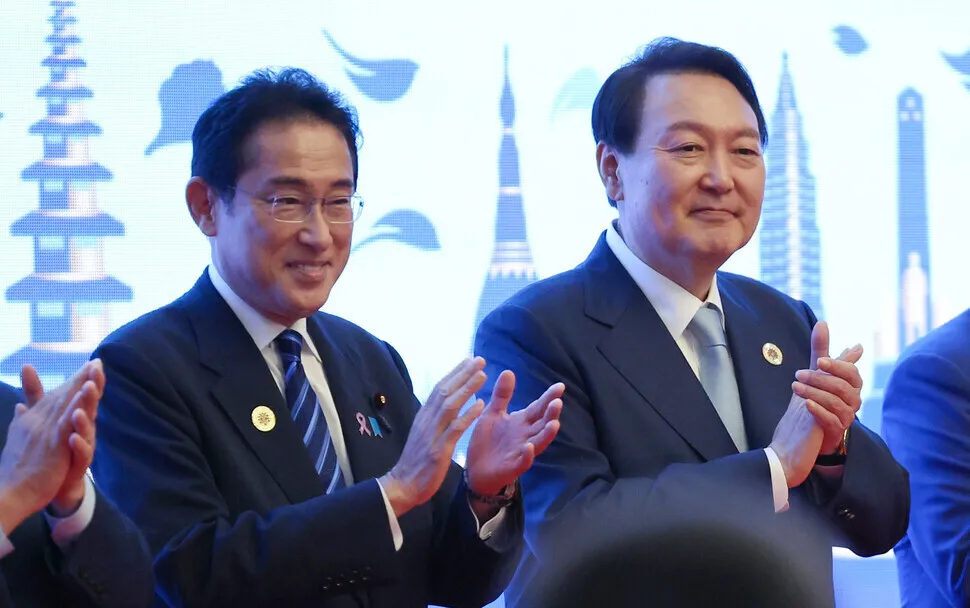
According to Japanese media, the Japanese and South Korean governments agreed in advance not to use the term “forced labor” regarding the gold mines on Sado Island in Niigata Prefecture, Japan, which were registered as a UNESCO World Heritage site on Saturday. The mining complex was the site of large-scale forced mobilization of Koreans during Japan’s colonial rule. This stands in contrast to the South Korean Ministry of Foreign Affairs’ claim that they did not discuss with Japan the issue of labeling the Korean labor at the mines as “forced.”
On Sunday, the Yomiuri Shimbun reported, “The Japanese and South Korean governments each made concessions over the UNESCO World Heritage registration of a gold mining complex in Sado, Niigata Prefecture, agreeing not to use terms related to ‘forced labor’ at an exhibition facility at the site but to include explanations about workers’ lives at the time.” The newspaper added, “Japan and South Korea reached their agreement apparently because officials wanted to avoid having another cause of conflict ahead of next year’s 60th anniversary of the normalization of diplomatic ties.”
The Yomiuri Shimbun also reported, “During closed-door negotiations, Japan proposed installing a permanent exhibition at an on-site facility describing the existence of about 1,500 workers from the Korean Peninsula and the harsh working conditions at the time [instead of using the term ‘forced labor’]. The South Korean government ultimately accepted the plan, according to sources.”
This stance contradicts claims made by the South Korean Foreign Ministry. With regard to the lack of discussion on the forced labor issue in the Sado mine registration process, a ministry official stated, “The issue surrounding the term ‘forced’ was already settled in 2015. There were no discussions with Japan about such terminology [this time].”
In July 2015, when Hashima Island and other locations that served as bases for the forced mobilization of Koreans were registered as World Heritage sites, the Japanese government publicly acknowledged that many Koreans and others were “forced to work” under harsh conditions “against their will.” Moreover, during a meeting with reporters at the ASEAN Foreign Ministers’ Meeting in Vientiane, Laos, on Saturday, a senior Korean Foreign Ministry official stated, “It was simply that the term [forced labor] was not used again; the intention to continue the previous promise [made in 2015] is still there.”
However, the South Korean government’s explanation that Japan pledged to uphold its promise to recognize the forced labor of Koreans is not based in reality. In response to a question about the exhibition on Korean workers at the Sado mines, a Japanese government official told the Sankei Shimbun the same day that Japan’s stance that the labor was not forced remained the same.
On Sunday evening, the Ministry of Foreign Affairs said that Japanese press reports stating that the two sides had reached a prior agreement to omit the phrase “forced labor” were “completely without basis in fact.”
Previous, the ministry had asked reporters to refer to a statement by the Japanese ambassador to UNESCO stressing that the Japanese government would, “bearing in mind all the relevant [World Heritage Committee] decisions as well as its commitments associated with these decisions, [. . .] faithfully and thoroughly implement the recommendation and continue to make efforts to enhance the interpretation and presentation strategy and facilities that comprehensively address the whole history of the Sado Island Gold Mines in close consultation with the ROK.” Later, it stated this to be groundless.
South Korean opposition parties were harshly critical.
In a briefing Sunday, Democratic Party floor spokesperson Kang Yu-jung said, “After Hashima Island, now another site [the Sado Mines] associated with a tragic history of Koreans being mobilized into forced labor under the Japanese occupation is being spotlighted as a global attraction.”
By Kim So-youn, Tokyo correspondent; Shin Hyeong-cheol, staff reporter; Park Min-hee, senior staff writer; Um Ji-won, staff reporter
Please direct questions or comments to [english@hani.co.kr]

Editorial・opinion
![[Column] The harder US pushes N.Korea to denuclearize, the greater the risk to S. Korea](https://flexible.img.hani.co.kr/flexible/normal/500/300/imgdb/original/2026/0628/2817826042176925.jpg "[Column] The harder US pushes N.Korea to denuclearize, the greater the risk to S. Korea") [Column] The harder US pushes N.Korea to denuclearize, the greater the risk to S. Korea
[Column] The harder US pushes N.Korea to denuclearize, the greater the risk to S. Korea![[Correspondent’s column] The new generation of ‘sewer socialists’ are in it to win it](https://flexible.img.hani.co.kr/flexible/normal/500/300/imgdb/original/2026/0626/8217824618600972.jpg "[Correspondent’s column] The new generation of ‘sewer socialists’ are in it to win it") [Correspondent’s column] The new generation of ‘sewer socialists’ are in it to win it
[Correspondent’s column] The new generation of ‘sewer socialists’ are in it to win it- [Editorial] Who benefits from tug-of-war over jurisdiction in the DMZ?
- [Column] Inequality in Korea hits high not seen since colonial era
- [Editorial] Unity doesn’t mean embracing defenders of insurrection
- [Editorial] Stiff sentence for ex-justice minister shows abetting insurrection won’t go unpunished
- [Column] Bridging the gap between pragmatic policies of North, South Korea
- The second China shock is here — and it’s bigger, broader and more global
- [Column] America declares its retreat from the Middle East
- [Column] North Korea’s economic boom
Most viewed articles
- 1[Column] The harder US pushes N.Korea to denuclearize, the greater the risk to S. Korea
- 2[Exclusive] US Congress calls for review of CCP’s ‘malign influence’ in South Korea
- 3[Reportage] Decoding the ‘Hefei model’: Four pillars of China’s tech ascent
- 4OPCON alarmism ignores how uncertain US wartime support for Korea already is
- 5Korean government to work with Samsung, SK to pour 2 quadrillion won into 3 ‘megaprojects’
- 6[Correspondent’s column] The new generation of ‘sewer socialists’ are in it to win it
- 7Outsourcing war to CFC has turned Korea’s military into a bureaucracy-first force
- 8Korean appeals court upholds 6-month sentence for Johnny Somali
- 9Police investigating 40 cases of assault at Olympic Park protests
- 10Former bodyguard’s dark tale of marriage to Samsung royalty